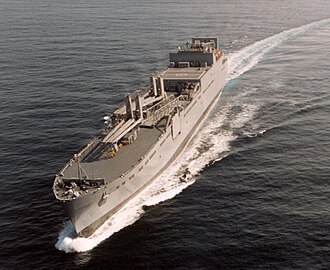
In the architecture of modern military operations, the ability to move forces rapidly across vast distances is as decisive as the ability to engage in combat. Armored brigades, mechanized infantry, and logistical units all depend on a reliable transportation network capable of delivering them to theaters of operation in a timely and efficient manner. At the center of this global mobility system stands the USNS Watkins (T-AKR-315), a high-speed, roll-on/roll-off (Ro-Ro) vehicle cargo ship operated by the United States Navy’s Military Sealift Command.
Unlike combat vessels or even replenishment ships, Watkins is designed with a singular focus: transporting large volumes of military equipment, including tanks, trucks, and support vehicles, across oceans. As part of the Watson-class of Large, Medium-Speed Roll-on/Roll-off (LMSR) ships, it represents one of the most important yet often overlooked components of U.S. power projection capability.
The Strategic Need for Roll-on/Roll-off Sealift
The concept behind roll-on/roll-off shipping is deceptively simple. Instead of relying on cranes to load and unload cargo, vehicles are driven directly onto the ship via ramps, secured for transit, and then driven off at the destination. This approach dramatically reduces loading and unloading times while minimizing the need for specialized port infrastructure.
For military operations, this capability is transformative. Heavy armored units such as main battle tanks and self-propelled artillery require rapid deployment, often under time-sensitive conditions. Traditional cargo ships would struggle to meet these demands, particularly in austere environments where port facilities may be limited or damaged.
The USNS Watkins (T-AKR-315) is specifically designed to address these challenges. Its massive internal decks, reinforced ramps, and high cargo capacity allow it to transport an entire brigade’s worth of equipment in a single voyage, making it a cornerstone of strategic sealift operations.
Origins of the Watson-Class LMSR Program
The Watson-class ships emerged from the U.S. Navy’s efforts in the 1990s to modernize its sealift capabilities. Lessons learned from earlier conflicts highlighted the need for faster, more efficient transport of heavy equipment. The result was the Large, Medium-Speed Roll-on/Roll-off (LMSR) program, which introduced a new generation of ships capable of combining high cargo capacity with improved speed and operational flexibility.
Named after private George Watson, the lead ship of the class, these vessels were designed to operate as part of the Military Sealift Command’s prepositioning and surge sealift forces. The Watson-class ships, including Watkins, represent the most advanced iteration of this concept, incorporating improvements in cargo handling, propulsion, and survivability.
Construction and Entry Into Service
The USNS Watkins (T-AKR-315) was constructed by National Steel and Shipbuilding Company (NASSCO) in San Diego, California. The ship was built using modular construction techniques, allowing large sections to be assembled independently before being joined together.
Launched in the early 2000s, Watkins entered service as part of a fleet designed to provide rapid deployment capability for U.S. forces worldwide. Its construction reflects a blend of commercial shipbuilding practices and military requirements, resulting in a vessel that is both cost-effective and highly capable.
Mission Profile: Strategic Sealift and Force Projection
The primary mission of Watkins is to transport military equipment from the United States to operational theaters around the world. This includes everything from armored vehicles and engineering equipment to supplies and support systems.
The ship operates as part of the Military Sealift Command’s surge sealift fleet, meaning it can be activated on short notice to support military operations. In addition, it may participate in prepositioning missions, where equipment is stored aboard ships stationed near potential hotspots, ready for rapid deployment.
The ability to deliver large quantities of equipment quickly and efficiently makes Watkins a critical enabler of U.S. military strategy. Without ships like this, the deployment of heavy forces would be significantly slower and more complex.
Cargo Capacity and Internal Layout
One of the most impressive aspects of the USNS Watkins (T-AKR-315) is its विशाल cargo capacity. The ship features multiple vehicle decks connected by internal ramps, allowing vehicles to be moved throughout the ship with ease.
These decks are designed to accommodate a wide range of vehicles, from light trucks to heavy tanks. The ship also includes specialized storage areas for ammunition and other sensitive materials, ensuring that all cargo can be transported safely.
The total cargo area is measured in hundreds of thousands of square feet, making Watkins one of the largest vehicle transport ships in the world. This capacity allows it to carry enough equipment to support large-scale military operations.
Propulsion and Speed Characteristics
Unlike many cargo ships that prioritize fuel efficiency over speed, the USNS Watkins (T-AKR-315) is designed to balance both. Its propulsion system typically consists of multiple diesel engines driving twin shafts, providing a maximum speed of approximately 24 knots.
This speed is significantly higher than that of traditional cargo vessels, allowing Watkins to deliver its cargo more quickly. In a military context, where timing can be critical, this capability is invaluable.
The propulsion system is also designed for reliability, ensuring that the ship can operate continuously over long distances without interruption.
Hull Design and Structural Strength
The hull of Watkins is engineered to support the immense weight of its cargo while maintaining stability and seaworthiness. Reinforced decks and structural supports ensure that heavy vehicles can be transported safely, even in rough seas.
The ship’s design also includes features to enhance survivability, such as compartmentalization and damage control systems. While not intended for combat, Watkins must be able to operate in potentially hostile environments, making these features essential.
Loading Systems and Port Flexibility
One of the defining features of the USNS Watkins (T-AKR-315) is its advanced loading system. The ship is equipped with a stern ramp and side port ramps, allowing vehicles to be loaded and unloaded in a variety of port configurations.
This flexibility is particularly important in regions where port infrastructure may be limited or damaged. By reducing reliance on specialized facilities, Watkins can operate in a wider range of environments, increasing its strategic utility.
Crew and Operational Structure
Like many auxiliary vessels, Watkins is operated by the Military Sealift Command, with a crew composed primarily of civilian mariners. The crew typically numbers around 25 to 40 personnel, depending on the mission.
This relatively small crew size is made possible by the ship’s high level of automation and efficient design. Despite its size and complexity, Watkins can be operated with fewer personnel than many smaller ships.
Role in Modern Military Operations
In today’s global security environment, the ability to deploy forces rapidly is more important than ever. Ships like Watkins play a crucial role in enabling this capability, providing the means to transport heavy equipment across oceans quickly and efficiently.
Whether supporting large-scale military operations, participating in joint exercises, or responding to crises, Watkins ensures that U.S. forces have the equipment they need, when and where they need it.
Technological Integration and Future Developments
As with other modern ships, Watkins is equipped with advanced navigation and communication systems that allow it to operate effectively in a networked environment. These systems enable coordination with other vessels, aircraft, and command centers, ensuring that the ship can fulfill its mission as part of a larger operational framework.
Future upgrades may include enhancements to cargo handling systems, improved fuel efficiency, and integration with emerging technologies such as autonomous logistics platforms.
Conclusion: The Engine of Strategic Mobility
The USNS Watkins (T-AKR-315) is a powerful example of how logistics and mobility underpin modern military capability. While it may not carry weapons or engage in combat, its ability to transport vast quantities of equipment makes it an indispensable asset.
In the complex and interconnected world of modern warfare, victory often depends not just on firepower, but on the ability to sustain and deploy that firepower effectively. In this regard, Watkins stands as a silent but essential engine of strategic mobility.
Technical Parameters of USNS Watkins (T-AKR-315)
| Parameter | Specification |
|---|---|
| Class/Type | Watson-class LMSR (Large, Medium-Speed Roll-on/Roll-off) |
| Builder | NASSCO, San Diego, USA |
| Displacement (Full Load) | ~62,000+ tons |
| Length Overall | ~950 ft (290 m) |
| Beam | ~106 ft (32.3 m) |
| Draft | ~34 ft (10.4 m) |
| Propulsion | Diesel engines, twin shafts |
| Power Output | ~60,000 hp (approx.) |
| Maximum Speed | ~24 knots |
| Crew | ~25–40 civilian mariners |
| Cargo Type | Military vehicles and equipment |
| Cargo Capacity | ~380,000+ sq ft of vehicle space |
| Loading System | Stern and side ramps (Ro-Ro capability) |
| Operator | Military Sealift Command (MSC) |
| Primary Role | Strategic sealift and vehicle transport |
.jpg)