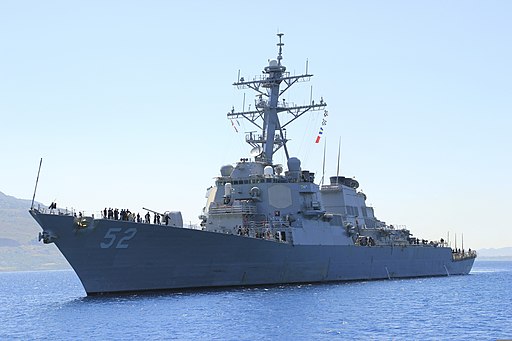
USS Barry (DDG-52)
The USS Barry (DDG-52) is an Arleigh Burke-class guided missile destroyer in service with the United States Navy. Commissioned in 1992, the USS Barry is named after Commodore John Barry, an officer renowned as the “Father of the American Navy” for his distinguished service during the American Revolutionary War. As one of the most advanced destroyers in the world, the USS Barry is equipped with sophisticated weaponry and systems, making it a versatile and formidable asset in naval operations.
With a length of approximately 505 feet (154 meters) and a displacement of around 9,200 tons, the USS Barry combines speed, firepower, and stealth capabilities. Its sleek design allows for swift maneuverability in various maritime environments, from open seas to coastal regions. Armed with an array of weaponry, including Tomahawk cruise missiles, Standard Missile surface-to-air missiles, and various anti-submarine warfare capabilities, the USS Barry is capable of engaging threats across multiple domains, ensuring maritime superiority for the United States and its allies.
Beyond its combat capabilities, the USS Barry plays a vital role in global maritime security and humanitarian missions. With its advanced radar and surveillance systems, it can detect and track potential threats, contribute to maritime surveillance operations, and provide assistance during natural disasters and humanitarian crises. Whether patrolling critical sea lanes, participating in multinational exercises, or conducting freedom of navigation operations, the USS Barry exemplifies the Navy’s commitment to maintaining stability and promoting peace and security in the world’s oceans.
Armament of USS Barry (DDG-52)
The armament of the USS Barry (DDG-52), an Arleigh Burke-class guided missile destroyer, typically includes a variety of advanced weaponry and systems designed for multi-mission capabilities. Here’s a list of its armament:
- MK 41 Vertical Launch System (VLS): The MK 41 VLS is capable of launching a wide range of missiles, including:
- Tomahawk Land Attack Missiles (TLAM)
- Standard Missile (SM) series surface-to-air missiles (e.g., SM-2, SM-3, SM-6)
- Evolved Sea Sparrow Missiles (ESSM)
- Vertical Launch Anti-Submarine Rockets (ASROC)
- Mark 45 5-inch/54-caliber Lightweight Gun: This naval artillery system is used for surface warfare and naval gunfire support missions.
- MK 46 and MK 50 Torpedoes: These are anti-submarine torpedoes used for underwater defense and engagement of enemy submarines.
- Close-In Weapon System (CIWS): Typically, the Phalanx CIWS provides close-range defense against anti-ship missiles and other threats.
- MK 38 25mm Machine Gun Systems: Remote-controlled machine gun systems used for defense against small boats and surface threats.
- AN/SPY-1D Radar: This multi-function radar system provides long-range surveillance, tracking, and missile guidance capabilities.
- AN/SQQ-89(V) Sonar Suite: An integrated sonar system used for anti-submarine warfare operations.
- MK 36 Super Rapid Blooming Offboard Chaff (SRBOC) Decoy System: This countermeasure system is used to decoy incoming anti-ship missiles.
- AN/SLQ-32 Electronic Warfare (EW) System: Provides electronic surveillance, countermeasures, and threat warning capabilities against electronic warfare threats.
- MK 160 Gun Fire Control System (GFCS): This system provides fire control solutions for the ship’s guns.
These armaments collectively provide the USS Barry with the capability to engage threats in various domains, including air, surface, and underwater, ensuring its effectiveness in fulfilling its mission requirements.
Dimensions of USS Barry (DDG-52)
The USS Barry (DDG-52), an Arleigh Burke-class guided missile destroyer, has approximate dimensions as follows:
- Length Overall: Around 505 feet (154 meters)
- Beam (Width): Approximately 66 feet (20 meters)
- Draft (Full Load): Roughly 31 feet (9.4 meters)
- Displacement (Full Load): About 9,200 tons
These dimensions may vary slightly depending on the specific configuration of the ship and any modifications made over time. For the most precise and up-to-date information, consulting official Navy sources or recent documentation is recommended.
_arrives_in_Souda_Bay,_Crete_April_29,_2013_130429-N-RF968-186.jpg)