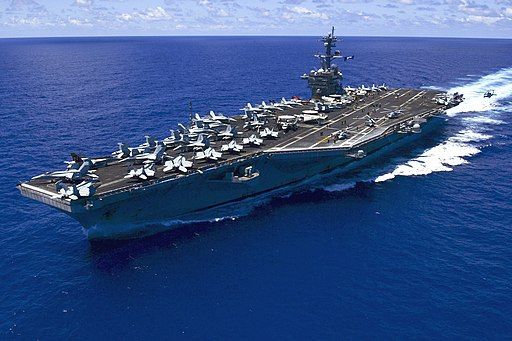
USS Carl Vinson (CVN-70)
The USS Carl Vinson (CVN-70) is a Nimitz-class nuclear-powered aircraft carrier in the United States Navy, named after Carl Vinson, a long-serving Congressman from Georgia known as the “Father of the Two-Ocean Navy.” Commissioned on March 13, 1982, the USS Carl Vinson represents a cornerstone of American naval power projection and strategic deterrence. Built by Newport News Shipbuilding in Virginia, it embodies the pinnacle of aircraft carrier technology and capabilities, supporting a wide array of missions essential to U.S. national security interests.
As a symbol of American military might and capability, the USS Carl Vinson is equipped to handle various air, surface, and subsurface threats. It features a complement of around 60 aircraft, including F/A-18 Hornet and Super Hornet fighters, E-2C/D Hawkeye airborne early warning aircraft, EA-18G Growler electronic warfare aircraft, and MH-60S/R Seahawk helicopters. The carrier also boasts a sophisticated defense system, including Close-In Weapon Systems (CIWS), Rolling Airframe Missile (RAM) launchers, and electronic warfare systems, providing robust protection against incoming threats.
Beyond its combat capabilities, the USS Carl Vinson plays a crucial role in projecting U.S. power and influence across the globe. It serves as a mobile airfield capable of sustained operations in remote and potentially hostile environments, supporting missions ranging from combat operations to humanitarian assistance and disaster relief. The carrier’s presence often serves as a visible deterrent to adversaries and reassurance to allies, underscoring the United States’ commitment to maintaining stability and security in key regions. With its immense size, technological sophistication, and operational versatility, the USS Carl Vinson remains a vital asset in the defense and projection of American interests worldwide.
Armament of USS Carl Vinson (CVN-70)
The USS Carl Vinson (CVN-70), being an aircraft carrier primarily focused on air operations and power projection rather than direct combat, does not have a traditional armament like surface combatants. However, it is equipped with defensive systems to protect itself and its aircraft. Here are some of the defensive systems typically found on an aircraft carrier like the USS Carl Vinson:
- Close-In Weapon Systems (CIWS):
- These are rapid-fire, radar-guided Gatling guns designed to defend against incoming anti-ship missiles and enemy aircraft at short range.
- Rolling Airframe Missile (RAM) Launchers:
- RAM is a small, lightweight, infrared homing surface-to-air missile used for point defense against anti-ship missiles and aircraft.
- Electronic Warfare Systems:
- These include radar jamming and deception systems designed to disrupt and counter enemy radar and missile guidance systems.
- Aircraft:
- While not traditionally considered armament, the carrier’s complement of aircraft, including fighters, electronic warfare aircraft, and surveillance aircraft, serve as its primary offensive and defensive capability.
These defensive systems and the carrier’s aircraft complement work together to provide protection and offensive capability, enabling the USS Carl Vinson to operate effectively in potentially hostile environments while projecting U.S. naval and air power worldwide.
Dimensions of USS Carl Vinson (CVN-70)
The dimensions and parameters of the USS Carl Vinson (CVN-70) are as follows:
- Overall Length: 1,092 feet (332.8 meters)
- Flight Deck Width: 252 feet (76.8 meters)
- Beam (at waterline): 134 feet (40.8 meters)
- Draft (full load): 37 feet (11.3 meters)
- Displacement: Approximately 100,000 to 104,600 tons (depending on load and mission)
Additional parameters include:
- Speed: Exceeds 30 knots (56 km/h; 35 mph)
- Crew: Approximately 3,200 (including air wing)
- Aircraft Capacity: Up to 90 aircraft, including a mix of F/A-18 Hornet and Super Hornet fighters, E-2 Hawkeye airborne early warning aircraft, EA-18G Growler electronic warfare aircraft, C-2 Greyhound logistics aircraft, and MH-60 Seahawk helicopters.
These dimensions and parameters highlight the immense size and capability of the USS Carl Vinson as one of the largest and most powerful aircraft carriers in the world. Its vast flight deck and hangar bays enable it to support a wide variety of aircraft and operations, ranging from combat missions to humanitarian assistance and disaster relief operations across the globe.
_underway_in_the_Pacific_Ocean_on_31_May_2015.JPG)