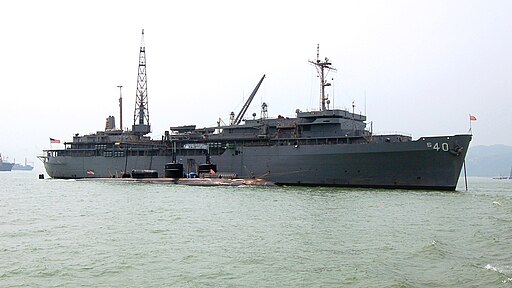
USS Frank Cable (AS-40)
USS Frank Cable (AS-40): A Submarine Tender at the Heart of U.S. Naval Operations
The USS Frank Cable (AS-40) is a submarine tender of the Emory S. Land-class, serving as a vital component of the U.S. Navy’s logistical and operational support structure. Commissioned on October 20, 1979, the vessel has a storied history of providing maintenance, resupply, and repair services to submarines and surface ships operating in the Indo-Pacific region. Named after Frank Cable, a pioneering electrical engineer and early submarine designer, the ship reflects his legacy by enabling the Navy’s undersea fleet to remain operational and ready for deployment.
Development and Construction
The USS Frank Cable was constructed by Lockheed Shipbuilding and Construction Company in Seattle, Washington, as part of the Emory S. Land-class of submarine tenders. The keel was laid on August 2, 1976, and the ship was launched on January 14, 1978, before being commissioned into active service in 1979.
Designed to support nuclear-powered submarines, the Frank Cable was equipped with advanced repair facilities, tools, and spare parts to maintain the highly specialized equipment onboard submarines. Its construction marked a significant step forward in the Navy’s ability to sustain undersea operations during the Cold War, reflecting the growing importance of nuclear-powered submarines in the U.S. strategic arsenal.
Design and Specifications
The USS Frank Cable is a large and capable vessel, purpose-built for supporting submarines and surface ships in forward-deployed environments. Its design emphasizes versatility, with extensive onboard facilities for repairs, maintenance, and logistical support.
Key Specifications:
- Class: Emory S. Land-class submarine tender
- Length: 644 feet (196 meters)
- Beam: 85 feet (26 meters)
- Draft: 28 feet (8.5 meters)
- Displacement: 23,347 tons (full load)
- Speed: 20 knots
- Crew: Approximately 1,500 personnel, including sailors and civilian technicians
- Powerplant: Two boilers and steam turbines driving a single shaft
The ship is equipped with workshops, tools, and storage areas designed to support a wide range of maintenance and repair tasks, from routine upkeep to emergency repairs. It also includes living quarters and amenities to accommodate the crews of submarines temporarily assigned to the tender for support.
Mission and Capabilities
As a submarine tender, the USS Frank Cable’s primary mission is to support the operational readiness of submarines and surface ships. It achieves this through a variety of capabilities:
1. Repair and Maintenance:
The ship is equipped with machine shops, electrical repair facilities, and specialized equipment to service submarine systems, including propulsion, electronics, weaponry, and hull integrity. Technicians onboard can perform complex tasks such as replacing components, welding, and recalibrating sensors, ensuring that submarines are ready for extended deployments.
2. Logistics and Supply:
The Frank Cable carries a wide range of spare parts, tools, and consumables needed by submarines and surface ships. It serves as a floating warehouse, providing everything from fuel and food to high-tech components.
3. Crew Support:
Submarine crews temporarily stationed aboard the Frank Cable benefit from its comprehensive facilities, including medical and dental services, recreational spaces, and mess halls. These amenities allow sailors to recuperate during maintenance periods.
4. Forward-Deployed Operations:
The ship’s ability to operate in remote areas, far from traditional naval bases, makes it an essential part of the Navy’s forward-deployed strategy. It serves as a mobile support hub, enabling submarines to remain operational in contested or austere environments.
Service History
Early Years:
After commissioning in 1979, the USS Frank Cable was assigned to the Atlantic Fleet and initially operated out of Charleston, South Carolina. During the early years of its service, it played a key role in supporting submarines engaged in Cold War operations, ensuring their readiness for strategic deterrence patrols and intelligence-gathering missions.
Transition to the Indo-Pacific:
In 1996, the USS Frank Cable was reassigned to the Pacific Fleet and forward-deployed to Guam, where it replaced the USS Holland (AS-32) as the region’s primary submarine tender. This move underscored the growing importance of the Indo-Pacific theater to U.S. naval strategy, particularly as China’s naval capabilities began to expand.
Forward Deployment in Guam:
Since its arrival in Guam, the Frank Cable has served as a critical asset for the Navy’s operations in the region. It supports both the Los Angeles-class and Virginia-class nuclear-powered submarines, as well as surface vessels. Its presence in Guam allows the U.S. to maintain a rapid response capability in the Western Pacific, supporting deterrence and regional stability.
Notable Deployments and Contributions:
- Operation Tomodachi (2011): In the aftermath of the Great East Japan Earthquake and tsunami, the Frank Cable played a role in providing logistical and repair support to U.S. forces involved in humanitarian assistance and disaster relief efforts.
- Freedom of Navigation Operations (FONOPs): The ship has supported submarines and surface ships conducting FONOPs in contested areas such as the South China Sea, reinforcing international law and the principle of free navigation.
Modernization and Upgrades
To keep pace with the evolving needs of the fleet, the USS Frank Cable has undergone several upgrades throughout its service life. These include:
- Enhanced Repair Capabilities: Upgraded workshops and tools to support the more advanced systems found on modern submarines, such as the Virginia-class.
- Advanced Communications: Improved command-and-control systems to better coordinate with other Navy assets.
- Habitability Improvements: Renovated living quarters and recreational spaces to enhance the quality of life for the crew and visiting submarine personnel.
Despite its age, the ship remains a key enabler of U.S. naval power in the Indo-Pacific and has demonstrated remarkable adaptability.
Legacy and Significance
The USS Frank Cable occupies a unique position in the Navy’s fleet, serving as both a logistical linchpin and a symbol of America’s commitment to maintaining maritime dominance. Its role as a forward-deployed submarine tender ensures that the U.S. undersea fleet remains ready and capable of meeting challenges in a dynamic and often unpredictable security environment.
The ship’s decades of service highlight the critical importance of support vessels in sustaining combat operations. While submarines and surface combatants often receive more attention, platforms like the Frank Cable are indispensable to the Navy’s success, providing the behind-the-scenes support that allows frontline vessels to operate at their full potential.
Future Outlook
As the Navy continues to modernize its fleet, the role of submarine tenders like the USS Frank Cable is expected to remain vital. While discussions about the replacement of aging Emory S. Land-class ships have surfaced, the Frank Cable’s continued upgrades and exceptional service record suggest that it will remain a cornerstone of the Navy’s forward-deployed operations for the foreseeable future.
In an era of great-power competition, the USS Frank Cable’s ability to sustain the Navy’s most advanced submarines ensures that the U.S. maintains an edge in undersea warfare—a domain widely regarded as critical to maintaining strategic superiority.
Conclusion
The USS Frank Cable (AS-40) exemplifies the Navy’s commitment to operational excellence, logistical innovation, and forward-deployed readiness. For over four decades, it has provided indispensable support to submarines and surface ships, enabling the U.S. Navy to project power and uphold its commitments around the globe. As it continues to serve in the Indo-Pacific, the Frank Cable stands as a testament to the enduring value of submarine tenders in modern naval warfare.
_at_Hong_Kong,_with_USS_La_Jolla_(SSN-701)_and_USS_Honolulu_(SSN-718),_7_October_2010_(061007-N-3228J-002).jpg)