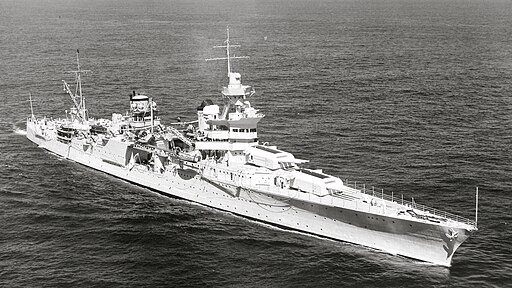
USS Indianapolis CA-35
USS Indianapolis (CA-35) holds a unique place in naval history, notably remembered for its tragic sinking during World War II. Commissioned in 1932, Indianapolis was a Portland-class heavy cruiser, serving as a versatile and formidable asset in the United States Navy’s Pacific Fleet. Throughout its service, Indianapolis participated in numerous campaigns and operations, earning a reputation for its firepower, speed, and endurance. However, its most infamous chapter unfolded in July 1945 when the cruiser was torpedoed and sunk by a Japanese submarine, resulting in one of the greatest maritime disasters in U.S. naval history.
The sinking of USS Indianapolis occurred shortly after the successful delivery of components for the atomic bomb “Little Boy,” which would later be dropped on Hiroshima, Japan, effectively ending World War II. The cruiser had completed a top-secret mission to deliver the crucial cargo to Tinian Island in the Pacific. Tragically, while en route to the Philippines for further orders, Indianapolis was struck by torpedoes from the Japanese submarine I-58, leading to its rapid sinking. The disaster claimed the lives of nearly 900 crew members, with only 316 surviving the ordeal, enduring days of exposure, dehydration, and shark attacks before rescue arrived.
Despite the devastating loss of USS Indianapolis and the suffering endured by its crew, the sinking spurred changes in naval protocols regarding communications and rescue procedures. The tragedy also highlighted the perils of wartime operations and the importance of ensuring the safety and security of naval vessels. Today, USS Indianapolis remains a poignant symbol of sacrifice, courage, and the human cost of war, with memorials and commemorations honoring the bravery and resilience of its crew amidst one of the darkest moments in maritime history.
Armament of USS Indianapolis (CA-35)
USS Indianapolis (CA-35), as a Portland-class heavy cruiser, was armed with a formidable array of weapons, typical for cruisers of its era. Here is a list of the armament associated with USS Indianapolis:
- Main Battery: USS Indianapolis was equipped with nine 8-inch (203 mm) Mark 12 guns, arranged in three triple turrets. These guns served as the cruiser’s primary armament for engaging surface targets, shore bombardment, and anti-aircraft defense.
- Secondary Battery: In addition to its main battery, Indianapolis carried a number of 5-inch (127 mm) dual-purpose guns for anti-aircraft defense. These guns were typically mounted in single turrets or in open mounts along the sides of the ship.
- Anti-Aircraft Weapons: To defend against air attacks, USS Indianapolis was equipped with a variety of anti-aircraft guns, including 40 mm and 20 mm anti-aircraft cannons. These guns were distributed across the ship in multiple mounts to provide a comprehensive defense against enemy aircraft.
- Torpedo Tubes: Indianapolis was also outfitted with torpedo tubes for launching torpedoes, which could be used to engage enemy surface vessels or conduct torpedo attacks against enemy ships. The exact number and arrangement of torpedo tubes varied among ships of the Portland class.
- Depth Charges: As part of its anti-submarine warfare capabilities, USS Indianapolis likely carried depth charges for use against enemy submarines. These depth charges could be launched from racks or thrown overboard to detonate near enemy submarines, potentially damaging or destroying them.
This armament configuration provided USS Indianapolis with a versatile and potent offensive and defensive capability, enabling it to engage a wide range of surface, air, and subsurface threats encountered during its service in World War II.
Dimensions of USS Indianapolis (CA-35)
USS Indianapolis (CA-35), a Portland-class heavy cruiser, had the following approximate dimensions:
- Length: The length of USS Indianapolis was approximately 610 feet (about 186 meters). This measurement includes the entire length of the cruiser’s hull from the tip of the bow to the end of the stern.
- Beam: The beam, or width, of USS Indianapolis was approximately 66 feet (about 20 meters). This measurement represents the widest point of the cruiser’s hull.
- Draft: The draft of USS Indianapolis, which refers to the depth of the cruiser below the waterline, was approximately 24 feet (about 7.3 meters). This measurement indicates how deep the cruiser sits in the water when fully loaded.
These dimensions made USS Indianapolis a large and powerful warship, capable of carrying out a variety of missions, including surface combat, shore bombardment, and anti-aircraft defense. As a heavy cruiser, Indianapolis played a significant role in naval operations during World War II, demonstrating its firepower, endurance, and versatility across the Pacific Theater.
_underway_at_sea_on_27_September_1939_(80-G-425615).jpg)