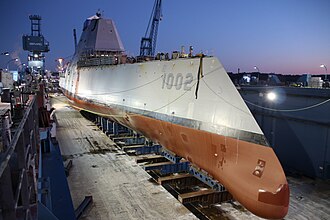
USS Lyndon B. Johnson (DDG-1002): The Final Zumwalt-Class Destroyer and a Glimpse Into the Future of Naval Warfare
The evolution of naval warfare has always been driven by innovation. From the transition from sail to steam, from battleships to aircraft carriers, and from conventional weapons to precision-guided missiles, each generation of warships has reflected the technological ambitions of its era. Among the most ambitious surface combatants ever constructed for the United States Navy is USS Lyndon B. Johnson (DDG-1002), the third and final Zumwalt-class guided-missile destroyer. Combining a futuristic stealth design, an integrated electric propulsion system, advanced automation, and an unprecedented level of computing power, the ship represents one of the most technologically sophisticated naval platforms ever built.
Named after the 36th President of the United States, USS Lyndon B. Johnson marks the conclusion of a revolutionary but limited shipbuilding program that sought to redefine what a destroyer could be. Although only three Zumwalt-class ships were ultimately constructed, the technologies developed for the class continue to influence the design of future naval vessels. From its distinctive wave-piercing tumblehome hull to its integrated combat systems and enormous electrical generating capacity, DDG-1002 serves as both a highly capable operational warship and a bridge toward the next generation of American naval power.
Honoring President Lyndon B. Johnson
USS Lyndon B. Johnson is named after President Lyndon Baines Johnson, who served as the 36th President of the United States from 1963 to 1969. Before becoming president, Johnson had served in the U.S. Navy Reserve during World War II, where he was assigned to the Pacific Theater as a lieutenant commander. Although his naval service was relatively brief, it reflected his commitment to supporting the American war effort during one of the nation’s most challenging periods.
As president, Johnson oversaw a period marked by significant domestic reforms, the expansion of the U.S. space program, and the intensification of American involvement in the Vietnam War. While historians continue to debate various aspects of his presidency, his administration undeniably shaped modern American politics, society, and defense policy.
Naming the third Zumwalt-class destroyer after President Johnson continues the Navy’s long-standing tradition of honoring American presidents whose leadership influenced both the nation and its armed forces. It also complements the class’s emphasis on innovation, reflecting an era in which technological progress increasingly shaped military capability.
The Zumwalt-Class Vision
A Revolutionary Concept
When the Zumwalt program was conceived during the 1990s and early 2000s, the U.S. Navy envisioned a new type of destroyer unlike any surface combatant previously built. Rather than simply improving existing Arleigh Burke-class destroyers, engineers pursued an entirely new design focused on stealth, automation, land attack capability, and survivability.
Originally planned as a class of more than 30 ships, budget constraints, changing strategic priorities, and rising costs ultimately reduced production to only three vessels: USS Zumwalt (DDG-1000), USS Michael Monsoor (DDG-1001), and USS Lyndon B. Johnson (DDG-1002).
Although the class became significantly smaller than originally envisioned, it introduced technologies that continue to influence future naval programs, including integrated electric propulsion, highly automated systems, advanced composite structures, and innovative combat management technologies.
A Stealth Warship
Perhaps the most visually striking aspect of USS Lyndon B. Johnson is its stealth-oriented appearance. Unlike conventional destroyers with numerous exposed structures and angled surfaces, the Zumwalt class features a distinctive tumblehome hull in which the sides slope inward as they rise above the waterline.
This unusual design significantly reduces the ship’s radar cross-section, making it appear much smaller on enemy radar than its actual size would suggest. Combined with enclosed sensors, flush-mounted equipment, infrared signature reduction measures, and careful shaping of external surfaces, the ship becomes substantially more difficult to detect than traditional surface combatants.
Construction and Development
Built at Bath Iron Works
USS Lyndon B. Johnson was constructed by General Dynamics Bath Iron Works in Bath, Maine, one of America’s premier naval shipbuilders. The shipyard has produced many of the Navy’s most advanced surface combatants and played a central role in developing the Zumwalt-class program.
Construction officially began with the first steel cut in 2012, while the keel was laid in January 2017. After years of assembly, systems integration, and testing, the destroyer was launched in December 2018 before beginning extensive sea trials.
Because DDG-1002 incorporated improvements based on lessons learned from the first two ships, its construction benefited from greater production experience and refinements to several onboard systems.
Commissioning and Fleet Introduction
USS Lyndon B. Johnson was commissioned on September 24, 2022, becoming the final member of the Zumwalt class. Following commissioning, the ship continued developmental testing and operational evaluations to validate its sophisticated combat systems, propulsion plant, and software architecture before entering routine fleet operations.
Its commissioning marked the conclusion of one of the Navy’s most technologically ambitious surface combatant programs.
Integrated Electric Propulsion
A New Approach to Power Generation
One of the defining innovations aboard USS Lyndon B. Johnson is its Integrated Power System (IPS). Unlike conventional destroyers, where propulsion and shipboard electrical systems are largely separate, DDG-1002 generates electricity through gas turbines that feed a common electrical network supplying every major onboard system.
This arrangement allows electrical power to be distributed efficiently between propulsion, sensors, communications, weapons, and future technologies.
The ship produces approximately 78 megawatts of electrical power—far more than previous destroyers—providing capacity for systems that may not yet even exist, including advanced directed-energy weapons and high-power sensors.
Advantages of Electric Propulsion
Integrated electric propulsion improves operational flexibility because energy can be allocated wherever it is most needed. During combat, more power can support radar and weapons systems, while during transit more energy can be directed toward propulsion.
This architecture also simplifies future modernization by allowing new technologies requiring significant electrical power to be integrated without redesigning the ship’s propulsion system.
Advanced Combat Systems
Total Ship Computing Environment
USS Lyndon B. Johnson incorporates the Total Ship Computing Environment Infrastructure (TSCEI), one of the most advanced computer architectures ever installed aboard a warship.
Rather than relying on numerous isolated computer networks, TSCEI integrates navigation, engineering, communications, combat systems, logistics, and damage control into a unified digital environment. This allows information to flow rapidly between different systems while reducing maintenance complexity.
Automation also enables the ship to operate with a significantly smaller crew than similarly sized destroyers.
Advanced Sensors
The Zumwalt class features sophisticated radar and sensor systems providing long-range detection and tracking capabilities against both air and surface threats.
Although the original dual-band radar concept was modified during development, the ship retains highly capable surveillance, navigation, and fire-control systems integrated into its stealthy superstructure.
Weapons Systems
Mk 57 Peripheral Vertical Launch System
Unlike traditional destroyers that concentrate missile launch cells in the center of the ship, USS Lyndon B. Johnson employs the Mk 57 Peripheral Vertical Launch System.
The destroyer carries 80 launch cells positioned around the outer edges of the hull. This arrangement improves survivability because damage affecting one section of the ship is less likely to disable the entire missile battery.
The launch system supports multiple missile types, including:
- Standard Missile family for air defense.
- Tomahawk land-attack cruise missiles.
- Evolved Sea Sparrow Missiles.
- Vertical Launch Anti-Submarine Rockets (ASROC).
This flexibility enables the ship to perform a broad range of missions.
Naval Guns and Mission Changes
The Zumwalt class was originally designed around two 155 mm Advanced Gun Systems (AGS) capable of delivering long-range precision fire support using specialized guided ammunition.
However, after the cancellation of the Long Range Land Attack Projectile due to excessive costs, the Navy shifted the Zumwalt class toward a greater emphasis on surface strike missions. Plans have been developed to replace the unused gun systems with advanced hypersonic missile launchers as part of the Conventional Prompt Strike (CPS) program.
USS Lyndon B. Johnson is expected to receive similar upgrades, making it one of the Navy’s first surface combatants capable of launching conventional hypersonic weapons.
Automation and Crew Efficiency
One of the most remarkable aspects of USS Lyndon B. Johnson is its extensive automation. Through computerized monitoring, integrated machinery control, and digital damage-control systems, the ship requires far fewer sailors than previous destroyers of comparable size.
With a crew of approximately 140 to 175 personnel, DDG-1002 operates with less than half the manpower required by many traditional surface combatants.
Automation reduces operating costs while allowing sailors to focus on mission-critical activities rather than routine mechanical tasks.
Future Role in the Fleet
As strategic competition increasingly emphasizes long-range precision strike capabilities, USS Lyndon B. Johnson is expected to play an important role in developing new operational concepts.
The ship’s stealth characteristics, electrical power generation, computing architecture, and planned hypersonic missile capability position it as an ideal platform for future technologies.
Rather than serving solely as a traditional destroyer, DDG-1002 is becoming a technology demonstrator and operational testbed that will influence future generations of surface combatants.
Strategic Importance
Although only three Zumwalt-class ships were built, their significance extends beyond their numbers.
The class introduced innovations in:
- Stealth design.
- Integrated electric propulsion.
- Advanced automation.
- Digital ship management.
- Future hypersonic strike capability.
- Reduced crew requirements.
Many of these technologies are expected to appear in future American warships, making USS Lyndon B. Johnson an important stepping stone toward the Navy’s next generation of surface combatants.
Conclusion
USS Lyndon B. Johnson (DDG-1002) represents one of the most ambitious warship designs ever produced by the United States Navy. Although the Zumwalt program ultimately consisted of only three ships, its technological innovations continue to shape the future of naval warfare.
Named after President Lyndon B. Johnson, the destroyer combines stealth, advanced computing, integrated electric propulsion, automation, and powerful missile capabilities within a unique platform unlike any other operational warship.
As the Navy continues modernizing the class with hypersonic weapons and other emerging technologies, USS Lyndon B. Johnson will remain at the forefront of surface warfare innovation. More than simply the final Zumwalt-class destroyer, it serves as a bridge between today’s fleet and the next generation of naval combat systems.
Technical Specifications
| Specification | Details |
|---|---|
| Ship Name | USS Lyndon B. Johnson (DDG-1002) |
| Class | Zumwalt-class guided-missile destroyer |
| Hull Number | DDG-1002 |
| Builder | General Dynamics Bath Iron Works, Bath, Maine |
| First Steel Cut | April 4, 2012 |
| Keel Laid | January 30, 2017 |
| Launched | December 9, 2018 |
| Commissioned | September 24, 2022 |
| Length | 610 ft (186 m) |
| Beam | 80.7 ft (24.6 m) |
| Draft | Approximately 27.6 ft (8.4 m) |
| Full-Load Displacement | Approximately 15,900 tons |
| Propulsion | Integrated Power System with 2 × Rolls-Royce MT30 gas turbines and 2 × Rolls-Royce RR4500 turbine generators driving electric motors |
| Electrical Generation | Approximately 78 megawatts |
| Maximum Speed | Over 30 knots |
| Range | Approximately 4,500 nautical miles at 20 knots |
| Crew | Approximately 140–175 officers and enlisted personnel |
| Vertical Launch System | 80-cell Mk 57 Peripheral Vertical Launch System |
| Main Guns | 2 × 155 mm Advanced Gun Systems (planned replacement with Conventional Prompt Strike hypersonic launchers) |
| Aviation Facilities | Flight deck and hangar for 2 × MH-60R Seahawk helicopters or unmanned aerial vehicles |
| Combat System | Total Ship Computing Environment Infrastructure (TSCEI) |
| Primary Missions | Surface strike, land attack, air defense, maritime security, technology development, future hypersonic strike operations |
| Expected Service Life | Approximately 35–40 years |
.jpg)