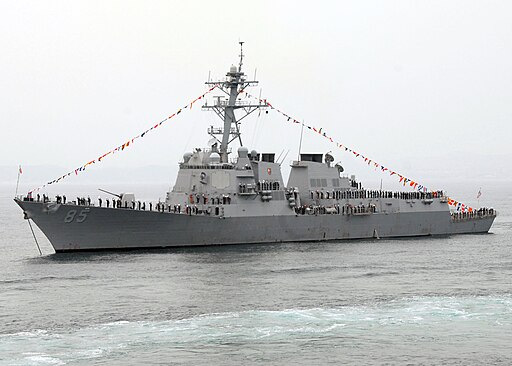
USS McCampbell (DDG-85)
USS McCampbell (DDG-85) is an Arleigh Burke-class guided missile destroyer that embodies the U.S. Navy’s commitment to technological innovation and operational versatility. Named in honor of Captain David S. McCampbell—one of the Navy’s greatest fighter aces and a Medal of Honor recipient—the ship not only carries forward a storied legacy but also stands as a modern-day workhorse, ensuring maritime security in an increasingly complex global environment .
Design and Construction
Evolution of the Arleigh Burke-Class
As a Flight IIA variant, USS McCampbell represents the evolutionary pinnacle of the Arleigh Burke-class destroyers. This subclass builds on earlier designs by incorporating advanced systems that enhance anti-air, anti-surface, and anti-submarine warfare capabilities. Bath Iron Works manufactured McCampbell, with key milestones including her keel laying on 15 July 1999, her launch on 2 July 2000, and her commissioning on 17 August 2002. These dates echo the long-standing tradition of turning groundbreaking design into operational reality, ensuring the Navy remains agile on the high seas .
Hull Design and Structural Integrity
The vessel’s hull design prioritizes both durability and agility. With a sharply contoured superstructure engineered for optimal sensor placement, USS McCampbell balances speed and stability. The integrated bridge and radar mast configuration minimizes topweight while offering expansive situational awareness. This equilibrium between form and function ensures that the destroyer can withstand harsh maritime environments and rapidly adapt to multifaceted combat scenarios.
Technical Specifications
The technical prowess of USS McCampbell is embodied in its well-calibrated dimensions, powerful propulsion system, and advanced weaponry. Below are the key technical details that define this formidable warship.
Dimensions and Displacement
- Length: Approximately 509 ft 6 in (155.30 meters)
- Beam: Approximately 66 ft (20 meters)
- Draft: Approximately 31 ft (9.4 meters)
- Full Displacement: Around 9,200 tons
These dimensions ensure excellent seakeeping characteristics, enabling the ship to operate efficiently in diverse maritime conditions while maintaining sufficient space for its elaborate suite of systems and armaments .
Propulsion and Performance
- Propulsion System: Four General Electric LM2500-30 gas turbines arranged on two shafts
- Combined Output: About 100,000 shaft horsepower (approximately 75 MW)
- Top Speed: Exceeds 30 knots (56 km/h or 35 mph)
- Operational Range: Over 4,400 nautical miles at a cruising speed of 20 knots
The propulsion configuration not only delivers rapid speeds for swift tactical maneuvers but also provides the endurance needed for extended deployments, particularly in the expansive regions of the Pacific .
Armament and Firepower
USS McCampbell is designed to deliver lethal precision with a layered armament system capable of addressing threats across multiple domains.
Primary Guns and Close-In Weapons Systems (CIWS)
- 127 mm/62 Mk 45 Mod 4 Gun: Mounted forward for both shore bombardment and surface combat
- Phalanx CIWS: Provides rapid automated defense against incoming anti-ship missiles
- Mk 38 Machine Gun Systems: Two 25 mm systems for close-range defensive fire
- Supplemental Small Arms: Multiple .50-caliber machine guns for point defense
These systems ensure that McCampbell can neutralize threats in its immediate vicinity with rapid response capabilities.
Vertical Launching System (VLS) and Missile Options
The integrated Mk 41 Vertical Launch System is the heart of McCampbell’s missile capabilities. It is configured with both 32-cell and 64-cell modules that provide up to 96 missile cells, enabling the ship to carry a diverse and flexible arsenal.
- Surface-to-Air Missiles: Including RIM-66M, RIM-156, and the advanced RIM-174A Standard ERAM
- Anti-Ballistic Missile Options: Such as the RIM-161
- Short-Range Defense: Quad-packed RIM-162 ESSM cells for layered air defenses
- Precision Strike Capability: BGM-109 Tomahawk cruise missiles for land-attack missions
- Anti-Submarine Warfare: RUM-139 Vertical Launch ASROC for underwater threats
This multipronged missile suite underlines McCampbell’s capacity to engage aerial, surface, and underwater adversaries simultaneously .
Torpedo Systems
To further augment its anti-submarine capabilities, USS McCampbell is equipped with:
- Mark 32 Triple Torpedo Tubes: Capable of launching Mark 46, Mark 50, and Mark 54 lightweight torpedoes
These torpedo systems are critical for enhancing the vessel’s defensive perimeter against stealthy submarine threats.
Sensor and Electronic Warfare Systems
The Aegis Combat System and Radar Capabilities
At the core of USS McCampbell’s intelligence and targeting capacity is the Aegis Combat System—a sophisticated network that integrates data from multiple sensors into a cohesive picture of the battlespace. Central to this system is the AN/SPY-1D multi-function phased array radar. This radar monitors air and surface activity across vast distances, tracking multiple targets and quickly relaying this information for rapid decision making .
Additional Sensors and Electronic Countermeasures
Complementing the Aegis suite are several specialized systems:
- Electronic Support Measures (ESM): Provide early warning and countermeasure initiation against hostile electronic signals
- Sonar Systems: Integrated hull-mounted and towed arrays assist in submarine detection
- Communication Systems: Secure and robust channels that ensure seamless networking with other vessels and allied forces
Together, these systems enable McCampbell to maintain unparalleled situational awareness and electronic supremacy on the modern battlefield.
Crew Accommodations and Aviation Facilities
Seamless Integration for Operational Excellence
Accommodating approximately 380 officers and enlisted personnel, USS McCampbell is designed for long-duration missions. The layout of the crew spaces, command centers, and logistical areas is optimized for high operational tempo while ensuring that crew members are well-supported and capable of performing under pressure.
Aviation Capabilities
The Flight IIA design includes a full-service hangar and a flight deck, typically supporting two MH-60R Seahawk helicopters. These rotary-wing assets extend the ship’s operational, surveillance, and anti-submarine warfare capabilities, allowing for aerial reconnaissance and rapid response in both combat and humanitarian scenarios.
Operational History and Strategic Significance
USS McCampbell’s service record reflects its strategic importance in the U.S. Navy’s global operations. Since its commissioning in 2002, McCampbell has participated in numerous exercises, patrols, and operational deployments—most notably within the U.S. 7th Fleet’s area of responsibility in the Indo-Pacific region.
Forward Deployment and Modern Challenges
Now forward deployed out of Yokosuka, Japan, McCampbell plays a vital role in maintaining the balance of power in regions marked by strategic competition and emerging threats. Her presence exemplifies the Navy’s commitment to freedom of navigation operations, rapid response to crises, and humanitarian assistance when required .
Evolving Tactics in a Dynamic Environment
The ship’s high-performance propulsion, integrated combat systems, and versatile armament allow her to operate effectively in multi-domain battles—ranging from high-intensity conflict to stability operations. This adaptability ensures that McCampbell remains a cornerstone of American naval power and a forward-deployed deterrent against potential adversaries.
Conclusion
USS McCampbell (DDG-85) is much more than a marvel of modern naval engineering—it is a symbol of resilience, technological innovation, and tactical versatility. From her robust design and dynamic propulsion to an array of advanced weapons and sensor systems, McCampbell stands ready to meet the challenges of 21st-century warfare. Her forward deployment to critical regions further underscores the strategic imperative of maintaining a versatile and powerful naval presence.
The integration of legacy design elements with cutting-edge technology ensures that ships like USS McCampbell will continue to evolve, potentially incorporating unmanned systems and advanced cyber-defense measures to meet future threats. This transformative approach signifies not only the ongoing modernization of naval assets but also the enduring dedication of the U.S. Navy to safeguard freedom across the world’s oceans.
_is_anchored_at_full_dress_ship_during_the_International_Fleet_Review.jpg)