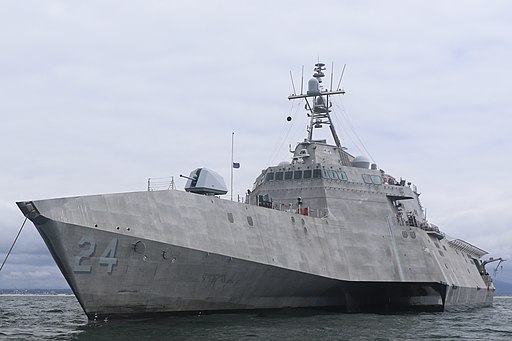
USS Oakland (LCS-24): Technical and Operational Profile
USS Oakland (LCS-24) is an Independence-class littoral combat ship of the United States Navy. Commissioned in April 2021, she embodies a trimaran hull design, modular mission bays, and high speed for operations in coastal and open-ocean environments.
Design and Construction
Namesake and Contract Award
Oakland is named for the City of Oakland, California, continuing a lineage of naval vessels honoring the Bay Area port. The contract for her construction was awarded to Austal USA on 29 December 2010 as part of the Navy’s procurement of ten additional Independence-variant LCS units.
Shipyard Milestones
Her keel was laid at Austal USA’s Mobile, Alabama yard on 20 July 2018. She was christened on 29 June 2019, launched on 21 July 2019, delivered to the Navy on 26 June 2020, and officially commissioned on 17 April 2021 at Naval Base San Diego.
General Characteristics
| Attribute | Specification |
|---|---|
| Class & Type | Independence-class littoral combat ship |
| Displacement (light/full) | 2,307 t / 3,104 t |
| Length | 127.4 m (418 ft) |
| Beam | 31.6 m (104 ft) |
| Draft | 4.27 m (14 ft) |
| Propulsion | 2× gas turbines, 2× diesel engines, 4× waterjets, selectable azimuth thruster, 4× diesel generators |
| Speed | 40 knots cruise, 47 knots sprint |
| Range | 4,300 nmi at 20 knots |
| Complement | 40 core crew (8 officers, 32 enlisted) plus up to 35 mission-module personnel |
| Homeport | San Diego, California |
Hull and Structural Design
The tri-hull (trimaran) aluminum superstructure and center hull deliver exceptional stability and a reduced radar cross-section. Foam-filled outriggers and an integrated flight deck support aviation operations, while the flanking hulls enhance seakeeping in littoral waters.
Propulsion and Performance
Combined Diesel or Gas (CODOG)
Oakland uses a combined diesel or gas configuration. Two General Electric LM2500 gas turbines provide high-speed capability, while two diesel engines and four steerable waterjets ensure efficient cruising and superb maneuverability in confined coastal zones.
Speed, Range, and Endurance
Cruising at 20 knots, Oakland can cover approximately 4,300 nmi on one fuel load. Her sprint speed exceeds 47 knots, enabling rapid response or evasion. Diesel generators supply hotel power and allow silent operations during diesel-only transits.
Mission Modules and Combat Systems
Modular Mission Bay
Oakland’s reconfigurable bay accommodates three interchangeable packages—surface warfare, anti-submarine warfare, and mine countermeasures—each featuring unmanned surface vessels (USVs), unmanned aerial vehicles (UAVs), towed arrays or robotic mine-hunting units.
Main Gun and Point Defense
A BAE Systems Mk 110 57 mm gun provides shore-bombardment and surface-engagement capability. Four .50-caliber machine guns and an 11-cell Evolved SeaRAM launcher deliver layered defense against small boats, aircraft, and anti-ship missiles.
Aviation and Unmanned Assets
The aft flight deck and hangar support two MH-60R/S Seahawk helicopters or one MQ-8B/C Fire Scout unmanned helicopter. An extendable davit and mission-bay crane facilitate launch and recovery of USVs and rigid-hull inflatable boats.
Sensors and Electronic Warfare
Oakland’s sensor suite includes a Saab Sea Giraffe 3D surface/air radar, Sperry Marine Bridgemaster-E navigation radar, and an AN/KAX-2 electro-optical/infrared targeting sensor. Electronic-support measures (EDO ES-3601) and four SRBOC chaff/flare launchers bolster self-defense against guided threats.
Crew and Habitability
The core crew of 40 enjoys modular berthing, a galley/mess facility, and a small gym. Climate-controlled interiors, LED lighting, and automated damage-control systems enhance habitability and reduce workload during extended deployments.
Operational History
Commissioning and Early Deployments
After commissioning, Oakland conducted acceptance trials and joined Littoral Combat Ship Squadron ONE. Early deployments focused on integration with U.S. 7th Fleet operations, demonstrating interoperability exercises in the Western Pacific and Southeast Asia.
Recent Operations
In January 2023, Oakland returned to San Diego after an 18-month rotational deployment, participating in multinational drills and forward-presence missions countering 21st-century coastal threats.
Future Upgrades and Outlook
Planned enhancements include integration of Naval Strike Missile (NSM) launchers, expanded autonomy for unmanned surface and undersea vehicles, and further software upgrades to the combat management system. As one of the newest LCS platforms, USS Oakland will shape future littoral warfare concepts.
.jpg)