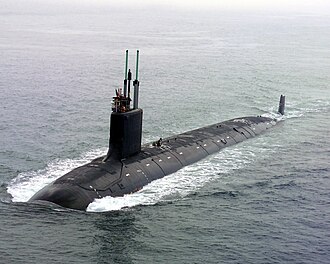
USS Oklahoma (SSN-802): The Virginia-Class Submarine Carrying a Historic Name Into the Future
The future USS Oklahoma (SSN-802) is one of the most significant submarines in the United States Navy’s next generation of undersea warfare. Built as the first Block V Virginia-class attack submarine, Oklahoma combines the proven characteristics of the Virginia-class design with a major increase in payload capacity and represents an important step in the Navy’s effort to maintain a powerful and survivable submarine force. The submarine is also deeply connected to American naval history. SSN-802 is the second U.S. Navy vessel and the first submarine to carry the name Oklahoma, deliberately reviving the name of the battleship USS Oklahoma (BB-37), which was lost during the Japanese attack on Pearl Harbor on December 7, 1941.
Unlike the famous battleship that preceded it, the new Oklahoma will operate almost entirely out of sight. Instead of massive guns and thick armor, its combat power will come from nuclear propulsion, stealth, advanced sonar, sophisticated sensors, precision weapons, and the ability to remain submerged for extended periods. The submarine is being constructed by Huntington Ingalls Industries’ Newport News Shipbuilding in partnership with General Dynamics Electric Boat, the two companies responsible for building America’s Virginia-class submarines. Its keel was authenticated on August 2, 2023, at Newport News, marking an important transition from design and component production toward the physical assembly of the submarine.
A New Oklahoma Beneath the Waves
The second Navy vessel to bear the name
The decision to name SSN-802 Oklahoma was announced in December 2019, when Acting Secretary of the Navy Thomas Modly selected Oklahoma and Arizona as the names for the next two Virginia-class submarines. The decision was deliberately connected to the sacrifices of the crews of USS Oklahoma (BB-37) and USS Arizona (BB-39), both of which were destroyed during the attack on Pearl Harbor. The original Oklahoma suffered enormous losses, with 429 Sailors and Marines killed in the attack. By naming a modern nuclear-powered submarine Oklahoma, the Navy sought to ensure that the name and memory associated with BB-37 would continue into a new generation of naval service.
The connection between the old battleship and the future submarine is particularly powerful because the two vessels represent completely different eras of naval warfare. BB-37 was a battleship designed around heavy guns, armor, and surface combat. SSN-802 is designed around concealment, information, mobility, and precision strike. Yet both ships share the same fundamental purpose: carrying American Sailors into dangerous environments in defense of the United States.
The Navy’s decision also gives Oklahoma a unique place in submarine history. According to the Navy, SSN-802 will be the first submarine named for the state of Oklahoma. The state therefore moves from having its name associated with one of the most tragic episodes in American naval history to having that same name carried by one of the Navy’s most technologically advanced undersea platforms.
The Virginia-Class Foundation
Designed for a changing maritime battlefield
Oklahoma belongs to the Virginia class, a family of nuclear-powered fast-attack submarines designed to replace aging Los Angeles-class submarines and provide the Navy with a flexible platform capable of performing missions in both deep-ocean and coastal environments. Virginia-class submarines are intended to conduct anti-submarine warfare, anti-surface warfare, intelligence, surveillance and reconnaissance, strike operations, mine warfare, and special operations support.
The class was developed around the principle that a modern submarine must be able to perform multiple missions without sacrificing its most important characteristic: stealth. A submarine can potentially observe an adversary without being detected, track hostile ships and submarines, gather intelligence, support special operations forces, and launch precision weapons while operating beneath the surface. This combination makes the Virginia class one of the central components of the U.S. Navy’s undersea strategy.
The Virginia design is also intended to be more economical and flexible than the much larger and more expensive Seawolf-class submarines developed during the Cold War. Rather than building a relatively small number of extremely specialized boats, the Navy developed Virginia as a class that could be produced in larger numbers while incorporating sophisticated acoustic, propulsion, weapons, and mission systems.
Block V: A Major Increase in Payload
The Virginia Payload Module changes the equation
The most important distinction between Oklahoma and earlier Virginia-class submarines is its Block V configuration. SSN-802 is the first Block V submarine, and Block V boats incorporate the Virginia Payload Module, or VPM. This feature significantly increases the submarine’s capacity to carry large payloads, particularly cruise missiles.
The Virginia Payload Module consists of an additional hull section containing four large payload tubes. Each tube can accommodate multiple Tomahawk cruise missiles, substantially increasing the submarine’s available strike capacity compared with earlier Virginia-class configurations. This additional payload space was developed in part to compensate for the retirement of the Navy’s four Ohio-class guided-missile submarines, which had provided a particularly large undersea strike capability.
The result is a submarine that retains the Virginia class’s basic stealth and multi-mission characteristics while possessing considerably greater capacity for long-range conventional strike. Oklahoma therefore represents a transition between the original Virginia concept and a later generation of boats optimized for a maritime environment in which distributed long-range fires are increasingly important.
The addition of the payload module also makes the submarine longer than earlier Virginia-class boats. Public Navy information generally describes the standard Virginia class at approximately 377 feet in length, while Block V submarines with the additional module are approximately 460 feet long. The extra hull length provides room for the payload system without fundamentally changing the submarine’s basic mission as a fast-attack platform.
Nuclear Propulsion and Undersea Endurance
Built to remain submerged
One of the defining characteristics of Oklahoma is its nuclear propulsion system. Nuclear power gives the submarine an enormous advantage in endurance because it does not need to surface or snorkel to obtain atmospheric oxygen for propulsion. Instead, the nuclear reactor provides the energy required to generate steam and power the submarine’s propulsion system and other onboard systems.
For a submarine, this has enormous operational consequences. Remaining submerged allows Oklahoma to maintain stealth while traveling across long distances, conducting surveillance, responding to changing operational requirements, or positioning itself for a mission. Its endurance is therefore limited less by propulsion fuel than by supplies, maintenance requirements, crew endurance, and the needs of a particular deployment.
Virginia-class submarines are publicly described as capable of exceeding 25 knots submerged. The exact performance characteristics of an individual boat, including many operational and acoustic details, are not publicly disclosed. Such restrictions are unsurprising because underwater speed, noise characteristics, sensor performance, and other technical capabilities can reveal valuable information about a submarine’s effectiveness.
Nuclear propulsion also allows the submarine to support a broad range of missions. It can travel rapidly when required, but it can also spend extended periods operating quietly and gathering information. That flexibility is one reason nuclear-powered attack submarines remain so valuable to the United States Navy.
Stealth and Advanced Sensors
The importance of hearing without being heard
A submarine’s most important weapon may be its ability to remain undetected. Oklahoma will therefore rely heavily on the Virginia class’s sophisticated sonar and sensor architecture. Underwater, sound is one of the primary means of detecting other vessels, making acoustic performance central to submarine warfare.
Virginia-class submarines employ advanced sonar systems designed to detect and track contacts in the underwater environment. These systems help the crew build a tactical picture of surrounding activity and distinguish potentially important contacts from the enormous amount of natural and man-made noise found in the ocean.
Stealth and sensors work together. A submarine that can detect another vessel without revealing its own location possesses an enormous tactical advantage. This allows it to monitor maritime traffic, search for enemy submarines, support intelligence missions, and potentially position itself for an attack without necessarily being aware to the opposing force.
The Navy describes Virginia-class submarines as capable of conducting long-term, covert surveillance of sea forces, littoral waters, and ground targets. That makes Oklahoma valuable not only as a weapons platform but also as an intelligence-gathering asset capable of operating in areas where surface ships or aircraft may face greater risks of detection.
Weapons and Strike Capability
A submarine built for multiple missions
Although much of Oklahoma’s combat capability remains classified, the publicly known Virginia-class weapons architecture includes heavyweight torpedoes and Tomahawk cruise missiles. Virginia-class submarines are equipped with four torpedo tubes and can employ Mk 48 Advanced Capability heavyweight torpedoes.
Torpedoes provide a powerful capability against submarines and surface ships, while Tomahawk cruise missiles allow Virginia-class boats to conduct precision strikes against targets ashore. The combination makes Oklahoma a flexible platform capable of contributing to both maritime and land-attack missions.
The addition of the Virginia Payload Module makes Block V boats especially significant. The four additional large-diameter payload tubes provide a major increase in missile capacity and can also provide flexibility for future payloads. This means Oklahoma is not simply a larger version of an earlier Virginia submarine; it is a platform designed with additional internal volume to support a broader and potentially evolving range of missions.
The Navy’s decision to begin the VPM-equipped Block V series with SSN-802 reflects the changing strategic environment. Long-range precision weapons are increasingly important to naval operations, and submarines offer the valuable ability to position those weapons covertly and operate from difficult-to-detect locations.
Construction of USS Oklahoma
From design to keel authentication
Construction of a Virginia-class submarine is an enormous industrial undertaking. The program involves two principal shipbuilders: General Dynamics Electric Boat and Huntington Ingalls Industries’ Newport News Shipbuilding. Components and sections are constructed at different facilities before being brought together as part of the final submarine.
For Oklahoma, Newport News Shipbuilding hosted the keel authentication ceremony on August 2, 2023. The event marked a traditional milestone in the life of a naval vessel. During the ceremony, Oklahoma’s sponsor, Mary “Molly” Slavonic, watched as her initials were placed on a ceremonial steel plate that would eventually become part of the submarine. The ceremony symbolized the transition of the vessel from a design and construction program into a recognizable ship taking physical form.
Slavonic was selected as the submarine’s sponsor in 2020. Her connection to Oklahoma and to the legacy of the original battleship made her an especially fitting choice. She had been closely involved in efforts to establish the USS Oklahoma Memorial at Pearl Harbor, which honors the 429 Sailors and Marines killed aboard BB-37. Her role provides a direct human link between the crew that died in 1941 and the future crew that will serve aboard SSN-802.
Remembering USS Oklahoma (BB-37)
From Pearl Harbor tragedy to modern naval legacy
The story of SSN-802 cannot be separated from the history of USS Oklahoma (BB-37). The original Oklahoma was a Nevada-class battleship commissioned in 1916. On December 7, 1941, it was moored at Pearl Harbor when Japanese forces attacked the U.S. Pacific Fleet.
Oklahoma was struck repeatedly by Japanese torpedoes and capsized. Hundreds of members of the crew were killed, while others were trapped inside the overturned hull. The disaster became one of the defining tragedies of the Pearl Harbor attack.
The modern SSN-802 deliberately carries this history forward. Navy officials have described the submarine as a means of ensuring that the sacrifice of the Oklahoma’s crew remains part of the Navy’s living heritage. This connection is reinforced by the submarine’s crew and representatives participating in commemorative activities at the USS Oklahoma Memorial at Pearl Harbor. In December 2025, members of PCU Oklahoma joined Pearl Harbor Naval Shipyard personnel at the memorial to honor those who died during the attack.
This relationship gives SSN-802 a responsibility beyond its technical mission. The submarine will carry the name into a new era, but its crew will also carry forward the memory of those who served aboard BB-37.
Why SSN-802 Matters to the U.S. Navy
The importance of Oklahoma extends beyond its individual capabilities. The submarine represents the Navy’s continuing effort to maintain a strong undersea force in an increasingly contested maritime environment. Submarines are particularly valuable because their stealth provides a form of survivability that many surface platforms cannot easily replicate.
As the first Block V Virginia-class submarine, Oklahoma also marks an important transition in the Virginia program. Its Virginia Payload Module provides additional weapons capacity while retaining the core characteristics of the class. The submarine therefore combines the proven Virginia design with an expanded role in long-range strike and future payload integration.
The broader significance is industrial as well as military. Maintaining the ability to construct nuclear-powered submarines requires a highly specialized workforce, a large network of suppliers, advanced manufacturing facilities, nuclear expertise, and long-term government investment. Every Virginia-class submarine represents the combined work of thousands of people across this industrial base.
Oklahoma is consequently both a combat platform and a symbol of America’s continuing commitment to undersea technology. Its construction demonstrates the scale of resources required to maintain a modern nuclear submarine fleet and the importance the Navy places on the underwater domain.
Technical Specifications of USS Oklahoma (SSN-802)
Because SSN-802 is still under construction and many performance characteristics of modern nuclear submarines are classified, publicly available specifications are primarily based on official Virginia-class and Block V information. Some exact figures may change as the submarine progresses through construction, testing, and eventual commissioning.
| Specification | USS Oklahoma (SSN-802) |
|---|---|
| Designation | SSN-802 |
| Ship type | Nuclear-powered fast-attack submarine |
| Class | Virginia class |
| Block | Block V |
| Position in Virginia class | 29th submarine |
| Builder | HII Newport News Shipbuilding / General Dynamics Electric Boat team |
| Propulsion | Nuclear-powered |
| Length | Approximately 460 ft (140 m), Block V configuration |
| Beam | Approximately 34 ft (10.4 m) |
| Displacement | Approximately 10,000+ tons submerged, depending on final configuration |
| Speed | More than 25 knots submerged |
| Primary missions | Anti-submarine warfare, anti-surface warfare, strike warfare, ISR, special operations, mine warfare |
| Torpedo tubes | Four |
| Torpedo armament | Mk 48 heavyweight torpedoes |
| Cruise-missile capability | Tomahawk cruise missiles |
| Virginia Payload Module | Yes |
| VPM payload tubes | Four |
| Reactor | Nuclear reactor; designed for long-term operation without routine refueling |
| Crew | Approximately 130+ Sailors, depending on final complement |
| Keel authentication | August 2, 2023 |
| Sponsor | Mary “Molly” Slavonic |
| Status | Under construction / pre-commissioning unit |
The exact specifications of SSN-802 should be treated with some caution because the submarine is not yet a commissioned operational vessel and because detailed characteristics of U.S. nuclear submarines are not publicly released. The Navy officially identifies Oklahoma as the 29th Virginia-class submarine and first Block V submarine, which is the most important distinction between SSN-802 and the earlier boats of the class.
The Future of USS Oklahoma
A name with a new mission
When Oklahoma eventually enters commissioned service, it will carry one of the most recognizable state names in American naval history into a completely new technological environment. Its crew will not operate a battleship surrounded by other surface combatants; instead, they will operate a stealthy nuclear-powered submarine designed to move through the world’s oceans largely unseen.
That transformation is precisely what makes the ship’s name so meaningful. BB-37 represented the battleship era of naval warfare, while SSN-802 represents the age of stealth, sensors, nuclear propulsion, precision weapons, and distributed maritime operations. The two ships could hardly be more different, yet the name connects their crews across generations.
The submarine’s eventual commissioning will also represent the culmination of years of work by shipbuilders, engineers, Navy personnel, suppliers, and the submarine’s future crew. From the naming decision in 2019 to sponsor selection in 2020 and keel authentication in 2023, the program has steadily transformed an idea into a physical vessel.
Conclusion
The future USS Oklahoma (SSN-802) is much more than another Virginia-class submarine. As the first Block V boat, it introduces the Virginia Payload Module and significantly expands the class’s strike potential while preserving the stealth, mobility, sensors, and multi-mission capabilities that define America’s modern attack-submarine force.
Its historical significance is equally important. SSN-802 revives the name of USS Oklahoma (BB-37), whose 429 Sailors and Marines were killed during the attack on Pearl Harbor. By carrying that name into the future, the submarine creates a direct connection between one of the darkest moments in U.S. naval history and the Navy’s continuing effort to prepare for future challenges beneath the sea.
Oklahoma will ultimately be judged by its ability to perform its missions quietly, safely, and effectively. Its greatest strength will probably never be visible to most people. The submarine’s power lies beneath the surface—in its nuclear propulsion, acoustic stealth, sensors, weapons, endurance, and ability to operate without revealing where it is. That invisible capability is precisely what makes nuclear attack submarines so valuable.
As the first Block V Virginia-class submarine, SSN-802 is therefore both a memorial and a technological milestone. It honors the Sailors who served aboard the original Oklahoma while providing a new generation of American submariners with one of the Navy’s most capable undersea platforms. When the submarine eventually joins the fleet, the name Oklahoma will once again sail beneath the waves, carrying forward a legacy that began with a battleship at Pearl Harbor and now continues into the future of American sea power.
_returns_to_the_General_Dynamics_Electric_Boat_shipyard.jpg)