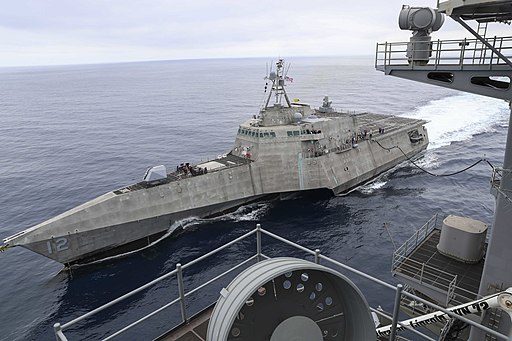
USS Omaha (LCS-12): Technical and Operational Overview
USS Omaha (LCS-12) is an Independence-class littoral combat ship of the United States Navy. Commissioned in February 2018, she is the fourth vessel named for Omaha, Nebraska. Designed for high-speed coastal operations, she combines modular mission bays, a trimaran hull form and a flight deck to conduct surface warfare, anti-submarine warfare and mine countermeasure missions.
Design and Construction
Namesake and Contract Award
The ship carries the name of Nebraska’s largest city, honoring Omaha’s legacy as a gateway to the American West. On 29 December 2010, the Navy awarded Austal USA a contract to build ten additional Independence-variant littoral combat ships.
Keel Laying, Launch and Commissioning
Her keel was laid at Austal’s Mobile, Alabama yard on 18 February 2015. The hull was launched on 20 November 2015 and christened on 19 December 2015, with philanthropist Susie Buffett as sponsor. After outfitting and trials, Omaha was commissioned on 3 February 2018 in San Diego and assigned to Littoral Combat Ship Squadron One.
Hull and Structural Design
Trimaran Hull Form
Omaha employs a steel-aluminum trimaran hull that yields superior stability, reduced drag and a lower radar cross-section. Two outrigger hulls flank the central hull, enhancing seakeeping in high seas and providing a broad flight deck footprint.
Mission Bay and Flight Deck
A reconfigurable mission bay between the outriggers supports interchangeable mission packages. The aft flight deck and hangar accommodate two MH-60R/S Seahawks or an MQ-8 Fire Scout unmanned helicopter, enabling over-the-horizon deployment of sensors and weapons.
Propulsion and Performance
Combined Diesel or Gas (CODOG)
Propulsion is provided by two General Electric LM2500 gas turbines for high-speed sprints and two diesel engines for efficient cruising. Power is directed to four waterjets and a retractable azimuth thruster, granting exceptional maneuverability in confined littoral waters.
Speed, Range and Endurance
- Continuous speed: 40 knots
- Sprint speed: 47 knots
- Range: 4,300 nmi at 20 knots
- Endurance: weeks of sustained sortie capability on diesel-electric hotel load
Mission Modules and Combat Systems
Modular Mission Bay
Omaha’s bay accepts three core mission packages: surface warfare (SUW), anti-submarine warfare (ASW) and mine countermeasures (MCM). Each package includes unmanned surface vehicles, towed arrays or robotic mine-hunting systems.
Armament
- Main gun: Mk 110 57 mm naval gun for surface and shore bombardment
- Point defense: 11-cell Evolved SeaRAM launcher, four .50 cal heavy machine guns
- Mission-dependent: SUW-packaged Griffin or naval strike missiles, ASW torpedo launchers
Aviation and Unmanned Systems
Two MH-60R/S Seahawks provide organic helicopter capability. The MQ-8 Fire Scout unmanned helicopter and launch-and-recovery cranes in the mission bay extend the ship’s sensor and targeting reach.
Sensors and Electronic Warfare
Radar and Navigation
The Saab Sea Giraffe 3D radar offers simultaneous air and surface detection. Bridgemaster-E navigation radar and an AN/KAX-2 electro-optical/infrared turret enhance situational awareness in crowded littorals.
Electronic Support and Decoys
An EDO ES-3601 electronic-support measures suite intercepts hostile emissions. Four SRBOC chaff/flare launchers and a Nulka active-decoy system provide layered countermeasures against incoming anti-ship missiles.
Crew and Habitability
Complement and Roles
Omaha operates with a core crew of 40 sailors (8 officers and 32 enlisted) plus up to 35 mission-module specialists. Rotational crews enable extended forward presence with minimal fatigue.
Accommodation and Training
Berthing modules offer personal storage and LED-lit reading lights. Integrated simulators in combat and engineering centers allow continual watch-team training. Automated fault-diagnosis systems reduce manual watch requirements.
Operational History
Squadron Assignment and Deployments
Since commissioning, Omaha has operated from San Diego as part of Littoral Combat Ship Squadron One. She has participated in joint exercises across the Indo-Pacific, demonstrating rapid reconfiguration between mission packages.
Notable Events
In July 2019, radar operators aboard Omaha detected and recorded multiple unidentified aerial phenomena off the California coast. Data from that incident contributed to the Pentagon’s Unidentified Aerial Phenomena Task Force assessment.
Modernization and Future Outlook
Planned Upgrades
The ship’s open-architecture combat system allows insertion of new radar firmware, enhanced data-link protocols and integration of Naval Strike Missiles. Expanded autonomy for unmanned vessels is slated in upcoming availability periods.
Role in Littoral Warfare
As one of the newest Independence-class vessels, USS Omaha’s combination of speed, modularity and aviation support shapes evolving littoral combat doctrine. Her ongoing deployments inform the design of next-generation small combatants.
Technical Specifications
| Characteristic | Specification |
|---|---|
| Class & Type | Independence-class littoral combat ship |
| Displacement (light/full) | 2,307 t / 3,104 t |
| Length | 127.4 m (418 ft) |
| Beam | 31.6 m (104 ft) |
| Draft | 4.27 m (14 ft) |
| Propulsion | 2× LM2500 gas turbines<br>2× diesel engines<br>4× waterjets<br>Retractable azimuth thruster |
| Speed | 40 knots (cruise)<br>47 knots (sprint) |
| Range | 4,300 nmi at 20 knots |
| Complement | 40 core crew + up to 35 mission specialists |
| Sensors | Sea Giraffe 3D radar<br>Bridgemaster-E radar<br>AN/KAX-2 EO/IR |
| Electronic Warfare | EDO ES-3601 ESM<br>4× SRBOC launchers<br>Nulka |
| Armament | 1× Mk 110 57 mm gun<br>11-cell SeaRAM launcher<br>4× .50 cal guns |
| Aircraft | 2× MH-60R/S Seahawks<br>1× MQ-8 Fire Scout |
| Builder | Austal USA, Mobile, Alabama |
| Ordered / Laid / Launched | 29 Dec 2010 / 18 Feb 2015 / 20 Nov 2015 |
| Commissioned | 3 Feb 2018, San Diego, CA |
