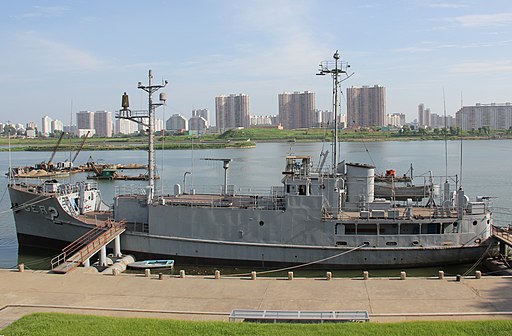
USS Pueblo (AGER-2)
The USS Pueblo (AGER-2) occupies a unique place in the annals of naval history, symbolizing a dramatic episode in Cold War tensions between the United States and North Korea. Commissioned in 1944 as a cargo ship, the USS Pueblo was later converted into an intelligence-gathering vessel tasked with monitoring naval activities along the coast of North Korea during the late 1960s. However, on January 23, 1968, the USS Pueblo found itself at the center of an international crisis when it was intercepted and captured by North Korean naval forces while conducting a reconnaissance mission in international waters.
The capture of the USS Pueblo and its crew of 83 sailors sparked a tense diplomatic standoff between the United States and North Korea. The crew was taken prisoner and held captive for 11 months, enduring harsh conditions and interrogation by North Korean authorities. The incident strained relations between the two countries and heightened Cold War tensions, raising concerns about the security of American naval vessels operating in hostile waters.
Following intense negotiations and diplomatic efforts, the crew of the USS Pueblo was eventually released on December 23, 1968, after nearly a year in captivity. The ship itself, however, remains in North Korean custody to this day, serving as a museum and propaganda tool for the North Korean regime. The USS Pueblo incident serves as a stark reminder of the dangers faced by American servicemen and women during the Cold War and underscores the complex geopolitical challenges inherent in naval operations conducted in hostile environments.
Armament of USS Pueblo (AGER-2)
As an intelligence-gathering vessel rather than a combat ship, the USS Pueblo (AGER-2) was not heavily armed. However, it did carry some defensive armament for self-protection. Here is a list of the armament typically carried by the USS Pueblo:
- Machine Guns: The USS Pueblo was equipped with a number of .50 caliber and .30 caliber machine guns for self-defense purposes. These machine guns were primarily intended for use against small boats, personnel, or low-flying aircraft that posed a threat to the ship.
- Small Arms: In addition to machine guns, the crew of the USS Pueblo would have had access to small arms such as rifles, pistols, and shotguns for close-range defense and repelling potential boarders or attackers.
- Signal Flares and Smoke Grenades: The ship likely carried signal flares and smoke grenades as non-lethal means of signaling distress or creating a smoke screen to evade potential threats.
It’s important to note that the primary mission of the USS Pueblo was intelligence gathering rather than engaging in combat. As a result, its armament was limited compared to other types of naval vessels, reflecting its role as a surveillance platform rather than a frontline warship.
Dimensions of USS Pueblo (AGER-2)
The USS Pueblo (AGER-2) had relatively modest dimensions compared to larger naval vessels. Here are the approximate dimensions of the USS Pueblo:
- Length: The USS Pueblo had a length of approximately 176 feet (53.6 meters) from bow to stern.
- Beam: The beam, or width, of the USS Pueblo was approximately 31 feet (9.4 meters).
- Draft: The draft, which refers to the depth of the ship’s hull below the waterline, of the USS Pueblo was approximately 9 feet (2.7 meters).
These dimensions reflect the compact size of the USS Pueblo, which was designed to be a small, maneuverable vessel suitable for conducting intelligence-gathering operations in coastal waters. Despite its modest size, the USS Pueblo played a significant role in Cold War-era reconnaissance efforts before its capture by North Korean forces in 1968.
