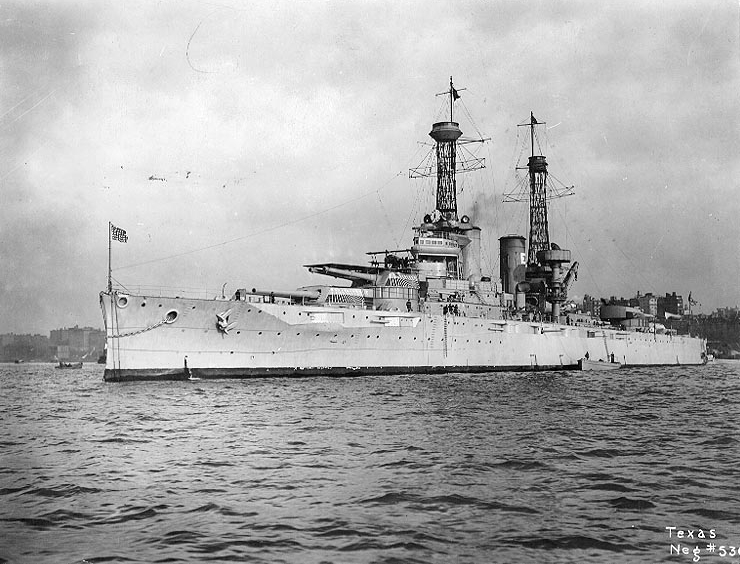
USS Texas (BB-35)
The USS Texas (BB-35), a dreadnought battleship commissioned in 1914, stands as a testament to the evolution of naval technology and the pivotal role played by the United States in the early 20th century. As the lead ship of the New York-class battleships, the USS Texas boasted impressive dimensions, measuring 573 feet in length with a beam of 95.3 feet and a draft of 28.5 feet. Displacing over 27,000 tons, the battleship represented a formidable force, equipped with ten 14-inch guns in five twin turrets and a host of secondary armaments. The USS Texas served as a flagship during World War I, participating in escort duties for Allied convoys and demonstrating the capabilities of the burgeoning U.S. Navy.
The USS Texas went on to play a prominent role in World War II, contributing to Allied efforts in both the Atlantic and Pacific theaters. The battleship supported the D-Day landings at Normandy in 1944, providing crucial fire support, and later participated in the Pacific island-hopping campaigns. The USS Texas, with its storied history and resilience in the face of evolving naval challenges, was decommissioned in 1948 and became a museum ship in 1948, permanently moored in the Houston Ship Channel. Today, the USS Texas is a floating museum, allowing visitors to step aboard and explore its decks, gaining a firsthand perspective on the naval history it embodies.
Armament of USS Texas (BB-35)
The USS Texas (BB-35), a battleship of the New York-class, was armed with a formidable array of weaponry. Here is a list of the main and secondary armament of the USS Texas:
Main Battery:
- Ten 14-inch/45 caliber guns
- Mounted in five twin turrets (two forward, two aft, and one amidships)
Secondary Battery: 2. Twenty-one 5-inch/51 caliber guns
- Placed in casemates along the sides of the ship
Anti-Aircraft Battery (as upgraded during World War II): 3. Four 3-inch/50 caliber guns
- Initially part of the ship’s anti-aircraft defense.
- Eight 40mm Bofors anti-aircraft guns
- Added during World War II to enhance the ship’s anti-aircraft capabilities.
- Twenty-four 20mm Oerlikon anti-aircraft guns
- Deployed for close-range anti-aircraft defense.
The USS Texas underwent various modifications and upgrades to its armament during its service, adapting to the changing requirements of naval warfare. The battleship played a significant role in both World War I and World War II, showcasing its versatility in engaging both surface and aerial threats.
Parameters of USS Texas (BB-35)
The USS Texas (BB-35), a pioneering battleship of the New York-class commissioned in 1914, featured parameters that highlighted its role as a significant naval asset during the early to mid-20th century. With an overall length of 573 feet, a beam (width) of 95.3 feet, and a draft (maximum depth submerged) of 28.5 feet, the USS Texas had a displacement exceeding 27,000 tons. These substantial dimensions provided the battleship with stability and seaworthiness, essential for navigating the challenging waters of the Atlantic and Pacific Oceans.
The parameters of the USS Texas were not just indicators of its physical presence but were integral to its operational capabilities. The battleship’s length and breadth allowed for the deployment of its powerful armament, including ten 14-inch guns in five twin turrets. The draft facilitated deep-water navigation, making the USS Texas versatile in various maritime environments. These features, coupled with its powerful propulsion system, showcased the USS Texas’s adaptability and effectiveness in naval operations during a transformative period in global history. The battleship, having served with distinction in both World War I and World II, now stands as a museum ship, allowing visitors to explore its decks and gain insights into its rich naval history.
