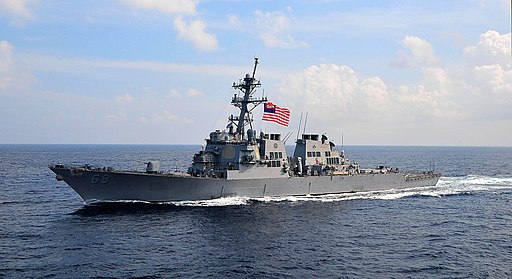
USS The Sullivans (DDG-68)
USS The Sullivans (DDG-68) is an Arleigh Burke–class Flight I guided-missile destroyer commissioned into the U.S. Navy on 19 April 1997. Named in honor of the five Sullivan brothers who perished together during World War II, she embodies multi-mission flexibility, integrating advanced sensors, robust firepower, and a high-speed propulsion system. Home-ported at Naval Station Mayport, Florida, The Sullivans routinely operates in both the Atlantic and Mediterranean theaters, supporting carrier strike groups, ballistic missile defense, and maritime security operations.
Design and Construction
Hull and Superstructure
The hull of The Sullivans features high-strength, low-alloy steel with a flared bow for improved seakeeping and an angled superstructure to reduce radar cross-section. Eight watertight compartments separated by transverse bulkheads enhance survivability against flooding or battle damage. Exterior panels on selected surfaces absorb infrared and radar energy, further lowering detectability.
Flight I Characteristics
As a Flight I Arleigh Burke, DDG-68 introduced the baseline Aegis Combat System and Mk 41 Vertical Launching System (VLS). Compared to later Flights, she lacks the Flight IIA hangar extension and some sonar upgrades, but retains the core sensor fusion, missile capability, and close-in defenses that define the class.
Dimensions and Displacement
| Parameter | Measurement |
|---|---|
| Overall length | 505 ft (154 m) |
| Beam | 59 ft (18 m) |
| Draft | 31 ft (9.4 m) |
| Light displacement | ~6,800 long tons |
| Full-load displacement | ~8,900 long tons |
These proportions balance high-speed maneuverability with the deck area required for sensors, weapons, and aviation support.
Propulsion and Performance
Gas Turbine Main Plant
The Sullivans is propelled by four General Electric LM2500-30 gas turbines, each producing 25,000 shaft horsepower. The turbines drive two controllable-pitch propellers through twin shafts, delivering a combined output of 100,000 shp. An automated control system manages turbine sequencing, load sharing, and fuel efficiency.
Auxiliary Power Generation
Three Rolls-Royce 501 K34 diesel generators each supply 3,000 kW of electrical power. These generators sustain combat systems, hotel services, and damage-control pumps during normal operations or when main turbines are offline.
Speed, Range, Endurance
- Maximum speed: in excess of 30 knots
- Cruising speed: 20 knots
- Range: 4,400 nautical miles at 20 knots
- Endurance: up to 45 days without logistical replenishment
This propulsion architecture enables sustained high-speed transits with minimal logistic footprint.
Combat Systems
Aegis Combat System
The core of DDG-68’s combat capability is the Aegis Combat System Baseline 5.1, centered on the AN/SPY-1D phased-array radar. This system simultaneously tracks hundreds of air and surface contacts, fuses data with electronic-warfare inputs, and automatically generates fire-control solutions for missiles and guns.
Vertical Launching System
Two Mk 41 VLS modules house a total of 90 cells (29 forward, 61 aft) capable of accommodating a mix of:
- Standard Missile 2 (SM-2) for area air defense
- Standard Missile 3 (SM-3) for ballistic missile defense
- Evolved Sea Sparrow Missile (ESSM) for point air defense
- Tomahawk Land-Attack Missile (TLAM) for long-range strike
- RUM-139 Vertical Launch ASROC for anti-submarine engagements
Rapid, simultaneous salvo launches enhance both defensive and offensive options.
Gun and Close-In Defenses
- One 5-inch/54 caliber Mk 45 gun for naval gunfire support and surface engagements
- Two Mk 15 Phalanx Block 1B CIWS for last-ditch defense against incoming missiles
- Two Mk 38 Mod 2 25 mm machine-gun systems for fast-reaction surface threats
- Four .50-caliber heavy machine guns for point defense
This layered armament suite counters threats from hypersonic missiles down to small-boat swarms.
Anti-Submarine Warfare Fit
- Two Mk 32 triple torpedo tubes firing Mk 46/Mk 50/Mk 54 lightweight torpedoes
- AN/SQS-53C hull-mounted active/passive sonar array
- AN/SQR-19 Tactical Towed Array Sonar for passive long-range detection
- Integration with VLS-launched ASROC rockets for standoff submarine prosecution
Combined shipborne and embarked helicopter assets deliver a comprehensive ASW envelope.
Electronic Warfare and Countermeasures
- AN/SLQ-32(V)3 electronic-support suite for radar warning and signal classification
- Mk 36 Super Rapid Bloom Offboard Chaff (SRBOC) for radar decoy deployment
- Mk 53 Nulka active-decoy rocket for targeting incoming anti-ship missiles
- AN/SLQ-25 Nixie towed acoustic decoy for torpedo defense
Automated algorithms select and deploy the optimal countermeasure mix within milliseconds.
Sensor and Data Systems
Radar Suite
- AN/SPY-1D phased-array 3D air and surface search radar
- AN/SPS-67(V)3 surface-search radar optimized for small target detection
- AN/SPQ-9B fire-control radar for high-resolution sea-skimmer tracking
- SPG-62 illuminators to guide semi-active homing missiles
These radars provide over-the-horizon situational awareness and precision targeting in cluttered littoral environments.
Sonar and Underwater Systems
- AN/SQS-53C hull sonar for active/passive medium-range detection
- AN/SQR-19 towed passive array for long-range acoustic surveillance
- AN/SQQ-89(V)6 ASW combat system integrating sonar feeds with fire-control solutions
This layered sonar architecture ensures detection of modern quiet submarines.
C4I and Networking
- Link 16 tactical data link for real-time air and surface picture sharing
- Cooperative Engagement Capability (CEC) enabling off-board targeting by other Aegis units
- Multi-band satellite communications for beyond-line-of-sight command and control
Integrated C4I keeps The Sullivans tightly coupled to fleet battle management and coalition forces.
Aviation Facilities
Flight Deck and Hangar
While Flight I ships lack an enclosed hangar extension, The Sullivans supports one embarked MH-60R Seahawk on her aft deck. Aboard handling systems and refueling rigs enable rapid launch, recovery, and maintenance of the helicopter for ASW, search-and-rescue, and over-the-horizon targeting tasks.
Aviation Support
Weapons-loading rails, sonobuoy launchers, and digital diagnostic consoles aboard facilitate helicopter weapons integration and prompt sortie generation during underway operations.
Crew and Habitability
Manning and Departments
The standard complement totals 281 personnel:
- 33 commissioned officers
- 38 chief petty officers
- 210 enlisted sailors
Departments include Operations, Combat Systems, Engineering, Supply, and Air Operations. Cross-trained damage-control teams maintain 24/7 readiness for fire, flooding, and system casualties.
Living Quarters and Amenities
- Officer staterooms and CPO cabins with private heads
- Modular berthing racks for junior enlisted with individual lockers
- Two-level mess deck and galley serving three meals per watch rotation
- Fitness area, crew lounge with multimedia consoles, and a small library
Acoustic insulation and zoned HVAC deliver comfort on extended deployments.
Service History
Construction and Commissioning
- Contract awarded: 8 April 1992 to Bath Iron Works, Maine
- Keel laid: 27 July 1994
- Launched: 12 August 1995
- Commissioned: 19 April 1997 in New York City
The ship quickly completed trials and joined the fleet as part of Destroyer Squadron 14.
Operational Deployments
Since entering service, The Sullivans has deployed regularly to the Fifth and Sixth Fleet areas, conducting ballistic missile defense patrols, maritime security operations, counter-piracy missions in the Gulf of Aden, and multilateral exercises such as RIMPAC and BALTOPS.
Modernization and Upgrades
Periodic overhauls at Naval Station Mayport and Norfolk Naval Shipyard have refreshed combat-system software, enhanced electronic-warfare suites, and improved habitability. These upgrades ensure The Sullivans remains mission-relevant against evolving threats.
Awards and Recognitions
- Multiple Battle “E” Efficiency Awards for sustained combat readiness
- Navy Unit Commendations for excellence during high-tempo operations
- Retention Excellence Award for superior crew morale and retention
These honors underscore the ship’s performance and the dedication of her crew.
Conclusion
USS The Sullivans (DDG-68) exemplifies the Arleigh Burke–class ethos of integrated combat power, modular flexibility, and enduring presence. Her blend of high-speed propulsion, Aegis-driven sensor fusion, and versatile weapons arrays makes her a formidable asset in air defense, anti-submarine warfare, surface strike, and missile defense. With continual upgrades and a highly trained crew, The Sullivans remains at the forefront of modern naval operations.
_flies_the_ship%27s_battle_flags_during_exercises_at_sea.jpg)