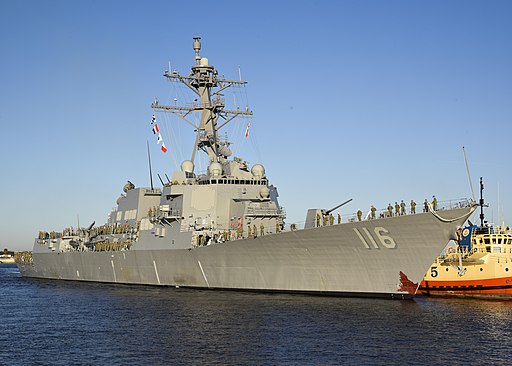
USS Thomas Hudner (DDG-116)
USS Thomas Hudner (DDG-116) is the Navy’s first Arleigh Burke-class destroyer built under the Flight IIA Technology Insertion program. Named for Medal of Honor recipient Lieutenant Commander Thomas J. Hudner Jr., this guided-missile destroyer combines proven hull architecture with advanced combat systems. Commissioned in December 2018, DDG-116 serves as a multi-mission surface combatant capable of anti-air, anti-submarine, anti-surface and strike warfare.
Design and Construction
Hull and Structural Features
DDG-116 follows the proven 513-foot Arleigh Burke hull form, constructed by Bath Iron Works in Maine. Modular sections were pre-outfitted with piping, wiring and mechanical shipsets before final assembly. Reinforced framing around the magazine and engineering spaces enhances damage resilience, while an incline bow and flared hull improve seakeeping in heavy seas.
Superstructure and Stealth Treatments
The forward and aft superstructures use radar-absorbing materials and angled surfaces to reduce radar cross-section. Exhaust uptakes are cooled and mixed with ambient air to lower infrared signature. Deckhouse apertures and sensor masts are tightly integrated to minimize visual and electronic signatures.
Dimensions and Displacement
| Parameter | Specification |
|---|---|
| Full-load displacement | 9,220 tons |
| Length overall | 513 ft (156.4 m) |
| Beam overall | 66 ft (20.1 m) |
| Draft | 31 ft (9.4 m) |
| Flight deck area | ~9,000 sq ft |
These dimensions support a potent sensor suite, a 96-cell vertical launch system, and a full-service hangar for two MH-60 helicopters.
Propulsion and Performance
Powerplant
- 4 × General Electric LM2500-GE gas turbines
- Total output: 100,000 shaft horsepower
- Combined diesel or gas (CODOG) configuration allows all-gas turbine operation for sustained high speeds.
Speed and Endurance
- Maximum speed: in excess of 30 knots
- Range: 4,400 nautical miles at 20 knots
- Endurance: 15-day mission without replenishment (extendable via underway replenishment)
Combat Systems and Armament
Vertical Launch System (VLS)
- 1 × 32-cell and 1 × 64-cell Mk 41 VLS (96 cells total)
- Can accommodate:
- RIM-66 Standard MR/SM-2
- RIM-156 Standard ERAM
- RIM-161 Standard Missile-3 (ballistic missile defense)
- RIM-162 ESSM (quad-packed)
- BGM-109 Tomahawk cruise missiles
- RUM-139 VL-ASROC anti-submarine rockets
Gun and Close-In Defenses
- 1 × 5-inch/62 Mk 45 Mod 4 naval gun for shore bombardment and surface targets
- 2 × 25 mm Mk 38 Mod 2 Bushmaster cannons
- 2 × 20 mm Phalanx CIWS for terminal missile and aircraft defense
- 4 × .50-caliber machine guns for close-range threats
Torpedo and Mine Warfare
- 2 × Mk 32 triple-torpedo launchers
- Lightweight torpedo compatibility: Mk 46, Mk 50, Mk 54
- Side-launch mine delivery via VLS cells
Sensors and Electronic Warfare
- AN/SPY-1D(V) multi-function radar (Aegis Combat System core)
- AN/SPS-67(V) surface-search radar
- AN/SQQ-89(V) anti-submarine warfare suite integrating hull-mounted and towed arrays
- AN/SLQ-32(V)6 electronic warfare system for detection and jamming
- Cooperative Engagement Capability (CEC) data link for networked air defense
Aviation Facilities
DDG-116 incorporates a double hangar and a flight deck capable of handling two MH-60R/S Seahawk helicopters simultaneously. Aircraft support includes:
- Integrated aviation fuel system
- Weapons handling elevator
- Maintenance and parts storage
- Flight-deck firefighting stations
Crew and Habitability
- Total complement: approximately 380 officers and enlisted
- Modular berthing compartments with improved berths, lockers and ventilation
- Galley, medical treatment spaces and fitness facilities designed for extended deployments
- Automated damage-control systems reduce crew workload during casualties
Mission Profile and Operational Role
As a multi-mission destroyer, Thomas Hudner can:
- Provide area and point air defense for carrier strike groups
- Conduct strike operations against shore targets with Tomahawks
- Execute anti-submarine patrols with embarked helicopters and onboard sonar
- Perform maritime interdiction and escort duties
- Integrate into ballistic missile defense architecture
Modernization and Future Upgrades
DDG-116’s Technology Insertion package includes upgraded power management for future directed-energy weapons and advanced radar signal processors. Planned enhancements:
- Replacement of analog machinery controls with digital automation
- Enhanced satellite communication terminals for higher data rates
- Structural provisions for laser weapon mounts and railgun tests
Conclusion
USS Thomas Hudner (DDG-116) represents the cutting edge of current destroyer design, blending a survivable hull, flexible mission load-outs and the Aegis Combat System. Her Flight IIA Technology Insertion features ensure relevance against evolving threats and provide a foundation for next-generation weapon integration.
_moors_at_Naval_Station_Mayport_for_a_port_visit_before_its_official_commission.jpg)