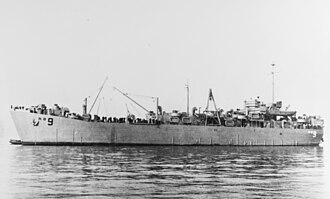
Although Ulysses did not achieve the public recognition associated with aircraft carriers, battleships, or famous destroyers, her contribution belongs to a vital part of naval history that is sometimes overlooked. Fleets depend not only on ships capable of engaging an enemy, but also on the vessels, personnel, equipment, and supply systems that allow those combatants to return to action after suffering mechanical failures or battle damage. During the final months of the Pacific War, the distances separating American forces from major industrial centers created enormous maintenance challenges. Repair ships helped reduce that burden by bringing specialized capabilities closer to the fleet, strengthening operational endurance and reducing dependence on distant shipyards. Ulysses subsequently served during the postwar occupation period before entering reserve status and eventually transferring to the West German Navy in 1961. Her history therefore extends beyond the closing stages of World War II, connecting American wartime shipbuilding with the reconstruction and development of West Germany’s postwar naval forces.
The Origins of USS Ulysses (ARB-9)
The strategic need for battle damage repair ships
The expansion of American naval operations during World War II created a demand for more than conventional fighting vessels. Aircraft carriers required escorts and maintenance support, amphibious forces needed transport and landing ships, and large fleets depended on a steady flow of fuel, ammunition, food, replacement equipment, and spare parts. Battle damage presented an especially difficult problem because even a relatively limited mechanical or structural failure could prevent a ship from participating in an operation. Damage to propulsion machinery, steering equipment, electrical systems, hull fittings, or other essential components could force a vessel to withdraw from the operational area, potentially leaving its formation short of an important capability. Returning every damaged ship to a major naval shipyard was neither efficient nor always practical, particularly in the Pacific, where the distances between operating areas and established industrial facilities could be immense. The Navy therefore developed auxiliary repair ships capable of performing important maintenance and repair work closer to the locations where the fleet was operating.
Ulysses belonged to the Aristaeus class, a group of battle damage repair ships adapted from landing ship hulls. The concept reflected a broader wartime preference for practical conversions and standardized shipbuilding wherever possible. A landing ship hull provided a useful starting point because it was designed to carry substantial loads, operate in demanding conditions, and support military activities close to shore. With the necessary modifications, a vessel of this type could be repurposed for repair work, providing a mobile platform for machinery, tools, stores, workshops, and heavy lifting equipment. This approach did not transform the ship into a fully equipped floating equivalent of a major naval shipyard, but it offered an important intermediate capability: repairs could be undertaken at forward locations, allowing damaged ships to regain some or all of their operational usefulness without immediately returning to distant bases.
Why Ulysses was originally planned as a landing ship
Before becoming USS Ulysses, the vessel was designated LST-967, identifying her as a tank landing ship in the LST series. These ships were developed to transport vehicles, personnel, and equipment to shore, including locations where conventional port facilities were unavailable or unsuitable for unloading military cargo. Their sturdy construction and practical cargo-carrying arrangements made them valuable to amphibious operations, but the wartime need for auxiliary vessels encouraged the Navy to adapt some hulls for different assignments. LST-967 was redesignated ARB-9 on 14 April 1944 and named Ulysses on 28 April 1944. The change placed her within the Navy’s expanding program of specialized battle damage repair ships rather than the landing force for which her original design had been intended.
This change in purpose is central to understanding Ulysses. The ship’s original design offered a useful structural foundation, but her eventual mission demanded a different set of capabilities. Instead of being optimized primarily for moving landing craft cargo, tanks, and other equipment toward a beach, she needed to support technical personnel and repair activities at sea or in forward anchorages. Her conversion illustrates the adaptability of wartime American shipbuilding, in which established hull designs could be modified to meet urgent operational needs. It also demonstrates that the Navy’s logistical strategy was not simply about producing ever-larger numbers of combat ships; it was about building a complete system in which vessels of different types supported one another and helped maintain the fighting strength of the fleet.
Construction and Commissioning
Building the hull at Bethlehem-Hingham Shipyard
Ulysses was laid down on 2 November 1944 at the Bethlehem-Hingham Shipyard in Hingham, Massachusetts, and launched on 2 December 1944. Her construction took place during a period when American shipyards were working at extraordinary levels to meet the requirements of a global war. Standardized designs, industrial production methods, and coordinated supply networks enabled shipbuilders to deliver vessels in large numbers, while the Navy increasingly assigned specialized functions to ships that might otherwise have been used for more conventional purposes. The short interval between Ulysses’s keel-laying and launch reflects the pace of wartime construction, although launch did not mean that the ship was immediately ready for her eventual repair mission. Additional fitting-out, equipment installation, testing, and conversion work remained necessary before she could operate in her intended role.
The construction location also reveals how the American naval expansion drew on shipbuilding facilities outside the country’s most prominent traditional naval yards. Commercial and contract shipyards became important partners in producing the vessels required by the armed forces, freeing other facilities to concentrate on different categories of warship and repair work. For a specialized auxiliary such as Ulysses, this industrial flexibility was particularly valuable because the vessel’s importance lay in the work she could perform after delivery rather than in the prestige associated with her construction. Her hull represented the first stage of a broader process: converting industrial production into a practical naval capability that could be deployed across a theater of operations.
Initial commissioning and conversion in Baltimore
Ulysses entered commissioned Navy service on 27 December 1944, initially under her original landing ship designation, to support her movement to the conversion facility. She subsequently proceeded to Baltimore, Maryland, where the Maryland Drydock Company undertook the work required to transform her into a battle damage repair ship. She was decommissioned on 8 January 1945, according to the detailed ship history maintained by NavSource, and recommissioned as USS Ulysses (ARB-9) on 20 April 1945 under Lieutenant James L. Johnstone, United States Naval Reserve. These separate commissioning dates can appear confusing when considered without the conversion context, but they reflect two distinct stages in the vessel’s development: her initial entry into service as a landing ship and her later entry into service in the specialized repair role for which she became known.
The conversion was the defining step in Ulysses’s early career. The Navy needed more than a hull capable of carrying cargo; it needed a ship that could serve as a forward engineering facility and support the restoration of damaged vessels. Such work required appropriate lifting arrangements, technical equipment, workshop facilities, and a crew capable of handling both shipboard operations and demanding maintenance tasks. The vessel’s reported largest boom capacity of 50 tons illustrates the importance of heavy lifting to her intended function, although that figure should not be interpreted as the lifting capacity of every piece of equipment aboard or as evidence that every type of ship repair could be completed independently. The goal was to provide a useful range of repair capabilities in a mobile naval platform, complementing rather than replacing the work of major shipyards.
Design and Technical Characteristics
Dimensions and displacement
USS Ulysses was a relatively compact auxiliary vessel by the standards of major American combatants, but her dimensions provided a useful balance between carrying capacity, stability, and the ability to operate in forward naval areas. She measured approximately 328 feet (100 meters) in overall length, with a beam of 50 feet (15.2 meters) and a draft of about 11 feet 2 inches (3.4 meters). Her reported displacement was approximately 1,781 long tons in light condition and 3,960 long tons at full load, figures that reflect the difference between the vessel’s relatively unloaded state and her weight when carrying the fuel, equipment, stores, and other materials associated with operational service. These measurements placed her within the general scale of the landing ship hulls from which the Aristaeus-class repair ships were developed, while the conversion adapted the vessel to a specialized technical mission rather than conventional amphibious transport.
The relationship between dimensions and mission is especially important for a repair ship. A vessel needed enough internal and deck space to accommodate equipment and technical personnel, while also maintaining sufficient stability to operate safely as stores and repair materials were moved around the ship. Heavy lifting operations placed particular demands on deck arrangements and structural strength, and the vessel’s ability to carry equipment was as important as her ability to travel from one anchorage to another. At the same time, a repair ship was not designed to keep pace with fast carrier task forces or high-speed combatants. Ulysses’s relatively modest speed was consistent with a role in which endurance, practicality, and the ability to support other ships mattered more than rapid tactical maneuvering.
Propulsion and performance
The ship’s propulsion system consisted of two Electro-Motive Diesel 12-567A diesel engines, each rated at approximately 900 horsepower, producing a combined output of about 1,800 shaft horsepower. Power was transmitted through a Falk main reduction gear arrangement to two propellers. Her reported maximum speed was approximately 11.6 knots, equivalent to about 13.3 miles per hour or 21.5 kilometers per hour. These characteristics made Ulysses a relatively slow-moving vessel compared with destroyers and other frontline combatants, but speed was not the primary measure of her effectiveness. Her value depended on reaching operating areas with the equipment, supplies, and personnel needed to help damaged ships return to service, and then remaining useful once she arrived.
Diesel propulsion was well suited to a support vessel of this kind because it provided a practical means of generating the power needed for sustained movement without the complexity of a larger, high-speed naval propulsion plant. Nevertheless, the engines were only one component of the ship’s technical system. Electrical generation, maintenance equipment, fuel storage, auxiliary machinery, and the reliability of the ship’s mechanical systems all contributed to her ability to perform extended deployments. The ship’s documented service demonstrates that moving the vessel across the Pacific was itself a significant undertaking, particularly when specialized equipment such as pontoons had to be transported securely and maintained under the stresses of an ocean voyage.
Armament and defensive capability
Although Ulysses was primarily a repair ship, she was equipped with defensive weapons appropriate to the wartime environment. Her listed armament consisted of two quadruple 40 mm Bofors anti-aircraft gun mounts and eight single 20 mm Oerlikon cannons. These weapons were intended to provide a measure of protection against aerial threats and other dangers that might confront an auxiliary vessel operating in a combat theater. Their presence reflected the reality that support ships could be exposed to the same broad operational risks as the forces they sustained, particularly in the Pacific, where air attack and hostile action could threaten vessels in anchorages as well as those underway.
This armament should be understood in the context of the ship’s mission rather than as evidence that she was intended to operate as an independent combatant. Her weapons were defensive in character, and her principal contribution to naval power remained the repair and support of other ships. A vessel with Ulysses’s speed, dimensions, and specialized equipment could not replace the escort, air cover, or broader protection provided by combat forces. Instead, her defensive guns formed one part of the precautions necessary to keep a valuable support asset available in potentially dangerous waters.
Crew and onboard organization
Ulysses’s published technical specifications list a complement of 15 officers and 271 enlisted personnel, for a total of 286 people. This relatively large complement reflects the manpower demands of operating a substantial naval vessel while also carrying out specialized repair assignments. A repair ship needed personnel capable of navigating and maintaining the vessel itself, alongside technicians and other specialists responsible for supporting the ships that came to her for assistance. The exact composition of the workforce could vary with assignments and operational circumstances, but the underlying requirement was clear: successful repair work depended on trained people as much as on machinery, tools, and lifting capacity.
The personnel aboard a vessel such as Ulysses worked within a complex environment in which routine shipboard duties and repair responsibilities were closely connected. Propulsion and electrical systems had to remain functional while repair teams supported other vessels; supplies had to be stored and managed; equipment needed inspection and upkeep; and operations had to be coordinated with the ships and naval authorities in the surrounding area. In forward anchorages, these demands could be intensified by limited infrastructure, weather, and the pressure to complete urgent work. Ulysses therefore represented not merely a mobile collection of tools, but an organized technical workforce operating as part of a larger naval maintenance network.
USS Ulysses During World War II
Shakedown and departure for the Pacific
After completing her conversion and recommissioning, Ulysses conducted shakedown exercises in Chesapeake Bay in May 1945. Shakedown training gave a ship and her crew the opportunity to test equipment, evaluate operating procedures, identify faults, and establish confidence in the vessel’s performance before deployment. For a specialized repair ship, this process was especially important because operational usefulness depended on the readiness of systems and equipment that might not be central to the operation of an ordinary transport vessel. The ship departed Norfolk on 22 May 1945 in company with USS Patroclus (ARL-19), beginning a long voyage toward the Pacific theater. Her route took her through the Panama Canal and onward to San Pedro, California, before she arrived in San Francisco on the morning of 1 June.
The journey illustrated the scale of the logistical system supporting American naval operations. A vessel intended to repair ships in the western Pacific first had to cross thousands of miles of ocean, pass through established maritime routes, and obtain the equipment and supplies needed for her assignment. San Francisco served as an important staging point where Ulysses loaded stores and pontoons before preparing to continue westward. The ship’s movement was therefore not simply a transfer from one port to another; it was the first major phase of deploying a specialized repair capability into a distant theater where such a capability could be particularly valuable.
The pontoon problem and a difficult ocean passage
Ulysses departed San Francisco Bay on 28 June 1945, carrying pontoons secured for the voyage. Within approximately six hours of getting underway, the bolts, plates, and turnbuckles holding the pontoons in place began to show signs of bending under the strain of the ocean passage. The ship was consequently ordered to return to San Francisco so that the pontoon mountings could receive additional work. After the necessary attention, she departed again at noon on 6 July, heading toward the Marianas by way of Pearl Harbor and Eniwetok. The episode demonstrates how the deployment of specialized equipment could introduce problems that were not necessarily apparent during preparations in port. An installation that appeared satisfactory under sheltered conditions could behave differently when subjected to the sustained movement and forces of the open ocean.
The delay also highlights an important principle of naval engineering: equipment must be suitable not only for its intended use but also for the conditions under which it is transported and deployed. Pontoons and other bulky materials could be essential to specialized operations, yet their secure handling at sea required robust mounting arrangements and careful preparation. For Ulysses, correcting the problem before continuing was an operational necessity rather than an incidental inconvenience. Continuing with compromised mountings might have risked further damage or loss of equipment during the remainder of the journey. Her departure on 6 July marked the resumption of the mission, although the remaining distance to the Marianas still presented a substantial undertaking.
Arrival at Saipan in August 1945
Ulysses reached Saipan on 6 August 1945 and reported to Commander, Service Division 103. Her arrival occurred during the final days of the Pacific War, when American forces were maintaining extensive operations across the western Pacific while preparing for the possibility of further campaigns. Saipan had become an important base within the Marianas following its capture by American forces in 1944, and the wider region supported the movement, maintenance, and supply of naval and amphibious formations. Ulysses’s arrival placed her within this network of forward support, where a ship capable of performing battle damage repairs could help reduce the burden on more distant facilities.
The timing of her arrival gives the ship’s deployment a distinctive historical context. On the same day, a B-29 bomber named Enola Gay took off from nearby Tinian and carried out the atomic bombing of Hiroshima, although the sailors aboard Ulysses were not immediately aware of that event. Japan announced its intention to surrender later in August, and the formal surrender ceremony followed on 2 September 1945. Ulysses had arrived too late to participate in the earlier major amphibious campaigns that defined much of the Pacific War, but the end of hostilities did not instantly eliminate the need for repair, maintenance, and logistical support. American forces still had ships to maintain, damaged equipment to assess, and occupation responsibilities to carry out across a vast region.
Repair assignments at Saipan and Okinawa
During the remainder of 1945, Ulysses undertook repair assignments while operating first from Saipan and then from Okinawa. These locations were important components of the American forward-base network, providing facilities and anchorages from which naval forces could support operations throughout the western Pacific. For a battle damage repair ship, an assignment in such a region offered the opportunity to provide technical assistance closer to the fleet than many continental facilities could manage. Repair work in a forward area could help restore a vessel’s ability to perform its duties, address defects before they became more serious, and support the continuing maintenance demands of a large concentration of ships and equipment.
The significance of these duties is best understood by considering the cumulative demands placed on a fleet after prolonged operations. A ship did not have to be sunk or catastrophically damaged to become unavailable for duty; machinery problems, structural defects, damaged fittings, and other technical issues could also reduce readiness. The ability to carry out repairs in an operational region could therefore help preserve the overall strength of the force, even when individual assignments did not result in dramatic or widely publicized events. Available summaries establish that Ulysses carried out repair assignments during this period, although they do not provide a complete itemized record of every ship she assisted or every repair performed. It is consequently more accurate to assess her importance through her documented role and deployment than to attribute specific unverified repair achievements to her.
The Typhoon of October 1945: A Major Test of Survival
Typhoon Louise and the danger at Buckner Bay
One of the most dramatic episodes in Ulysses’s history occurred on 9 and 10 October 1945, when the ship was anchored at Buckner Bay, Okinawa, during Typhoon Louise. The storm subjected vessels in the anchorage to dangerous conditions, creating the risk of dragging anchors, collisions, and serious structural damage. Ulysses collided with USS LST-717 three times as the storm battered the area, and her crew struggled to keep the vessel under control. In attempting to hold her position, the repair ship lost three anchors and ultimately emerged from the ordeal with a hole approximately six feet (1.8 meters) across in one side of her hull. The incident was a sobering reminder that even vessels designed to support others could themselves become casualties of the demanding environment in which naval operations took place.
Typhoon Louise was not simply an inconvenience that interrupted routine operations; it exposed the vulnerability of ships operating in crowded forward anchorages, where limited room to maneuver could turn deteriorating weather into a serious emergency. A vessel could be carried off position by wind and current, while nearby ships faced similar difficulties and might drift into one another despite their crews’ efforts to maintain control. Losing three anchors illustrates the strain placed on Ulysses as her crew attempted to keep her secure, and the hole in her hull demonstrates that the resulting damage was substantial enough to require attention. For a ship whose purpose was to repair other vessels, the storm presented an ironic reversal of roles: Ulysses herself had suffered damage and now depended on the wider naval repair system to remain serviceable.
What the storm reveals about wartime naval operations
The episode at Buckner Bay reveals why weather preparedness, anchorage management, and emergency repair capability were essential elements of naval logistics. Even after Japan’s surrender, ships remained exposed to natural hazards that could damage valuable equipment, endanger personnel, and disrupt operational schedules. Forward bases were often located in regions subject to tropical storms, and the concentration of numerous vessels in an anchorage could magnify the consequences of a single ship losing control. Although warships and auxiliaries were built to withstand demanding conditions, their resilience had limits, particularly when powerful winds, waves, and currents acted together over an extended period.
Ulysses’s experience also highlights the broader importance of repair capacity after a disaster. A ship damaged in a storm might require hull inspection, structural repairs, replacement equipment, or assistance to restore her ability to operate safely. A mobile repair vessel could contribute to the recovery process, but she also had to maintain her own equipment and seaworthiness to continue helping others. The available historical account documents the collisions, the loss of anchors, and the hole in Ulysses’s hull, but it does not establish every subsequent repair step in sufficient detail to reconstruct the entire recovery process. Even with that limitation, the incident remains one of the clearest illustrations of the hazards faced by the vessel during her Pacific service.
Postwar Service and the Return to the United States
From Okinawa to Shanghai
The conclusion of World War II changed the mission of American naval forces, but it did not bring their overseas responsibilities to an immediate end. Ships still required maintenance, occupation forces needed logistical support, and the Navy had to sustain a presence across numerous ports and strategic locations. In January 1946, Ulysses shifted her operations to Shanghai, China, extending her service beyond the main combat period and into the complicated transition toward postwar occupation and regional stabilization. Her assignment formed part of a wider American naval presence in East Asia, where military vessels and support ships helped sustain operations while the political and military situation evolved after Japan’s defeat.
Shanghai’s importance as a major port made it a significant location for postwar naval activity, but the city’s commercial prominence should not be confused with a claim that Ulysses performed any particular repair job there. The documented record establishes the movement of the ship and her continued service; it does not provide a complete list of her customers or individual maintenance projects during this phase. Nevertheless, the shift from Saipan and Okinawa to Shanghai reflects the changing geography of American naval responsibilities. A vessel originally sent forward to support wartime operations could remain useful after the fighting ended because fleets continued to need technical assistance, maintenance, and logistical services during occupation duties and the demobilization process.
The voyage home and final American assignment
In March 1946, Ulysses began her return journey to the United States, transiting the Panama Canal before reaching Charleston, South Carolina, in mid-May. At Charleston, she unloaded ammunition and subsequently proceeded to Jacksonville, Florida, for preservation work. On 3 September 1946, she reported to the 16th Fleet, a formation associated with the Navy’s reserve and postwar organization. These movements marked the transition from active overseas operations toward the end of her American naval career. The ship that had crossed the Pacific to provide repair support was now returning to a domestic setting where the Navy could prepare her for preservation and eventual removal from active service.
The return journey also provides an important perspective on the scale of Ulysses’s wartime deployment. She had traveled from the American East Coast to the Pacific by way of the Panama Canal, proceeded through staging points on the West Coast and across the Pacific, served in forward operating areas, moved to Shanghai, and then returned to the United States. Such a voyage demanded fuel, stores, navigational planning, machinery maintenance, and the sustained efforts of her crew. Her history demonstrates that support vessels were not stationary workshops tied to one base; they could be deployed across enormous distances to place specialized services closer to the forces that needed them.
Decommissioning and the Atlantic Reserve Fleet
USS Ulysses was decommissioned on 28 February 1947 and joined the Atlantic Reserve Fleet at Green Cove Springs, Florida. Her removal from active service came less than two years after her recommissioning as a battle damage repair ship, reflecting the rapid reduction in wartime naval requirements that followed Japan’s surrender. During the war, the Navy had needed large numbers of specialized vessels to support intensive operations across distant theaters. In the postwar period, maintaining every ship in active commission became less necessary, and many vessels were placed in reserve while the Navy reassessed its force structure and future requirements.
Ulysses remained in reserve for years, rather than immediately disappearing from the Navy’s inventory. Reserve status allowed the service to retain a vessel without bearing the full demands of continuous active operation, although long-term preservation did not guarantee that a ship would eventually return to service. On 1 January 1961, Ulysses was struck from the Naval Vessel Register, ending her formal status as a United States Navy vessel. Her subsequent transfer to West Germany opened a second chapter in the ship’s history, demonstrating how older American vessels could continue to serve when transferred to another navy.
USS Ulysses Becomes the West German Ship Odin
Transfer to West Germany
On 7 June 1961, the former USS Ulysses was transferred to the West German Navy, where she became known as Odin, with the hull designation A512. Her new name came from Odin, the prominent god in Norse mythology, replacing the American vessel’s reference to the Greek and Roman tradition surrounding Ulysses. The transfer placed the ship within the maritime forces of the Federal Republic of Germany during the Cold War, when West Germany was developing and maintaining naval capabilities as part of its wider defense responsibilities and its relationship with Western allies. Rather than ending her career with her American decommissioning, Ulysses continued under a different national flag and with a new identity.
The transfer also illustrates a broader feature of postwar naval history: ships built for one country’s wartime needs could remain useful to another navy when their design and condition suited a continuing requirement. A specialized auxiliary might not possess the speed or weapons of a modern frontline combatant, but it could still offer a practical platform for supporting other vessels. Transferring such a ship could provide a receiving navy with useful capabilities without requiring it to build an entirely new vessel from the keel up. For West Germany, a country rebuilding its armed forces in the postwar era, the acquisition of an existing support ship represented one way to expand its naval infrastructure.
Odin’s role in the German Navy
The former Ulysses served in the West German Navy as Odin (A512), and historical summaries identify Kiel as the location of her commissioning in German service and the Naval Base Olpenitz as a place where she was stationed for many years. Published ship histories differ in how they summarize the precise administrative dates surrounding her transfer and German commissioning, so the American transfer date of 7 June 1961 is best distinguished from the German service chronology. The important point is that her career continued after the transfer and that her identity as a support vessel remained central to her historical significance.
Her German service provides a useful example of how a ship’s history can span different political eras. Ulysses had been built during the enormous industrial mobilization of World War II, served American forces in the Pacific, entered reserve status during postwar demobilization, and then passed into the service of a West European navy during the Cold War. These changes were more than administrative adjustments: they reflected the transformation of international security and naval priorities in the decades after 1945. A vessel that had once supported America’s Pacific campaign became part of a different national fleet operating within the strategic framework of postwar Europe.
The ship’s eventual fate
Ulysses was struck from the American Naval Vessel Register in 1961, but that event should not be confused with the end of the physical vessel. Her transfer to West Germany allowed her to continue under the name Odin, and later records identify her eventual disposition as scrapping. The exact final disposal date and location are not consistently established in the readily available summaries, so it is more accurate to describe her final fate as scrapped without assigning an unsupported date.
Although the ship no longer exists as an operational vessel, her service record remains relevant to naval historians because it connects wartime auxiliary shipbuilding, Pacific fleet support, the postwar reserve system, and the reconstruction of West German naval forces. Her story also shows why a ship’s final operational role cannot always be understood from her original designation alone. LST-967 was intended as a landing ship, ARB-9 became a repair ship, and Odin subsequently served another navy. Each phase reflects the changing requirements of the institution that operated her.
Why USS Ulysses Was Important to the United States Navy
The importance of keeping ships in service
The importance of USS Ulysses cannot be measured solely by the number of weapons she carried, the speed she could achieve, or the size of her hull. Her principal value lay in supporting other vessels and helping preserve the availability of a larger naval force. Modern naval operations require an extensive support structure because ships are complex machines exposed to mechanical wear, harsh weather, demanding workloads, and the possibility of battle damage. When a ship becomes unavailable, the consequences can extend beyond that vessel: an escort may be missing from a formation, a transport may fail to deliver cargo on schedule, or a specialized ship may be unable to perform its assigned task. Repair facilities positioned closer to the fleet help reduce these risks by allowing some problems to be addressed without sending every affected vessel back to a distant industrial center.
Forward repair ships therefore formed part of the infrastructure that made long-distance naval operations sustainable. Their value was especially clear in the Pacific, where the distance between operational areas and major shipyards complicated the maintenance of large fleets. Ulysses was not a replacement for a naval shipyard, and her presence could not eliminate every need for a lengthy repair period. Instead, she provided an intermediate capability that could help bridge the gap between immediate operational needs and the much greater resources available at major maintenance facilities. This combination of mobility, technical equipment, and trained personnel made repair ships a practical component of wartime naval organization.
The relationship between logistics and combat power
Naval history often emphasizes battles, commanders, weapons, and decisive engagements, but the ability to sustain forces over time is equally important to understanding military outcomes. A fleet may possess powerful combatants, yet its effective strength depends on whether those ships can be fueled, supplied, maintained, and repaired as operational demands accumulate. Auxiliary vessels like Ulysses helped turn industrial output into continuing operational capability by supporting ships after their initial construction and delivery. Their contributions could be less visible than those of frontline combatants, but they formed part of the practical foundation on which prolonged naval campaigns depended.
The lesson is particularly clear when considering the enormous distances involved in the Pacific War. A damaged vessel sent back to a major shipyard might spend considerable time traveling, waiting for facilities, undergoing repairs, and returning to its assigned area. Forward maintenance could shorten some of these delays, depending on the nature of the damage and the equipment available. The resulting benefits were not limited to the repaired ship: restoring one vessel could also reduce the burden on other units and improve the resilience of the wider force. Ulysses’s documented mission reflects this principle, even though the surviving summaries do not provide a complete quantitative record of the repairs she performed.
Adaptability as a feature of wartime shipbuilding
Ulysses also demonstrates the importance of adaptability in wartime industrial planning. Her original designation as LST-967 belonged to the landing ship program, but the Navy redirected her into a repair role before she completed her operational career. This type of conversion allowed the service to use an established hull design to meet a different requirement, reducing the need to create a wholly new vessel design for every specialized mission. The process still required significant engineering work and appropriate equipment, but it demonstrated how the shipbuilding system could respond to changing demands as the war progressed.
Her later transfer to West Germany reinforces the same theme from another angle. Once her American service had ended, the ship retained enough practical value to enter another navy’s inventory. The vessel’s changing roles across different decades show that a ship’s usefulness can extend beyond the strategic circumstances that originally justified her construction. Ulysses’s history is therefore not simply the story of an individual repair ship; it is also an example of how naval organizations adapt their equipment to new missions, new political conditions, and changing operational priorities.
The Name Ulysses and Its Historical Significance
The name Ulysses refers to the legendary hero known in Greek tradition as Odysseus, the central figure of Homer’s Odyssey, whose long journey home became a lasting symbol of endurance, hardship, and perseverance. The choice of this name gave the ship a classical identity that was distinct from her functional designation, ARB-9. As the second United States naval vessel to bear the name, she belonged to a broader tradition in which American warships and auxiliaries were named after historical figures, places, mythological characters, and other subjects chosen to establish a recognizable identity within the fleet.
There is an interesting symbolic contrast between the name and the ship’s actual mission. Ulysses was not a fast raider or a vessel celebrated for a famous single engagement; she was a working ship whose career depended on persistence, practical engineering, and the ability to continue operating across difficult distances. Her voyage from the American East Coast to the Pacific, the problems encountered while transporting equipment, her service in forward anchorages, and her survival of a devastating typhoon all fit naturally within a story of endurance. This comparison is interpretive rather than an assertion about the intentions of the officials who selected her name, but it offers a fitting way to understand the ship’s historical character.
USS Ulysses (ARB-9) in Naval History Today
The historical significance of USS Ulysses lies in the connection she provides between shipbuilding, repair work, wartime logistics, and the changing uses of naval vessels in the twentieth century. Her service in 1945 took place during the final months of the Pacific War, but the tasks she was designed to perform were part of a much broader problem faced by every navy: how to sustain complex machinery in remote operating areas where time, space, and access to industrial facilities are limited. Her history demonstrates that specialized auxiliaries could provide important capabilities without being designed primarily to destroy enemy targets. They helped make it possible for other ships to remain effective, and their contribution belongs within any comprehensive account of naval operations.
Ulysses is also a useful subject for anyone interested in the less familiar categories of American warships. Her changing identity, from LST-967 to ARB-9 and eventually Odin (A512), demonstrates the need to follow a vessel through all phases of her career rather than treating her wartime designation as the whole story. Her record includes a rapid construction program, a specialized conversion, a lengthy Pacific deployment, a severe encounter with a typhoon, postwar service in East Asia, decommissioning, reserve status, and a transfer to another navy. Together, these episodes create a more complete picture of how an auxiliary ship could move through several distinct historical settings while retaining a practical role in naval support.
For researchers and readers seeking further information, useful starting points include the Naval History and Heritage Command’s Dictionary of American Naval Fighting Ships and the historical ship records maintained by NavSource. The Navy’s historical reference collection provides an authoritative framework for understanding individual ship careers, while NavSource offers a specialized record of photographs, technical particulars, and service chronology. Consulting more than one source is particularly helpful when dealing with auxiliary ships, for which administrative dates, conversion details, and final-disposition records can sometimes be reported differently across secondary summaries.
Summary Table of USS Ulysses (ARB-9) Technical Specifications
The following table summarizes the principal reported characteristics of USS Ulysses during her service as a United States Navy Aristaeus-class battle damage repair ship. Figures are drawn from published ship histories and should be treated as historical specifications rather than measurements of her later configuration under German service.
| Specification | Details |
|---|---|
| Official U.S. Navy name | USS Ulysses |
| Hull number | ARB-9 |
| Original designation | LST-967 |
| Ship type | Battle damage repair ship |
| Class | Aristaeus class |
| Original hull design | LST-542-class tank landing ship |
| Builder | Bethlehem-Hingham Shipyard |
| Construction location | Hingham, Massachusetts, USA |
| Yard number | 3437 |
| Keel laid | 2 November 1944 |
| Launched | 2 December 1944 |
| Initial commissioning | 27 December 1944 |
| Recommissioned as ARB-9 | 20 April 1945 |
| Decommissioned from U.S. Navy | 28 February 1947 |
| Struck from U.S. Naval Vessel Register | 1 January 1961 |
| Transferred to West Germany | 7 June 1961 |
| Later name | Odin |
| German hull designation | A512 |
| Light displacement | 1,781 long tons (approximately 1,810 metric tonnes) |
| Full-load displacement | 3,960 long tons (approximately 4,020 metric tonnes) |
| Overall length | 328 ft (approximately 100 m) |
| Beam | 50 ft (approximately 15.2 m) |
| Draft | 11 ft 2 in (approximately 3.4 m) |
| Main engines | 2 × Electro-Motive Diesel 12-567A |
| Power output | 2 × 900 hp; 1,800 shaft horsepower combined |
| Transmission | Falk main reduction gears |
| Propulsion | 2 propellers |
| Maximum reported speed | 11.6 knots (approximately 21.5 km/h) |
| Officers | 15 |
| Enlisted personnel | 271 |
| Total listed complement | 286 |
| Main defensive armament | 2 quadruple 40 mm Bofors mounts |
| Additional defensive armament | 8 single 20 mm Oerlikon cannons |
| Largest reported boom capacity | 50 tons |
| Primary wartime role | Forward repair of battle-damaged ships |
| Principal documented Pacific locations | Saipan, Okinawa, Buckner Bay |
| Other documented operational location | Shanghai, China |
| Final reported fate | Scrapped; precise disposal details uncertain |
Note: Published references occasionally differ on conversion-related dates and some technical details. The table follows the commonly listed ship particulars and uses the 20 April 1945 recommissioning date for Ulysses’s entry into full service as a repair ship.
Conclusion
USS Ulysses (ARB-9) was an important example of the specialized support vessels that helped sustain American naval power during World War II. Built originally as LST-967, she was converted into an Aristaeus-class battle damage repair ship and deployed across the Pacific at a time when American forces depended on extensive logistical networks to maintain their operational reach. Her voyage from Norfolk to San Francisco and onward to Saipan, her repair assignments at Saipan and Okinawa, and her encounter with Typhoon Louise at Buckner Bay illustrate both the value and the hazards of operating a support vessel in a distant theater. After the war, she continued her service through operations in Shanghai and her return to the United States, before decommissioning and entering the Atlantic Reserve Fleet.
Her later transfer to West Germany and service as Odin extended her story beyond the American wartime period, making her an example of the long and sometimes unexpected careers of naval auxiliaries. Although she was not remembered for a celebrated naval battle, her mission was closely connected to the endurance of the ships that fought one. Ulysses demonstrates that naval effectiveness rests not only on combat power but also on maintenance, engineering, logistical planning, and the skilled personnel who keep vessels operational. Her career remains a worthwhile subject for naval history enthusiasts because it brings attention to a category of ship whose contributions were often practical, technical, and essential to the wider fleet.
,_circa_in_1945_(NH_84685).jpg)