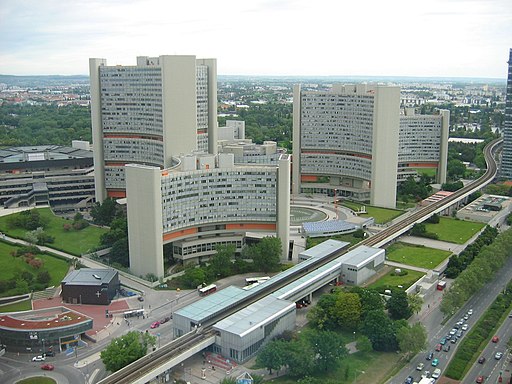
Vienna International Centre
The Vienna International Centre (VIC), often referred to as UNO City, is a significant hub for international diplomacy and cooperation, located in Vienna, Austria. Opened in 1979, this sprawling complex serves as one of the four major offices of the United Nations, alongside New York, Geneva, and Nairobi. Designed by Austrian architect Johann Staber, the VIC’s modernist architecture features a series of interconnected Y-shaped buildings, which collectively create a dynamic and functional environment for the diverse range of international organizations it houses. This unique design not only optimizes space but also fosters a sense of unity and collaboration among the various entities working within its walls.
The VIC is home to numerous UN bodies, including the International Atomic Energy Agency (IAEA), the United Nations Office on Drugs and Crime (UNODC), and the United Nations Industrial Development Organization (UNIDO), among others. This concentration of organizations dedicated to global issues such as nuclear safety, drug control, and industrial development makes the VIC a crucial center for addressing some of the world’s most pressing challenges. The presence of these organizations in Vienna underscores the city’s role as a key player in international diplomacy, facilitating dialogue and cooperation on a global scale.
Beyond its architectural and diplomatic significance, the Vienna International Centre is also a symbol of Vienna’s commitment to internationalism and its role as a bridge between different cultures and regions. The VIC hosts numerous conferences, meetings, and events each year, bringing together diplomats, experts, and policymakers from around the world. This dynamic environment not only promotes the exchange of ideas and best practices but also fosters cultural understanding and cooperation. As such, the Vienna International Centre stands as a beacon of international collaboration, dedicated to the pursuit of peace, security, and development for all.
Using Vienna International Centre
The Vienna International Centre (VIC), a cornerstone of global diplomacy and cooperation, stands as a prominent landmark in Vienna, Austria. Established in 1979, this expansive complex serves as one of the four main offices of the United Nations, alongside New York, Geneva, and Nairobi. Designed by the Austrian architect Johann Staber, the VIC features a distinctive array of interconnected Y-shaped buildings, which not only maximize spatial efficiency but also symbolize the interconnectedness and unity of the international organizations housed within. This innovative architectural design fosters an environment conducive to collaboration and synergy among the various entities working to address global challenges.
Using the Vienna International Centre as a base, numerous United Nations agencies and international organizations tackle some of the most pressing issues facing the world today. Key tenants include the International Atomic Energy Agency (IAEA), the United Nations Office on Drugs and Crime (UNODC), and the United Nations Industrial Development Organization (UNIDO). These organizations, among others, utilize the VIC’s state-of-the-art facilities to conduct research, develop policies, and implement programs aimed at promoting global security, sustainable development, and human rights. The concentration of such influential bodies in one location enhances Vienna’s stature as a vital hub for international diplomacy and problem-solving.
Beyond its functional role, the Vienna International Centre is a symbol of Vienna’s enduring commitment to fostering international dialogue and cooperation. By hosting a multitude of conferences, meetings, and cultural events annually, the VIC facilitates the exchange of ideas and best practices among diplomats, policymakers, and experts from around the globe. This vibrant, multicultural setting not only drives progress on critical global issues but also promotes mutual understanding and cultural exchange. In this way, the Vienna International Centre exemplifies the spirit of internationalism, dedicated to advancing peace, security, and development worldwide.
Parameters Vienna International Centre
The Vienna International Centre (VIC) is a prominent hub for international organizations and diplomacy. Here are some key parameters and features of the VIC:
- Location and Accessibility:
- Situated in the Donaustadt district of Vienna, Austria.
- Easily accessible via public transportation, including the U1 subway line, buses, and trams.
- Proximity to the Danube River and the Donaupark, providing a scenic environment.
- Architectural Design:
- Designed by Austrian architect Johann Staber.
- Consists of a complex of interconnected Y-shaped buildings.
- Features a modernist architectural style, with an emphasis on functionality and spatial efficiency.
- Facilities and Infrastructure:
- Comprises approximately 230,000 square meters of office space.
- Includes conference rooms, meeting halls, and event spaces equipped with advanced audio-visual technology.
- Houses a medical center, banking facilities, postal services, and dining options.
- Offers amenities such as fitness centers, retail shops, and daycare services for staff and visitors.
- Environmental and Sustainability Initiatives:
- Incorporates eco-friendly designs and sustainable practices.
- Utilizes energy-efficient systems for heating, cooling, and lighting.
- Implements waste management and recycling programs.
- Security and Safety:
- Equipped with robust security measures, including controlled access points, surveillance systems, and on-site security personnel.
- Provides emergency response and evacuation plans.
- Key Organizations and Agencies:
- Hosts several United Nations agencies, including:
- International Atomic Energy Agency (IAEA)
- United Nations Office on Drugs and Crime (UNODC)
- United Nations Industrial Development Organization (UNIDO)
- Comprehensive Nuclear-Test-Ban Treaty Organization (CTBTO)
- Accommodates other international organizations and non-governmental entities.
- Hosts several United Nations agencies, including:
- Events and Conferences:
- Regularly hosts international conferences, summits, and meetings.
- Facilitates workshops, training sessions, and cultural events.
- Provides spaces for exhibitions and public engagements.
- Staff and Population:
- Employs thousands of international staff members from various countries.
- Welcomes diplomats, policymakers, researchers, and visitors from around the world.
- Cultural and Recreational Amenities:
- Features art installations and cultural exhibits within the complex.
- Offers recreational areas and green spaces for relaxation and social activities.
- Impact and Significance:
- Serves as a crucial center for international diplomacy and policy-making.
- Contributes to Vienna’s reputation as a global city and a hub for international cooperation.
- Facilitates collaboration and networking among diverse international actors.
These parameters highlight the Vienna International Centre’s multifaceted role as a key site for international diplomacy, organizational headquarters, and a model of modern, sustainable architecture.
