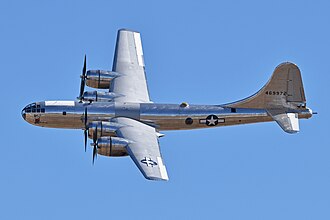
Boeing B-29 Superfortress – The Revolutionary Heavy Bomber That Changed Aviation History
The Boeing B-29 Superfortress stands as one of the most influential aircraft ever created. Developed during the Second World War, it represented a dramatic leap forward in bomber technology and introduced innovations that shaped the future of military aviation. More than simply a larger version of previous bombers, the B-29 was a highly advanced aircraft that combined pressurized crew compartments, remote-controlled defensive systems, advanced radar equipment, improved aerodynamics, and exceptional long-range capability.
When it entered service in 1944, the B-29 was unlike anything that had flown before. It was designed to conduct strategic bombing missions over vast distances, carrying heavy payloads while operating at altitudes beyond the reach of many enemy defenses. Its development required enormous engineering effort and industrial investment, making it one of the most ambitious aviation projects of the twentieth century.
The aircraft became famous for its role in the Pacific War, where it conducted bombing campaigns against Japan and carried out the atomic bomb missions against Hiroshima and Nagasaki in 1945. However, its importance extends far beyond those events. The B-29 influenced post-war bomber design, contributed to the development of modern strategic air forces, and served as the foundation for several later aircraft programs.
Today, the Boeing B-29 Superfortress remains a symbol of technological ambition and wartime innovation. Surviving examples preserved in museums demonstrate the remarkable complexity of the aircraft and allow modern audiences to appreciate the engineering achievements behind one of aviation’s greatest milestones.
This article explores the history, design, technology, operational career, and lasting legacy of the Boeing B-29 Superfortress, explaining why this aircraft remains one of the most important bombers ever produced.
The Development History of the Boeing B-29 Superfortress
The origins of the Boeing B-29 Superfortress can be traced to the late 1930s, when military planners recognized that future conflicts would require aircraft capable of delivering heavy bomb loads over extremely long distances. Traditional bombers of the era had limited range and were vulnerable to increasingly effective air defenses. Advances in engine technology, aerodynamics, and aircraft construction created the possibility of a new generation of strategic bomber.
The United States Army Air Corps began exploring designs for a very long-range bomber capable of operating across the Pacific Ocean. Unlike the European theatre, where bases were relatively close together, the Pacific presented enormous distances between islands and targets. Aircraft needed exceptional range, payload capacity, and reliability to operate effectively in this environment.
Boeing responded with an advanced design that eventually became the XB-29 prototype. The company had already gained experience producing successful bomber aircraft, but the B-29 represented a completely different level of complexity. Engineers were required to solve numerous challenges, including pressurization, engine cooling, structural strength, remote weapon control, and long-distance operation.
The development program became one of the largest military aviation projects of the Second World War. Thousands of engineers, technicians, factory workers, and suppliers contributed to bringing the aircraft into production. The scale of the project reflected the strategic importance placed on achieving air superiority through long-range bombing capability.
The first prototype flew on 21 September 1942, but development problems quickly became apparent. The aircraft’s advanced Wright R-3350 engines suffered from overheating issues, and the complexity of the systems created significant testing challenges. Despite these difficulties, the potential of the design was clear, and the program continued with intense effort.
Production began before all problems were completely solved because military demands during the war were urgent. Boeing, along with manufacturing partners including Bell Aircraft and the Glenn L. Martin Company, produced thousands of B-29s. The aircraft gradually improved through operational experience, engineering modifications, and extensive maintenance procedures.
Design Philosophy – Creating a New Generation of Bomber
Beyond Traditional Heavy Bombers
The Boeing B-29 Superfortress was not simply an enlarged version of earlier heavy bombers such as the B-17 Flying Fortress or B-24 Liberator. Instead, it represented a new design philosophy focused on high-altitude, long-range strategic bombing. Every major element of the aircraft was developed to improve performance, survivability, and operational effectiveness.
The designers aimed to create an aircraft capable of carrying large bomb loads while flying faster and higher than previous bombers. This required careful attention to weight reduction, aerodynamic efficiency, engine power, and crew protection. The result was an aircraft that looked familiar in overall shape but incorporated revolutionary technology.
The B-29 featured a streamlined fuselage, large wings, powerful engines, and advanced internal systems. Its design allowed it to operate at altitudes above many enemy fighters and anti-aircraft weapons, reducing vulnerability during daylight missions. The aircraft’s combination of speed, altitude, and range made it one of the most capable bombers of its era.
Pressurized Crew Compartments
One of the most revolutionary features of the B-29 was its pressurized crew system. Before the Superfortress, bomber crews operating at high altitude faced freezing temperatures, reduced oxygen levels, and extreme physical discomfort. Aircraft typically required heavy protective clothing and oxygen equipment, which limited crew effectiveness.
The B-29 introduced a pressurized environment that allowed crew members to work in a more comfortable and efficient atmosphere. The forward crew compartment and rear crew compartment were connected by a pressurized tunnel running above the bomb bays. This design allowed crew members to move between sections without entering the unpressurized areas of the aircraft.
The pressurization system represented a major technological achievement. Maintaining a sealed aircraft structure while allowing bomb doors, gun positions, and access points required extensive engineering. The lessons learned from the B-29’s pressurization technology influenced later commercial aircraft development, including passenger aircraft that eventually transformed global air travel.
Airframe and Aerodynamic Innovations
The B-29’s airframe incorporated many advanced features designed to improve efficiency and performance. The aircraft used a large all-metal structure with carefully shaped aerodynamic surfaces that reduced drag and improved high-altitude capability. Compared with earlier bombers, the Superfortress was significantly more refined.
The wings were among the aircraft’s most important components. The large wing design provided the lift required to carry heavy fuel loads and substantial bomb payloads. Engineers carefully balanced wing size, structural strength, and aerodynamic efficiency to achieve the desired range and altitude performance.
The aircraft featured a tricycle landing gear arrangement, which was becoming increasingly common among advanced aircraft designs. This improved ground handling and visibility for pilots compared with traditional tailwheel configurations used on many earlier bombers.
Another important feature was the use of advanced flight control systems. The aircraft incorporated powered controls to help pilots manage the large airframe. Without these systems, controlling such a heavy aircraft would have been extremely difficult, especially during takeoff, landing, and high-altitude operations.
The Engines – Powering the Superfortress
Wright R-3350 Duplex-Cyclone Engines
The Boeing B-29 Superfortress was powered by four Wright R-3350 Duplex-Cyclone radial engines. These enormous 18-cylinder engines were among the most powerful aircraft engines of the period and provided the performance necessary for long-range bombing missions.
Each engine produced approximately 2,200 horsepower, giving the B-29 a total power output approaching 9,000 horsepower. This immense power allowed the aircraft to carry heavy payloads while maintaining impressive altitude and speed for its size.
However, the R-3350 engine also created significant engineering challenges. Cooling such powerful engines was difficult, especially during demanding combat operations. Early aircraft experienced overheating problems that contributed to mechanical failures and required extensive improvements.
Over time, engineers developed solutions including improved cooling systems, modified engine components, and better maintenance procedures. Later versions became much more reliable, allowing the B-29 to achieve the operational effectiveness expected from such an advanced aircraft.
Performance and Long-Range Capability
The B-29’s greatest advantage was its ability to fly long distances while carrying significant bomb loads. It could travel thousands of kilometres, making it ideal for operations across the vast Pacific region. This range capability fundamentally changed strategic bombing possibilities.
The aircraft could operate at altitudes of approximately 30,000 feet, significantly higher than many previous bombers. This allowed it to avoid some enemy defenses and provided greater flexibility in mission planning.
Its maximum speed of around 575 km/h made it one of the fastest heavy bombers of the Second World War. Combined with its range, defensive systems, and payload capacity, the B-29 represented a major technological advantage.
Crew Layout and Internal Systems
Operating the Boeing B-29 required a large and highly trained crew. The aircraft typically carried around eleven crew members, including pilots, flight engineers, navigators, bombardiers, radio operators, and gunners. Each person had a specialized role essential to mission success.
The flight deck was designed around the needs of long missions. The pilot and co-pilot worked alongside the flight engineer, who monitored the aircraft’s complex systems, including engines, fuel management, and electrical equipment.
The bomber also included advanced navigation and communication equipment for its era. Long-range missions required accurate route planning, weather information, and coordination between crew members. The complexity of these operations demonstrated how aviation had evolved from simple aircraft into sophisticated flying systems.
Armament Systems and Defensive Technology
The Boeing B-29 Superfortress introduced some of the most advanced defensive weapon systems of the Second World War. Earlier bombers relied heavily on manually operated machine guns positioned throughout the aircraft, requiring individual gunners to physically operate each weapon. The B-29 replaced this approach with an innovative remote-controlled defensive system that represented a major step toward modern aircraft automation.
The standard defensive armament consisted of multiple Browning M2 .50-calibre machine guns mounted in strategically positioned turrets. These weapons were controlled remotely by gunners using sighting stations equipped with optical systems. Instead of sitting directly beside the guns, crew members could operate them from protected positions inside the pressurized sections of the aircraft.
The remote turret system provided several advantages. It reduced aerodynamic drag because external gun positions could be streamlined when not in use, improved crew protection by allowing gunners to remain inside the aircraft, and enabled more precise defensive fire through centralized control. This system required sophisticated electrical and mechanical components that were considered highly advanced for the 1940s.
The aircraft typically carried four remotely operated gun turrets and a tail turret. The tail position was especially important because enemy fighters frequently attacked from behind. The tail gunner had a dedicated position equipped with powerful optical equipment that allowed effective engagement of approaching aircraft.
Later versions of the B-29 received improved defensive systems, including radar-assisted fire control. The introduction of the AN/APG-15 radar system allowed the tail gunner to detect and engage enemy aircraft even in poor visibility conditions. This represented another significant advancement in military aviation technology.
Bomb Load Capability and Strategic Mission Design
The primary purpose of the Boeing B-29 Superfortress was strategic bombing. Its design focused on carrying large quantities of explosives over extremely long distances while maintaining sufficient speed, altitude, and defensive capability. This mission requirement shaped almost every aspect of the aircraft’s engineering.
The B-29 featured two internal bomb bays located in the centre section of the fuselage. This arrangement improved aerodynamic efficiency compared with carrying bombs externally. Internal bomb storage reduced drag and allowed the aircraft to maintain better performance at high altitude.
The aircraft could carry a substantial bomb load depending on mission requirements and distance. For shorter missions, it could carry heavier loads, while longer missions required additional fuel and therefore reduced payload capacity. This flexibility made the B-29 suitable for a wide range of strategic operations.
The bomb bays were equipped with pressurized doors and sophisticated opening mechanisms. Designing reliable bomb doors for a high-altitude pressurized aircraft presented significant engineering challenges. The solution demonstrated Boeing’s ability to integrate complex mechanical systems into a large operational aircraft.
The B-29’s bombing capability transformed strategic warfare. Its ability to reach distant targets from bases located thousands of kilometres away changed military planning and demonstrated the growing importance of air power in modern conflicts.
The Boeing B-29 Superfortress in World War II
Introduction to Combat Operations
The B-29 entered combat service in 1944, initially operating against Japanese targets in the Pacific theatre. Its first major deployments were based in China and later from newly captured Pacific islands, where improved logistics allowed more effective operations.
The aircraft’s first combat mission took place on 5 June 1944, when B-29s attacked targets in Bangkok, Thailand. Although the aircraft performed successfully, early operations revealed several mechanical and logistical challenges. Maintaining such a sophisticated aircraft thousands of kilometres from major industrial centres required enormous organizational effort.
The establishment of bases in the Mariana Islands, including Saipan, Guam, and Tinian, transformed the effectiveness of the B-29 campaign. These locations placed Japan within operational range and allowed large-scale bombing operations against strategic targets.
The Strategic Bombing Campaign Against Japan
The B-29 became the primary aircraft used in the American strategic bombing campaign against Japan during the final year of World War II. Its ability to fly high-altitude missions initially led commanders to focus on precision bombing of industrial facilities.
However, operational experience showed that high-altitude precision bombing was affected by weather conditions, strong winds at altitude, and limited visibility. As a result, tactics changed significantly under General Curtis LeMay, who introduced lower-altitude nighttime incendiary bombing missions.
These raids targeted Japanese cities with large concentrations of wooden structures. The incendiary attacks caused enormous destruction and demonstrated the devastating potential of strategic bombing. The B-29’s long range and large payload capacity made such operations possible.
The aircraft also played a central role in the final stages of the Pacific War through its involvement in atomic bomb missions. On 6 August 1945, the B-29 Enola Gay dropped the atomic bomb on Hiroshima. Three days later, the B-29 Bockscar carried out the mission against Nagasaki.
These missions became among the most historically significant aviation events ever recorded. They marked the beginning of the nuclear age and permanently changed international military strategy.
Post-War Service and Global Operations
After World War II, the Boeing B-29 continued to serve as a major component of the United States Air Force’s strategic bomber fleet. Although newer aircraft were eventually developed, the Superfortress remained an important platform during the early years of the Cold War.
The aircraft was adapted for several specialized roles beyond conventional bombing. These included reconnaissance, weather observation, electronic warfare, and experimental testing. Its large size, range, and payload capacity made it suitable for many missions beyond its original purpose.
During the Korean War, the B-29 returned to combat operations. It was used for strategic bombing missions against North Korean targets. However, advances in fighter technology created new challenges, particularly with the introduction of Soviet-built MiG-15 jet fighters.
The appearance of high-performance jet fighters demonstrated the changing nature of aerial warfare. Although the B-29 remained effective, it became increasingly vulnerable in contested airspace. This accelerated the development of jet-powered replacements such as the Boeing B-47 Stratojet and Boeing B-52 Stratofortress.
Variants and Specialized Versions
Boeing B-29A Superfortress
The B-29A represented an improved production version with several manufacturing and structural refinements. Produced primarily by Boeing’s Renton facility, it incorporated modifications that improved reliability and operational effectiveness.
The B-29A became one of the most numerous versions of the aircraft and benefited from lessons learned during earlier combat operations. Improvements included revised wing structures, better systems integration, and manufacturing changes that simplified production.
Boeing B-29B
The B-29B was designed primarily for missions where improved speed and reduced weight were considered more valuable than maximum defensive capability. Many defensive weapons were removed to reduce weight, allowing improved performance.
This variant demonstrated how flexible the B-29 design was. The same basic airframe could be adapted for different strategic requirements depending on mission priorities.
KB-29 Tanker Conversion
One of the most important post-war modifications was the KB-29 tanker version. These aircraft were converted to provide aerial refuelling capability, helping extend the range of early jet fighters and bombers.
The KB-29 played a significant role in developing aerial refuelling techniques that became essential to modern air operations. The experience gained from these conversions influenced later tanker aircraft designs.
Operational Challenges and Reliability Issues
Despite its impressive capabilities, the Boeing B-29 Superfortress was one of the most complex aircraft of its era, and this complexity created operational challenges. The aircraft introduced many technologies simultaneously, meaning engineers and crews had to solve problems that had never previously been encountered.
The Wright R-3350 engines were the most significant early reliability concern. Their immense power output generated considerable heat, and insufficient cooling during demanding conditions could result in engine failures. These problems caused numerous accidents during the aircraft’s early service period.
Engine improvements gradually solved many of these issues. Better cooling methods, improved materials, and refined maintenance procedures increased reliability. By the later stages of World War II and the post-war period, the B-29 had become a much more dependable aircraft.
Maintenance requirements were extensive. The aircraft required highly trained ground crews, specialized equipment, and carefully organized logistics. However, this was expected for such an advanced strategic bomber.
Influence on Future Aircraft Development
The Boeing B-29 Superfortress influenced aviation far beyond its own service life. Many technologies introduced or refined through the program became standard features of future aircraft design.
Pressurization technology directly influenced the development of commercial airliners. The ability to maintain comfortable cabin environments at high altitude became essential for the growth of passenger aviation after World War II.
The aircraft’s aerodynamic design, systems integration, and long-range capability also influenced future bomber development. Aircraft such as the Boeing B-47 and B-52 incorporated lessons learned from the Superfortress program.
The B-29 demonstrated that strategic aircraft could become complex technological systems rather than simply platforms carrying weapons. This philosophy continues to define modern military aviation.
The Legacy of the Boeing B-29 Superfortress
The Boeing B-29 Superfortress occupies a unique position in aviation history because it represented the transition between traditional piston-engine aircraft and the modern era of strategic aviation. It was one of the last great propeller-driven bombers, yet it introduced technologies that became essential for the aircraft of the future. The combination of range, altitude capability, pressurization, defensive automation, and heavy payload capacity established a new standard for military aircraft design.
The aircraft’s historical significance extends beyond its combat achievements. The B-29 demonstrated how complex engineering projects could combine thousands of individual technologies into a single operational system. Its development required advances in metallurgy, manufacturing, electronics, propulsion, aerodynamics, and logistics. Many of these innovations influenced both military and civilian aviation for decades afterward.
The B-29 also changed the concept of strategic air power. Before its introduction, bombers were limited by range and vulnerability. The Superfortress proved that aircraft could deliver enormous destructive capability across continental distances. This concept became central to Cold War military planning and influenced the development of later strategic bombers.
Although the aircraft is strongly associated with the final months of World War II, its influence continued long after the conflict ended. It served as a technological bridge between wartime aviation and the jet age, helping define the future direction of aerospace development.
The B-29 Superfortress Compared With Contemporary Aircraft
Boeing B-17 Flying Fortress
The B-17 Flying Fortress was one of the most famous bombers of World War II, particularly in the European theatre. Compared with the B-29, however, it represented an earlier generation of aircraft design. The B-17 lacked pressurization, had a shorter range, and operated at lower altitudes.
The B-29 was significantly larger, faster, and more technologically advanced. It could carry heavier bomb loads over much greater distances while providing improved crew comfort and protection. While the B-17 became legendary for durability and defensive strength, the B-29 represented the future of strategic bombing.
Consolidated B-24 Liberator
The B-24 Liberator was another important American heavy bomber of World War II. It offered excellent range and played a major role in many theatres of operation. However, its design philosophy focused more on production efficiency and versatility rather than the advanced high-altitude capability of the B-29.
The Superfortress surpassed the B-24 in almost every performance category, particularly altitude, speed, crew environment, and technological sophistication. The difference reflected the rapid advancement of aviation engineering during the war years.
Tupolev Tu-4
The Soviet Union’s Tupolev Tu-4 deserves special mention because it was directly influenced by the B-29. During World War II, several B-29 aircraft made emergency landings in Soviet territory, and the Soviet Union later developed a reverse-engineered version of the aircraft.
The Tu-4 demonstrated the technological importance of the B-29 design. Even a major aviation power recognized that the Superfortress represented one of the most advanced bomber platforms of its time.
Preservation and Surviving B-29 Aircraft
Today, only a small number of Boeing B-29 Superfortresses remain preserved. These aircraft are maintained by museums and aviation organizations dedicated to protecting important examples of aerospace history. Because of the aircraft’s size, complexity, and specialized systems, restoration and operation require enormous resources.
One of the most famous surviving examples is FIFI, operated by the Commemorative Air Force. It is one of the few B-29 aircraft restored to flying condition and provides enthusiasts with a rare opportunity to experience the sound and presence of this historic bomber.
Museum examples allow visitors to appreciate the scale and complexity of the aircraft. Standing beside a B-29 reveals the enormous size of the wings, the complexity of the engines, and the challenging environment experienced by wartime crews.
Preserving these aircraft is important because they represent more than machines. They reflect the engineering achievements, industrial capability, and human experiences associated with one of the most transformative periods in aviation history.
Restoration Challenges and Maintenance Requirements
Maintaining a Boeing B-29 Superfortress is an extremely demanding task. Unlike smaller aircraft, the B-29 contains thousands of components, many of which are no longer produced. Restoration teams often rely on custom manufacturing, historical research, and specialized expertise to keep surviving examples operational.
The Wright R-3350 engines remain among the most challenging components to maintain. Their complexity requires experienced technicians familiar with large radial engines. Cooling management, lubrication systems, and careful operating procedures are essential for safe operation.
The aircraft’s electrical systems, hydraulic components, pressurization equipment, and defensive systems also require extensive knowledge. Many original parts must be repaired, recreated, or adapted using modern manufacturing techniques while preserving historical accuracy.
Because of these challenges, every surviving B-29 represents a significant achievement in preservation. The dedication required to maintain these aircraft ensures that future generations can continue learning from this remarkable machine.
Why the Boeing B-29 Superfortress Remains Important Today
The Boeing B-29 Superfortress remains important because it represents a turning point in aviation history. It demonstrated that aircraft could become highly integrated technological systems rather than simple combinations of engines, wings, and weapons.
Many features considered normal in modern aircraft began with developments pioneered during the B-29 program. Pressurized cabins, advanced navigation systems, automated defensive equipment, and long-range strategic capability all influenced later aircraft designs.
The B-29 also represents the enormous industrial effort required to produce advanced military technology. Thousands of companies and millions of workers contributed to its creation, making it one of the largest engineering projects of its time.
For aviation enthusiasts, historians, and engineers, the B-29 remains a fascinating example of innovation under pressure. It demonstrates how necessity can accelerate technological progress and produce machines that permanently change history.
Technical Specifications of the Boeing B-29 Superfortress
| Specification | Boeing B-29 Superfortress |
|---|---|
| Manufacturer | Boeing Aircraft Company |
| First Flight | 21 September 1942 |
| Primary Role | Strategic heavy bomber |
| Production Period | 1943–1946 |
| Total Production | Approximately 3,970 aircraft |
| Powerplant | Four Wright R-3350 Duplex-Cyclone radial engines |
| Engine Power | Approximately 2,200 hp per engine |
| Total Power Output | Approximately 8,800–9,000 hp |
| Length | 30.18 metres |
| Wingspan | 43.05 metres |
| Height | 8.46 metres |
| Wing Area | Approximately 161.3 square metres |
| Maximum Speed | Approximately 575 km/h |
| Cruising Speed | Approximately 350 km/h |
| Service Ceiling | Approximately 9,700 metres |
| Range | Approximately 5,200 km depending on mission load |
| Maximum Takeoff Weight | Approximately 54,000 kg |
| Crew | Approximately 11 personnel |
| Bomb Capacity | Up to approximately 9,000 kg depending on mission configuration |
| Defensive Armament | Multiple remotely controlled .50 calibre machine gun turrets and tail turret |
| Special Equipment | Pressurized crew compartments, radar systems, remote fire-control system |
| Major Historical Roles | Pacific strategic bombing, atomic bomb missions, reconnaissance, tanker conversion |
Final Verdict – The Enduring Legacy of the Boeing B-29 Superfortress
The Boeing B-29 Superfortress was far more than a successful wartime bomber. It was a technological milestone that changed the direction of aviation. Its advanced design introduced capabilities that previously seemed impossible and demonstrated what could be achieved through large-scale engineering and industrial cooperation.
From its pressurized crew compartments and remote-controlled defensive weapons to its extraordinary range and payload capacity, the B-29 represented the cutting edge of aircraft technology in the 1940s. Its combat history remains historically significant, but its greatest achievement may be the way it influenced every generation of aircraft that followed.
As a symbol of innovation, ambition, and engineering excellence, the Boeing B-29 Superfortress continues to inspire aviation enthusiasts around the world. The surviving examples serve as reminders of the remarkable achievements of the engineers, pilots, maintenance crews, and workers who created and operated one of history’s most important aircraft.
More than seventy years after its first flight, the B-29 remains a legendary aircraft. It represents a moment when aviation crossed from the traditional age of propeller-driven machines into the modern era of advanced aerospace technology. Few aircraft have had such a profound impact, and fewer still have earned a place as significant in the history of flight.
_(50871638276).jpg)