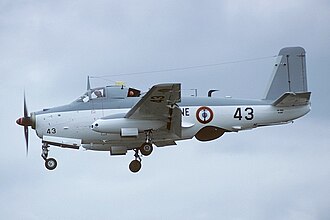
Bréguet 1050 Alizé: France’s Long-Serving Carrier-Based Anti-Submarine Aircraft
The Bréguet 1050 Alizé was one of the most distinctive naval aircraft produced by postwar France. Designed during the 1950s for the French Navy, it was a carrier-based anti-submarine warfare and maritime patrol aircraft that combined a turboprop engine, retractable radar, folding wings, a weapons bay, and sophisticated acoustic-detection equipment in a relatively compact airframe. The aircraft was designed at a time when the submarine threat was changing rapidly and naval aviation was searching for a practical replacement for the wartime Grumman Avenger. Although it was developed from the earlier Bréguet Vultur attack-aircraft family, the Alizé became a highly specialized machine whose primary mission was to detect, track, and attack submarines rather than engage enemy aircraft. Its first flight took place in October 1956, production aircraft began reaching the French Navy in 1959, and the type ultimately remained in French service until September 2000.
The longevity of the Alizé is perhaps its most remarkable characteristic. Many aircraft designed during the early Cold War were retired after a decade or two as jet technology transformed military aviation. The Alizé, by contrast, continued operating for roughly four decades. It survived because its basic airframe was only one part of the system: radar, electronic support equipment, acoustic sensors, communications, navigation equipment, and weapons were repeatedly upgraded. In its later years the aircraft no longer represented the cutting edge of anti-submarine warfare, but it remained useful for maritime surveillance and patrol. Its career demonstrates how a carefully designed specialized aircraft can remain relevant when its mission equipment is continually modernized.
Origins of the Alizé
From the Bréguet Vultur to an Anti-Submarine Aircraft
The story of the Bréguet 1050 begins with another aircraft, the Bréguet 960 Vultur. In the late 1940s, Bréguet designed the Vultur as a carrier-based attack aircraft for the French Navy. The design was unusual because it employed mixed propulsion: an Armstrong Siddeley Mamba turboprop provided economical cruising power, while a Rolls-Royce Nene turbojet supplied additional thrust for high-speed attack. The first Vultur prototype flew in August 1951, but the rapidly changing nature of naval aviation made the concept increasingly difficult to justify. Jet-powered fighters and attack aircraft were developing quickly, while naval doctrine was placing increasing emphasis on detecting and hunting submarines.
Instead of abandoning the Vultur’s strong airframe completely, Bréguet transformed the second prototype into an experimental anti-submarine aircraft. The rear turbojet was removed and the airframe was extensively modified. The resulting aircraft, initially associated with the Bréguet 965 Épaulard, provided the starting point for the Bréguet 1050 Alizé. The transformation illustrates an important aspect of postwar aviation engineering: an airframe originally designed around speed and attack could be redesigned around endurance, sensors, and weapons if the underlying structure was sufficiently adaptable.
The French Navy ultimately gave the new aircraft the name Alizé, meaning “trade wind.” The name was appropriate for an aircraft intended to spend long periods patrolling over the sea. Rather than being a fast interceptor or strike aircraft, the Alizé was designed to remain airborne for extended periods, searching large areas of ocean for submarines and coordinating its sensors with the weapons carried aboard the aircraft.
Design of the Bréguet 1050
A Purpose-Built Naval Monoplane
The Alizé was a relatively large, low-wing, single-engine turboprop aircraft with a conventional tail and retractable tricycle landing gear. It measured approximately 13.86 metres in length, had a 15.60-metre wingspan, and possessed a wing area of roughly 36 square metres. Its empty weight was approximately 5,700 kilograms, while maximum takeoff weight reached about 8,200 kilograms.
Although its basic aerodynamic configuration was conventional, almost every part of the aircraft reflected its carrier-based mission. The wings folded to reduce the aircraft’s footprint on the flight deck, allowing more aircraft to be stored aboard a carrier. A robust landing gear system was designed for repeated carrier operations, while an arresting hook beneath the fuselage enabled the Alizé to recover aboard an aircraft carrier.
The aircraft also incorporated catapult attachment points and other equipment required for naval operations. Its structural design had to cope not only with normal flight loads but also with the severe stresses associated with arrested landings and carrier handling. This distinction is important when comparing the Alizé with land-based maritime patrol aircraft: the naval aircraft had to be a complete carrier system, not simply a patrol aircraft fitted with a naval paint scheme.
Folding Wings and Carrier Operations
The Alizé’s folding wing was essential to its operational identity. The central portion of the wing remained fixed while the outer sections folded upward. This allowed the aircraft to occupy substantially less space when parked aboard a carrier.
Carrier aviation imposes unusual constraints on aircraft design. Every metre of deck space matters, and aircraft must be capable of being moved, parked, launched, recovered, and serviced in a confined environment. The Alizé’s folding wings therefore represented more than convenience: they were fundamental to its ability to operate from the French Navy’s carriers.
Testing confirmed that the aircraft was well suited to carrier operations. Trials were conducted aboard the British carrier HMS Eagle as well as the French carrier Arromanches, and the Alizé demonstrated that it could operate from a carrier deck under demanding conditions. The first arrested landing on the French carrier Foch was subsequently performed in September 1962.
The Rolls-Royce Dart Powerplant
Turboprop Propulsion for Endurance
At the heart of the Alizé was a single Rolls-Royce Dart RDa.7 Mk 21 turboprop engine. Depending on the source and method of measurement, the engine is generally listed at around 1,950–2,100 horsepower. The engine drove a four-bladed propeller and provided the combination of economical cruising and sufficient power needed by an aircraft whose primary advantage was endurance rather than outright speed.
The choice of a turboprop was particularly logical for anti-submarine warfare. Unlike a jet aircraft, a turboprop could remain efficient at the relatively low speeds and altitudes frequently used during maritime patrol. The aircraft could cruise for hours while operating its sensors, rather than consuming enormous quantities of fuel simply to remain airborne.
A typical Alizé mission could last around four hours, with substantial fuel capacity required to support extended patrol operations. Some sources give a maximum endurance approaching seven hours depending on configuration and fuel load. The aircraft’s patrol speed was around 232 km/h, substantially below its maximum speed, because efficient slow cruising was much more useful during a submarine search than flying as quickly as possible from one location to another.
A Deliberately Moderate Top Speed
The Alizé’s maximum speed was approximately 459 km/h at sea level, with some published sources giving slightly higher figures at altitude. Its service ceiling was around 6,250 metres, while its range was approximately 2,500 kilometres in some published specifications.
These numbers reveal the aircraft’s priorities. The Alizé was not designed to outrun fighters or intercept enemy aircraft. Its performance envelope was optimized around the submarine-hunting mission. Long endurance, low-speed handling, sensor operation, and the ability to loiter over a patrol area were far more important than achieving fighter-like acceleration.
This also explains why the Alizé remained useful despite the rapid expansion of jet aviation. The aircraft’s mission demanded qualities that early jets could not easily provide. A fast jet could cover enormous distances rapidly, but it was not necessarily efficient at spending several hours conducting a slow, methodical search over the ocean.
The Alizé’s Sensor Suite
The Retractable Radar
One of the most recognizable features of the Alizé was its retractable ventral radar radome. The radar system was housed in a large structure beneath the fuselage that could be lowered during patrol operations and retracted when the aircraft needed to take off or land.
The original production aircraft used a Thomson-CSF DRAA-2B radar, while later modernization introduced the considerably improved DRAA-10A Iguane system. The radar gave the aircraft an important ability to search the surface of the sea, locate vessels, support navigation, and contribute to the detection and tracking of maritime contacts.
The retractable arrangement was a clever solution to the competing requirements of aerodynamics and sensor coverage. A large radar antenna was extremely useful during patrol operations but would have been an awkward obstruction during carrier launch and recovery. By retracting the radome into the fuselage, Bréguet could give the aircraft a substantial radar installation without permanently compromising its carrier handling.
Acoustic Detection and Sonobuoys
Radar alone could not reliably locate a submerged submarine. The Alizé therefore carried a sophisticated acoustic system based on sonobuoys. These expendable sensors could be dropped into the sea to listen for underwater contacts and transmit information back to the aircraft.
The aircraft could carry numerous acoustic buoys, with published specifications listing up to 14 sonobuoys in appropriate configurations. Buoys could be deployed in patterns designed to search a particular area, allowing the crew to investigate suspected submarine activity systematically.
This made the Alizé a genuine sensor platform rather than simply a bomber with a radar. The crew had to interpret information from multiple systems, determine whether a contact was genuine, establish its location and movement, and then decide how best to prosecute the target.
The work demanded considerable coordination. The pilot had to fly a precise search pattern while the other crew members operated the radar, acoustic equipment, navigation systems, and communications. The Alizé was therefore a highly specialized airborne command-and-sensor environment.
Crew and Mission Organization
Three Specialists in the Aircraft
The Alizé is generally described as having a three-person crew: a pilot, a navigator, and an operator responsible for radar and other detection systems. Some historical descriptions of early production arrangements give a larger crew under particular configurations, but the standard later description is three crew members.
The pilot sat forward and controlled the aircraft, while the other crew members concentrated on the demanding information-processing requirements of maritime patrol. The separation of responsibilities was essential because submarine hunting could involve long periods of monotonous surveillance punctuated by sudden bursts of activity.
Unlike a fighter pilot who might have to make a decision within seconds, an Alizé crew often had to assemble information from several sensors over many minutes. A radar contact might turn out to be a merchant ship, while an acoustic signal could be a false contact or a biological source rather than a submarine. The crew’s task was therefore as much analytical as it was mechanical.
Weapons and Anti-Submarine Warfare
Torpedoes and Depth Charges
The Alizé’s internal weapons bay could accommodate an anti-submarine torpedo or depth charges. Among the weapons associated with the aircraft were the L4 torpedo, later Mk 44 and Mk 46 torpedoes, and anti-submarine depth charges.
The internal bay was particularly useful because it allowed the aircraft to maintain a clean aerodynamic configuration during patrol. Once a submarine had been detected and tracked, the aircraft could approach the target and release the appropriate weapon.
The aircraft’s weapons were therefore the final stage of a much larger process. Radar and visual search could identify surface activity, sonobuoys could detect underwater sounds, navigation equipment could establish the aircraft’s position, and the crew could combine this information to build a tactical picture before launching the attack.
Rockets and AS.12 Missiles
Although anti-submarine warfare was the Alizé’s principal role, its external pylons gave it additional flexibility. The aircraft could carry 68 mm rockets, bombs, depth charges, and AS.12 wire-guided air-to-surface missiles.
The AS.12 gave the Alizé a limited anti-surface capability, allowing it to engage suitable maritime targets from outside the immediate range of some shipboard defenses. This was especially useful for a patrol aircraft that might encounter hostile surface vessels while conducting maritime surveillance.
The combination of internal and external stores made the aircraft adaptable. It could be configured for different missions depending on the tactical circumstances, although the fundamental design remained centered on maritime patrol and anti-submarine warfare.
Entering French Naval Service
Production and Early Operations
The French Navy initially planned to acquire around 100 Alizés, but the order was eventually reduced to approximately 75 production aircraft. The first production aircraft flew in March 1959, and deliveries to the French naval aviation service followed soon afterward.
Production figures vary between sources because some accounts include prototypes and pre-production aircraft while others count only production machines. A commonly cited figure is 89 aircraft, while other historical accounts distinguish between 75 French production aircraft and additional prototypes or export machines.
The Alizé equipped French naval aviation units operating from carriers including Arromanches, Clemenceau, and Foch. It also operated from shore bases for training and maritime surveillance. Its ability to transition between carrier and land-based operations was important because not every training or patrol mission required a carrier deployment.
The aircraft became closely associated with French carrier aviation during the 1960s and 1970s. It accompanied carrier groups on major deployments, including cruises associated with French nuclear testing activities in the Pacific. Its role was to provide a persistent maritime surveillance and anti-submarine capability around the fleet.
The Indian Navy’s Alizé
Service in India
France was not the only operator of the Bréguet 1050. India acquired Alizés for its naval aviation arm, with the aircraft entering Indian service in 1961. The type was operated by INAS 310 “Cobras”, one of the Indian Navy’s best-known aviation units.
The Indian aircraft performed maritime patrol and reconnaissance missions and operated both from shore bases and from the light aircraft carrier INS Vikrant. The Alizé therefore became part of India’s early development of carrier-based maritime aviation.
During the 1961 annexation of Goa, Indian Alizés were employed for maritime patrol and photographic reconnaissance. The aircraft’s long endurance and surveillance equipment made it well suited to monitoring coastal and maritime activity.
India ultimately retired the type in 1991, replacing its anti-submarine duties with helicopters. This gave the Alizé a remarkably long international career as well as its lengthy French service history.
Modernization of the Alizé
The Alizé M Upgrade
The French Navy understood that the Alizé could remain useful only if its electronics kept pace with technological developments. During the early 1980s, a number of aircraft were upgraded to the Br.1050M standard. The modernization included the improved Thomson-CSF Iguane radar, new navigation equipment, and an upgraded electronic support system.
The Iguane radar was particularly important because it extended the useful life of the aircraft’s surveillance capability. By replacing the original detection system with a more modern radar, France could continue using the existing airframes without designing and purchasing an entirely new patrol aircraft.
This was a sensible approach to a specialized platform. The expensive part of an anti-submarine aircraft is not necessarily the airframe alone; it is the integrated system of sensors, communications, weapons, and trained crews. Keeping the airframe in service while replacing obsolete electronics could therefore be economically attractive.
Alizé ALM and ALH
Further modernization continued into the 1990s. Upgraded aircraft received new data-processing equipment, datalinks, decoy systems, and other avionics. Later aircraft were also fitted with the Thomson-CSF TTD Optronique Chlio forward-looking infrared sensor, giving them an additional means of detecting and identifying surface contacts.
These modifications reveal just how long the Alizé remained in active service. An aircraft designed in the 1950s was receiving computer-based systems and modern electro-optical sensors decades later.
By this stage, however, the aircraft’s anti-submarine capabilities were no longer sufficient to track the newest nuclear submarines effectively. Its mission therefore shifted increasingly toward surface surveillance and maritime patrol. Rather than being discarded immediately, the aircraft was assigned missions that better matched its remaining strengths.
The Alizé During the 1990s
From Submarine Hunter to Maritime Patrol Aircraft
By the late 1990s, the Alizé was unmistakably a veteran. Modern helicopters and dedicated maritime patrol aircraft had overtaken it in many aspects of anti-submarine warfare, but the aircraft remained useful for surface surveillance.
The ability to fly for several hours, operate radar and electronic sensors, and deploy from an aircraft carrier made the Alizé valuable for monitoring maritime activity. Its role had changed, but the aircraft still provided a capability that was difficult to replace without acquiring a completely new carrier-based platform.
The aircraft’s longevity was also a testament to the strength of its original design. The Alizé had been built for the demanding environment of carrier aviation, where corrosion, repeated arrested landings, vibration, and intensive maintenance could quickly shorten an airframe’s life. Its continued operation demonstrated considerable structural durability.
Operations Over Kosovo
One of the final operational chapters of the Alizé’s French career came during the 1999 NATO air campaign over Yugoslavia and Kosovo. French Alizés operated from the aircraft carrier Foch, conducting maritime surveillance missions during the deployment.
The aircraft was by then nearly half a century removed from its original design era. Nevertheless, it could still contribute to a modern naval task force because its mission was surveillance rather than high-speed air combat.
This final operational period perfectly illustrates the Alizé’s evolution. The aircraft that began life as a Cold War anti-submarine hunter had become a veteran maritime surveillance platform operating alongside much more modern aircraft.
Retirement in 2000
The End of an Extraordinary Career
The Alizé’s French career ended in 2000, coinciding with the retirement of the Foch. The last aircraft were finally withdrawn after approximately four decades of service.
The retirement was more than the end of an aircraft type. It marked the disappearance of a particular generation of carrier-based anti-submarine aircraft. The mission had increasingly shifted toward helicopters, sophisticated maritime patrol aircraft, satellite-supported surveillance, and networked sensor systems.
The Alizé had nevertheless accomplished something remarkable. Few military aircraft have remained relevant for such a long period while retaining the same fundamental airframe configuration. Its survival was possible because its operators continually changed the equipment around the aircraft rather than expecting the original 1950s technology to remain adequate.
Why the Bréguet 1050 Alizé Matters
The Alizé is significant because it demonstrates the importance of specialization and adaptability in military aviation. It was never intended to be an all-purpose combat aircraft. Instead, every aspect of its design was shaped by the requirements of submarine hunting from aircraft carriers.
Its retractable radar, acoustic buoy system, internal weapons bay, folding wings, arresting hook, turboprop engine, and spacious crew arrangement all served that single broad mission. The aircraft was effectively an airborne anti-submarine workstation.
Its career also illustrates how aircraft can outlive their original technology. The Alizé’s first-generation radar and electronics eventually became obsolete, but new sensors and processors repeatedly extended the aircraft’s usefulness. The airframe itself became a stable platform onto which increasingly modern equipment could be installed.
That philosophy remains relevant today. Modern military aircraft are increasingly designed around open systems, modular sensors, software, and network connectivity. The Alizé was not a modern digital aircraft, but its long service life demonstrated an early version of the same principle: a durable platform can remain useful when its mission systems evolve.
Technical Specifications of the Bréguet 1050 Alizé
Published specifications differ slightly depending on the aircraft standard and the method used to measure engine power and range. The following table summarizes commonly cited figures for the Bréguet 1050 Alizé.
| Specification | Bréguet 1050 Alizé |
|---|---|
| Country of origin | France |
| Manufacturer | Bréguet Aviation |
| Type | Carrier-based anti-submarine warfare / maritime patrol aircraft |
| First flight | 5–6 October 1956 |
| Entered service | 1959–1961 |
| French retirement | September 2000 |
| Crew | 3 |
| Engine | Rolls-Royce Dart RDa.7 Mk 21 turboprop |
| Number of engines | 1 |
| Engine power | Approximately 1,950–2,100 hp |
| Propeller | Four-bladed |
| Length | 13.86 m |
| Wingspan | 15.60 m |
| Height | 5.00 m |
| Wing area | 36.0 m² |
| Empty weight | 5,700 kg |
| Maximum takeoff weight | Approximately 8,200–8,250 kg |
| Maximum speed | Approximately 459 km/h |
| Patrol speed | Approximately 232 km/h |
| Service ceiling | Approximately 6,250 m |
| Rate of climb | Approximately 421 m/min |
| Maximum range | Approximately 2,500 km |
| Typical endurance | Approximately 4 hours on patrol |
| Extended endurance | Up to roughly 7 hours depending on configuration |
| Radar | Thomson-CSF DRAA-2B; later DRAA-10A Iguane |
| Electronic support | ARAR-series systems |
| Acoustic equipment | Sonobuoy receivers and processing systems |
| Sonobuoy capacity | Up to approximately 14 |
| Internal weapons | Anti-submarine torpedo or depth charges |
| External weapons | Bombs, depth charges, rockets, AS.12 missiles |
| Typical torpedoes | L4, Mk 44, later Mk 46 |
| Primary operator | French Navy / Aéronavale |
| Foreign operator | Indian Navy |
| Production | Approximately 89–95 depending on counting method |
Conclusion
The Bréguet 1050 Alizé was not one of the fastest or most glamorous aircraft of the Cold War, but it was one of the most enduring. Born from the abandoned Bréguet Vultur attack-aircraft programme, it was transformed into a specialized anti-submarine platform at exactly the moment when navies were confronting a new underwater threat. Its turboprop engine gave it the endurance necessary for long maritime patrols, while its retractable radar, sonobuoys, internal weapons bay, and specialized crew arrangement made it a genuine submarine-hunting system rather than simply a conventional aircraft adapted for naval use.
Its carrier capability was equally important. Folding wings, robust landing gear, an arresting hook, and carefully engineered naval structure allowed the Alizé to operate from French aircraft carriers including Arromanches, Clemenceau, and Foch. The aircraft was tested aboard both French and British carriers during its development, demonstrating that its design could meet the demanding requirements of carrier aviation.
The Alizé’s most impressive achievement, however, was its longevity. Entering service around the beginning of the 1960s and remaining operational in France until 2000, it survived several generations of technological change. Its original radar and electronics were replaced, new navigation and electronic-warfare systems were installed, datalinks were introduced, and electro-optical equipment was added. Eventually the aircraft moved away from sophisticated submarine hunting toward maritime surface surveillance, but it continued contributing to French naval operations.
India also demonstrated the usefulness of the design, operating Alizés from shore bases and the aircraft carrier INS Vikrant. The aircraft performed maritime patrol and reconnaissance missions and participated in significant Indian naval operations before being retired in 1991.
In the end, the Bréguet 1050 Alizé represents an important chapter in the history of naval aviation. It was an aircraft built around a very specific problem: finding submarines at sea and attacking them before they could threaten a fleet. Its designers responded with an ingenious combination of endurance, sensors, weapons, and carrier compatibility. Its operators then demonstrated that the airframe was sufficiently robust to survive for decades.
The Alizé may have looked old-fashioned beside the jets and helicopters that eventually replaced it, but its long career tells a different story. It was a carefully balanced machine whose usefulness came not from spectacular speed, but from persistence, specialization, adaptability, and reliability. Few aircraft better demonstrate how a well-designed naval platform can remain valuable long after the technological world in which it was created has disappeared.
