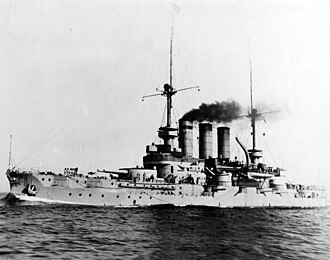
SMS Preussen (1903): The Prussian Battleship That Bridged Two Naval Eras
SMS Preussen was one of the last major pre-dreadnought battleships constructed for Imperial Germany and one of the most representative warships of the Kaiserliche Marine’s rapid expansion in the years before the First World War. Launched in 1903 and commissioned in 1905, she belonged to the Braunschweig class, a group of five battleships that incorporated important improvements in German naval artillery and protection. Her four 28 cm main guns and fourteen 17 cm secondary guns made her a formidable capital ship by the standards of her day, while her 18-knot speed and heavy Krupp armor reflected the continuing evolution of battleship design.
Yet Preussen entered service at an awkward moment in naval history. She was completed only months before HMS Dreadnought began construction, and the British battleship’s appearance in 1906 effectively divided battleship history into two eras. Ships such as Preussen, which had been designed as modern capital ships, were suddenly classified as pre-dreadnoughts and relegated to secondary duties. Nevertheless, she enjoyed a surprisingly long career. She served as a flagship of the German battle fleet, participated in peacetime training and foreign cruises, undertook guard duties during the First World War, supported a fleet operation associated with the 1914 British coastal raids, and later became a depot ship for minesweepers. Even after her naval career officially ended, part of her hull survived for decades as an experimental target.
The Origins of SMS Preussen
Germany’s Naval Expansion
The story of Preussen begins with the transformation of Germany into a major naval power. After the unification of Germany in 1871, the new empire initially possessed a relatively modest navy compared with Britain and France. That changed dramatically under the leadership of Alfred von Tirpitz, who became State Secretary of the Imperial Naval Office and developed a long-term program for constructing a powerful battle fleet.
The Second Naval Law of 1900 provided funding for another generation of German battleships. The Braunschweig class was among the first major results of this program, following the earlier Wittelsbach class. The new ships were intended to be more powerful than their predecessors, particularly in artillery. Their main battery increased from 24 cm to 28 cm guns, while their secondary battery introduced 17 cm weapons. This represented a substantial increase in firepower and reflected German concerns about the growing effectiveness of torpedo boats and other smaller warships.
Preussen was the fourth of the five Braunschweig-class battleships. She was constructed by AG Vulcan at Stettin, with her keel laid in April 1902. The ship was launched on 30 October 1903 and commissioned on 12 July 1905. Her construction cost approximately 23.99 million marks, demonstrating the enormous financial investment involved in building a modern capital ship at the beginning of the twentieth century.
The name Preussen, the German spelling of “Prussia,” was especially significant. Prussia was the dominant state within the German Empire and had played the central role in German unification. Naming a battleship after Prussia therefore gave the vessel a strong connection with the political and military traditions that had shaped Imperial Germany.
Design and Construction
Preussen was approximately 127.7 meters long, 22.2 meters wide, and had a designed draft of about 8.1 meters. Her designed displacement was approximately 13,208 metric tons, increasing to roughly 14,394 tons at full load. Her machinery consisted of three vertical three-cylinder triple-expansion engines driving three propeller shafts. Steam was generated by fourteen boilers, eight of them water-tube boilers and six cylindrical boilers. The machinery produced approximately 16,980 horsepower and gave the battleship a top speed of around 18.5 knots. At 10 knots, she could travel approximately 5,200 nautical miles.
These characteristics made Preussen a powerful and capable ship when she was designed. Her speed was respectable for a battleship, her range allowed substantial operations without constant coaling, and her combination of heavy and medium artillery was typical of contemporary naval thinking. The class was regarded as maneuverable and seaworthy, although the ships tended to roll in heavy seas.
The vessel was protected by Krupp armor, with the main belt reaching approximately 225 mm at its thickest point. The armored deck was around 40 mm thick, while the main turrets and command structures received very substantial protection. Some technical references give turret armor of up to 250 mm, while German naval data lists maximum main-gun armor at 300 mm, reflecting differences in how individual protected components are measured.
Main Armament
The most important improvement over the preceding German battleships was the main battery. Preussen carried four 28 cm SK L/40 guns in two twin turrets, with one turret forward and the other aft. The 28 cm weapon was a significant step forward from the 24 cm guns of the Wittelsbach class.
The secondary battery was equally characteristic of the Braunschweig design. Fourteen 17 cm SK L/40 guns were distributed around the ship, providing a powerful intermediate-caliber battery. Eighteen 8.8 cm quick-firing guns supplemented the main and secondary artillery, while six 45 cm torpedo tubes gave the battleship an additional close-range weapon. Four machine guns were also carried according to later technical listings.
The logic behind this armament was straightforward. Battleship engagements were expected to involve multiple ranges and targets. The 28 cm guns were intended for enemy capital ships, the 17 cm guns could attack cruisers and other medium-sized vessels, and the 8.8 cm weapons were primarily useful against torpedo boats and similar light craft.
This approach was perfectly reasonable in 1905. Within a few years, however, it would be overtaken by an entirely different philosophy.
The Dreadnought Revolution
A Modern Battleship Becomes Obsolete
The defining event of Preussen’s early career was the arrival of HMS Dreadnought. Launched in 1906 and commissioned in December of that year, the British ship carried ten 12-inch guns and used turbine propulsion. Her most important innovation was the concentration of firepower into a large battery of heavy guns rather than the mixed battery characteristic of ships such as Preussen.
The consequences were enormous. A modern battleship was no longer simply a vessel with heavy armor, a few large guns, and numerous medium weapons. The new standard emphasized multiple heavy guns capable of engaging at long range, combined with enough speed to control the range of an engagement.
Preussen was therefore caught on the wrong side of a technological divide. When she entered service in July 1905, she was a modern German capital ship. By the end of 1906, she belonged to the pre-dreadnought generation.
This did not make her worthless. Her armor remained substantial, her 28 cm guns were still powerful, and her 18.5-knot speed was adequate for many secondary missions. But she could no longer compete on equal terms with the new generation of dreadnoughts.
The German response was rapid. The Imperial Navy began constructing its own dreadnought battleships, starting with the Nassau class. These ships represented a new stage in the German naval program, while Preussen and her Braunschweig-class sisters increasingly became second-line assets.
Peacetime Service With the High Seas Fleet
Flagship of the II Battle Squadron
One of the most important aspects of Preussen’s peacetime career was her role as flagship of the II Battle Squadron of the High Seas Fleet. This gave her considerably greater significance than her later reputation might suggest. She was not simply an ordinary battleship assigned to routine patrols; she served as a command platform for a major component of Germany’s battle fleet.
Her peacetime career revolved around exercises, tactical training, fleet maneuvers, and cruises to foreign ports. These activities were essential to the German Navy because the fleet needed to operate as a coherent force under wartime conditions. Officers and sailors had to practice formation maneuvers, gunnery, signaling, navigation, damage control, and coordination between individual ships.
The Braunschweig-class battleships were also useful as instruments of naval diplomacy. Foreign cruises allowed Germany to demonstrate its expanding maritime capabilities while giving crews valuable experience operating far from their home ports. Although these missions rarely produced dramatic historical events, they formed a substantial portion of the everyday life of a prewar battleship.
The class had a reputation for being maneuverable and good seagoing ships, although they could roll considerably in heavy seas. Their design represented a balance between protection, firepower, speed, and range that reflected German naval thinking immediately before the dreadnought era.
SMS Preussen During the First World War
The Role of an Obsolete Battleship
When the First World War began in 1914, Preussen was already obsolete as a first-line capital ship. Nevertheless, Germany had only a limited number of modern dreadnoughts, and older battleships could still perform valuable supporting duties.
Preussen remained associated with the II Battle Squadron and served primarily in defensive and guard roles. She was employed in the German Bight and later in the Danish Straits, areas where an older battleship could still provide significant artillery power without being exposed constantly to the most modern enemy capital ships.
Her service demonstrates an important reality of naval warfare. Obsolescence is relative. A pre-dreadnought was dangerously outmatched by a modern dreadnought, but it could still be a formidable opponent against cruisers, older battleships, coastal targets, or smaller warships. The German Navy therefore had every reason to continue using vessels such as Preussen where the strategic circumstances permitted.
The December 1914 Fleet Sortie
One of the most interesting episodes in Preussen’s wartime history came in December 1914, when she participated in a German fleet sortie connected with the raids on the British coastal towns of Scarborough, Hartlepool, and Whitby.
The German operation was intended to draw out elements of the British Grand Fleet and attack them under favorable circumstances. The German battlecruisers conducted the bombardment while the High Seas Fleet provided distant support. During the operation, German and British naval forces briefly came into contact.
Preussen therefore came closer to a major fleet engagement than many accounts of her career might suggest. However, the encounter did not develop into a full-scale battle between the main German and British battle fleets. The German force eventually withdrew, and the British Grand Fleet was unable to force a decisive engagement.
The episode nevertheless demonstrated why the German Navy retained older battleships. Even though Preussen could not compete with the newest British dreadnoughts, she could contribute to the mass of German naval forces assembled for a major operation.
Why SMS Preussen Missed the Battle of Jutland
The most famous surface engagement of the First World War, the Battle of Jutland in May–June 1916, was fought between the German High Seas Fleet and Britain’s Grand Fleet. Yet Preussen was not present.
This was largely the result of her temporary assignment to guard-ship duties in the Baltic and Danish Straits. She was away from the main fleet at precisely the time when the High Seas Fleet concentrated for its most important battle of the war.
Her absence is historically significant because the Battle of Jutland is often treated as the defining action of the German surface fleet. Had Preussen been present, she would have been among the older and more vulnerable German capital ships. Her absence therefore spared her from the extraordinary stresses experienced by the ships that fought the battle.
After Jutland, Preussen did not return to a major combat role. Her age and limited capabilities made continued front-line employment increasingly difficult to justify.
From Battleship to U-Boat Tender
The End of Her Combat Career
In 1917, Preussen was removed from her guard-ship duties and converted into a tender for U-boats at Wilhelmshaven. This marked a fundamental change in her purpose. The battleship had been designed to fight enemy capital ships; she was now supporting Germany’s submarine arm.
The conversion reflected the changing nature of German naval warfare. By 1917, submarines had become one of Germany’s most important weapons. The U-boat campaign against Allied shipping had become central to German strategy, while the surface fleet remained largely constrained by the British blockade and the risk of a major fleet confrontation.
An old battleship could still be useful as a large floating support facility. Her extensive internal spaces, machinery, workshops, stores, and accommodation made her suitable for supporting smaller vessels. Thus, Preussen entered the final stage of her Imperial German naval career in a role very different from the one for which she had originally been built.
Life in the Reichsmarine
Surviving the Treaty of Versailles
Germany’s defeat in 1918 did not immediately end Preussen’s career. Under the Treaty of Versailles, the newly established German Reichsmarine was permitted to retain a limited number of older battleships. Preussen was among those selected for continued service.
This was a remarkable development. The ship had been built as an expression of Imperial Germany’s naval ambitions, but she was now part of a drastically reduced navy operating under international restrictions.
In 1919, Preussen was converted into a depot or parent ship for F-type minesweepers. The need for such vessels was substantial because the North Sea and Baltic contained extensive minefields laid during the war. Minesweeping was dangerous work, and the surviving German Navy required support ships capable of providing accommodation, maintenance, supplies, and command facilities.
Her conversion involved removing her original armament and installing facilities to support the smaller minesweepers. In practice, however, the ship proved too top-heavy to serve effectively as a minesweeper mother ship. She was soon replaced in this function by the older light cruiser Gazelle.
Retirement and Scrapping
After her unsuccessful period as a minesweeper depot ship, Preussen was placed in reserve. She remained there until 5 April 1929, when she was finally struck from the naval register. On 25 February 1931, she was sold to ship breakers for 216,800 Reichsmarks and subsequently dismantled.
The disposal of Preussen was part of the gradual disappearance of the pre-dreadnought generation. By the early 1930s, these ships had no meaningful future as combatants. The Reichsmarine was developing newer vessels within the limitations imposed by the Versailles system, and the old battleships had become increasingly difficult to justify.
The Strange Survival of Part of the Hull
Although most of Preussen disappeared in the early 1930s, the story did not quite end there. A roughly 63–65 meter section of her hull was retained for experimental use as a target. This surviving section was employed for torpedo and mine experiments, giving part of the old battleship a final military purpose.
The target survived into the Second World War. In April 1945, during the final stages of the conflict, Allied bombers attacked and sank the remaining hull section. It was eventually raised and broken up in 1954.
This unusual afterlife meant that Preussen physically survived for considerably longer than her official naval career. The ship that had once served as a flagship of the Imperial German battle fleet ultimately became a test object and target, decades after her original design had become obsolete.
The Historical Significance of SMS Preussen
A Product of the Tirpitz Era
Preussen is an excellent example of the ambitions behind Germany’s naval expansion before the First World War. Her construction was part of a deliberate effort to create a powerful battle fleet capable of challenging established maritime powers. Her name itself invoked Prussia, the state most closely associated with German military power and unification.
Her service as a squadron flagship further emphasized her importance. She was not simply an experimental or marginal vessel; she was a serious capital ship in the years immediately before the dreadnought revolution.
A Victim of Technological Progress
At the same time, Preussen demonstrates the extraordinary speed of technological change. Her four 28 cm guns were a major improvement over the 24 cm weapons of the preceding generation, yet they were quickly overshadowed by the much heavier batteries carried by dreadnoughts.
Her story is therefore not one of a badly designed ship. On the contrary, she was a logical and capable product of the technology available when she was designed. Her problem was that the definition of a battleship changed almost immediately afterward.
An Example of Naval Adaptation
Perhaps the most interesting aspect of Preussen’s career is her ability to find new uses after her combat value declined. She became a guard ship, supported fleet operations, served as a U-boat tender, and later became a minesweeper depot ship. Even after being scrapped, part of her hull was retained as a target.
Each transformation reflected a different stage in German naval history. The battleship was an instrument of Imperial naval power; the guard ship belonged to wartime defensive strategy; the U-boat tender reflected the growing importance of submarine warfare; and the minesweeper depot ship reflected Germany’s postwar obligations and restrictions.
Technical Specifications of SMS Preussen
| Specification | Details |
|---|---|
| Ship name | SMS Preussen |
| Type | Pre-dreadnought battleship; later auxiliary/depot ship |
| Class | Braunschweig class |
| Builder | AG Vulcan, Stettin |
| Keel laid | April 1902 |
| Launched | 30 October 1903 |
| Commissioned | 12 July 1905 |
| Struck from naval register | 5 April 1929 |
| Sold for scrap | 25 February 1931 |
| Length overall | 127.7 m |
| Length at waterline | Approximately 126.0 m |
| Beam | 22.2 m |
| Draft | Approximately 8.1–8.16 m |
| Designed displacement | 13,208 metric tons |
| Full-load displacement | Approximately 14,394 metric tons |
| Propulsion | 3 × three-cylinder vertical triple-expansion engines |
| Boilers | 8 × water-tube + 6 × cylindrical boilers |
| Propeller shafts | 3 |
| Power | Approximately 16,980 PS |
| Maximum speed | Approximately 18.5 knots |
| Range | Approximately 5,200 nautical miles at 10 knots |
| Main armament | 4 × 28 cm SK L/40 guns |
| Secondary armament | 14 × 17 cm SK L/40 guns |
| Light armament | 18 × 8.8 cm SK L/35 guns |
| Machine guns | 4 |
| Torpedo armament | 6 × 45 cm torpedo tubes |
| Maximum belt armor | Approximately 225 mm |
| Main gun armor | Up to approximately 250–300 mm, depending on component |
| Deck armor | Approximately 40 mm |
| Original crew | 35 officers and approximately 708 enlisted personnel |
| Primary prewar role | Battleship and II Battle Squadron flagship |
| World War I roles | Guard ship, fleet support, later U-boat tender |
| Postwar role | F-type minesweeper depot ship |
| Final fate | Scrapped in 1931 |
| Surviving hull section | Retained as an experimental target until sunk in 1945 and scrapped in 1954 |
Technical sources differ slightly in measurements and armor figures. German naval references list a maximum displacement of 14,394 tons, 16,980 PS, 18.5 knots, and a maximum belt thickness of 225 mm, while other references use somewhat different wartime displacement figures. The table therefore combines the most commonly cited values for the ship in her original battleship configuration.
Conclusion
SMS Preussen was a battleship caught between two worlds. She was conceived during the great expansion of Imperial Germany’s navy and entered service as one of the most advanced pre-dreadnoughts in the Kaiserliche Marine. Her four 28 cm guns, powerful 17 cm secondary battery, substantial armor, and 18.5-knot speed made her an imposing capital ship in 1905.
Yet history moved faster than her designers could have anticipated. The appearance of HMS Dreadnought only a year later transformed the battleship into an entirely different type of weapon. Preussen remained useful, but her role steadily shifted away from front-line combat. She served as a flagship, guard ship, fleet-support vessel, and U-boat tender before being converted into a depot ship for minesweepers after the First World War.
Her story did not even end with the scrapping of the ship in 1931. A large section of her hull survived as a target for naval experiments and remained in use until the final months of the Second World War. Bombed and sunk in 1945, the surviving section was eventually scrapped in 1954.
The career of Preussen therefore provides a compact history of German naval development during one of the most turbulent periods in maritime history. She began as a symbol of Prussian and Imperial German power, became obsolete through the dreadnought revolution, survived two radically different political systems, and ultimately became an experimental object. Her history is a reminder that the value of a warship is determined not only by its guns and armor, but also by its ability to adapt when technology, strategy, and politics change around it.
