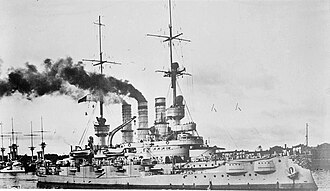
SMS Hannover: The Long Career of a German Pre-Dreadnought Battleship
SMS Hannover was one of the last pre-dreadnought battleships constructed for the Imperial German Navy and the second ship of the Deutschland class. Launched in September 1905 and commissioned in October 1907, she represented the culmination of a battleship design philosophy that was already being overtaken by rapid developments in naval artillery, propulsion, armor, and fire control. Her four 28 cm guns, fourteen 17 cm secondary guns, heavy Krupp armor, and three-shaft steam machinery made her a formidable capital ship when construction began, but the appearance of HMS Dreadnought in 1906 transformed the international battleship race almost overnight.
Despite her technological obsolescence, Hannover enjoyed a remarkably long career. She served in the High Seas Fleet before the First World War, took part in major wartime fleet operations including the Battle of Jutland, and subsequently performed coastal-defense and guard duties. Unlike many German capital ships, she survived the war and was permitted to remain in the reduced Reichsmarine established under the Treaty of Versailles. She returned to active fleet service during the 1920s, participated in peacetime cruises, and eventually became an experimental vessel before being dismantled at Bremerhaven between 1944 and 1946.
Her story is therefore particularly interesting because it spans three distinct phases of German naval history: the ambitious expansion of the Kaiserliche Marine, the desperate wartime employment of aging capital ships, and the restricted naval existence of the Weimar-era Reichsmarine. Hannover was built as a battleship intended to fight alongside Germany’s battle fleet, but she ultimately became a survivor of a vanished naval age.
The Origins of SMS Hannover
The Deutschland-Class Battleships
The Deutschland class was developed as the successor to the Braunschweig class, and the two classes shared many characteristics. Both were armed with four 28 cm guns in twin turrets, supplemented by fourteen medium-caliber guns and numerous smaller quick-firing weapons. The Deutschland class, however, incorporated improvements in armor and other aspects of the design, although this additional protection came at the cost of some of the maneuverability that had characterized the earlier Braunschweig ships. The five Deutschlands were also the final pre-dreadnought battleships built for Germany.
The timing of the class was unfortunate. German naval planners were attempting to create increasingly powerful battleships in response to the international naval competition of the early twentieth century, but battleship technology was advancing at extraordinary speed. The Deutschland design was already conservative compared with some contemporary foreign projects, and before the ships could establish themselves as Germany’s principal capital ships, the British Royal Navy introduced a fundamentally different type of battleship.
Hannover was built at the Kaiserliche Werft in Wilhelmshaven, with her keel laid in November 1904. She was launched on 29 September 1905 and commissioned on 1 October 1907. Construction cost approximately 24.3 million marks. She was named after the former Kingdom of Hanover, which had become part of Prussia in the nineteenth century and subsequently formed the basis of the Prussian Province of Hanover.
The choice of name was characteristic of Imperial Germany’s naval naming practices. Battleships were often named after German states, provinces, rulers, or important geographical regions, and Hannover connected the new warship with one of the historic territories incorporated into the German Empire.
Design and Construction
Dimensions and Machinery
Hannover was approximately 127.6 meters long overall, with a beam of 22.2 meters and a maximum draft of about 8.2 meters. Her designed displacement was approximately 13,191 tons, while full-load displacement reached roughly 14,218 tons. She carried a crew of approximately 743 officers and sailors during her original battleship service.
Her propulsion system consisted of three vertical three-cylinder triple-expansion steam engines driving three propeller shafts. Twelve marine boilers supplied steam to the machinery. Contemporary technical references give power figures in the region of 17,500–17,800 horsepower, sufficient to produce a maximum speed of approximately 18 to 18.5 knots. At a cruising speed of 10 knots, her range was around 4,800 to 5,200 nautical miles, depending on the source and the precise operating conditions.
Coal was the principal fuel during the early part of her career. Like several other German battleships, she was later fitted for supplementary oil firing, reflecting the gradual transition in naval engineering toward more flexible and efficient fuel arrangements. Her three-shaft arrangement gave her adequate maneuverability for a battleship of her size, although the Deutschland class was somewhat less agile than the preceding Braunschweig class.
Armor Protection
Protection was one of the most important features of Hannover. Her designers recognized that the battleship’s magazines, machinery, and crew required substantial protection against enemy shellfire, and the ship was protected primarily with Krupp armor, one of the most advanced forms of naval armor available at the time.
The main armored belt reached approximately 240 mm at its thickest. The armored deck was considerably thinner, at around 40 mm in its principal sections, although additional sloped or protective elements increased the effective protection over vital spaces. The main gun turrets received armor up to approximately 280 mm, while the command tower was also heavily protected.
This protection reflected the prevailing theory of battleship combat before the dreadnought revolution. Designers expected ships to fight at relatively moderate ranges where armor and the ability to absorb punishment could be decisive. The heavily protected central citadel around the magazines and machinery was therefore fundamental to the design.
In this respect, Hannover was anything but lightly built. Although later developments made her obsolete as a first-line battleship, she remained a heavily armored ship capable of absorbing considerable punishment from weapons of her own generation.
Armament of SMS Hannover
The Main Battery
The centerpiece of Hannover’s offensive power was her four 28 cm SK L/40 guns. These weapons were mounted in two twin turrets, one forward and one aft of the central superstructure. The arrangement was conventional for German pre-dreadnoughts and allowed the ship to bring her main artillery to bear against targets ahead or astern as well as across the broadside.
The 28 cm guns were powerful weapons for the period in which they were designed. The Deutschland class retained essentially the same main-caliber artillery philosophy as the preceding Braunschweig class, rather than adopting a substantially larger main battery. This continuity reflected German confidence in the existing weapon system, but it also contributed to the class’s vulnerability to the technological leap represented by Dreadnought.
Secondary and Torpedo Armament
Supporting the four heavy guns were fourteen 17 cm guns, positioned largely in armored casemates. Their purpose was to engage enemy cruisers and other medium-sized vessels while also providing additional firepower during a battleship engagement.
The ship’s lighter battery originally consisted of twenty 8.8 cm quick-firing guns, while six 45 cm torpedo tubes provided an additional weapon for close-range engagements. The combination of heavy artillery, secondary guns, quick-firing weapons, and torpedoes reflected the layered approach to battleship armament that was characteristic of the pre-dreadnought period.
A modern observer might regard such a mixture as inefficient compared with the later all-big-gun battleships, but at the time it was a logical response to the expected battlefield. Battleships were anticipated to fight at different ranges against different classes of opponents, and the secondary battery was regarded as an important component of a capital ship’s overall offensive and defensive capability.
The Dreadnought Revolution
Obsolete Before Her Career Had Really Begun
The central paradox of Hannover’s history is that she was constructed as a modern battleship but entered service into a world in which the definition of a modern battleship had already changed.
HMS Dreadnought was launched in 1906 and commissioned in December of that year. Her ten 30.5 cm guns and turbine propulsion established a new standard. Instead of combining a small number of heavy guns with numerous medium-caliber weapons, Dreadnought concentrated her offensive power around a much larger battery of heavy guns. Her speed was also high enough to make her a formidable opponent against existing battleships.
The consequences were immediate. A ship such as Hannover could still be dangerous, but in a direct confrontation with a modern dreadnought she would be seriously disadvantaged. Her four 28 cm guns could not match the volume and range of fire that newer battleships could produce, while her speed was insufficient to compensate for the disparity.
This did not make Hannover useless. It simply changed the circumstances under which she could be employed effectively. The German Navy retained her because an older battleship could still perform guard duties, support fleet movements, defend coastal waters, and contribute artillery during operations in which modern enemy capital ships were not expected to be encountered.
Peacetime Service With the Imperial German Navy
Fleet Exercises and Training
Before the First World War, Hannover participated in the routine activities of the High Seas Fleet. Fleet exercises were a crucial component of German naval preparation because the effectiveness of a battle fleet depended not merely upon the characteristics of individual ships but upon the ability of dozens of vessels to maneuver and fight as an organized formation.
Gunnery exercises, formation maneuvers, tactical drills, navigation practice, and long-distance cruises were all part of this demanding training system. Hannover and her sister ships provided the fleet with valuable experience even as newer dreadnoughts began to assume the leading role.
Her relatively high speed for a pre-dreadnought and substantial armor made her useful in training formations and fleet exercises. At the same time, the German Navy understood that the older Deutschland-class battleships would eventually be relegated to secondary duties as more modern ships entered service.
By the outbreak of war in 1914, this process had already begun, but the enormous demands of wartime ensured that Hannover would continue to serve.
SMS Hannover in the First World War
Guard Duty and the Opening of the War
At the beginning of the First World War, Hannover was assigned to guard duty in the Altenbruch roadstead near the mouth of the Elbe during the mobilization of the German fleet. This was an appropriate role for an older battleship because her heavy armor and artillery could still contribute to the defense of important coastal approaches without exposing her unnecessarily to Britain’s modern dreadnoughts.
In late October 1914, the ship went to Kiel for modifications intended to improve her underwater protection against mines and torpedoes. The decision reflected the changing realities of naval warfare. Underwater explosions had become an increasingly serious threat, and even heavily armored ships could be crippled by mines or torpedoes striking below the armored belt.
After these modifications, Hannover returned to fleet operations.
The December 1914 Coastal Raid
On 15–16 December 1914, Hannover participated in the German operation associated with the bombardment of Scarborough, Hartlepool, and Whitby. German battlecruisers conducted the actual bombardments while the High Seas Fleet provided supporting forces intended to protect the raiders and, ideally, lure British forces into an engagement.
The operation produced one of the most dramatic missed opportunities of the early naval war. German and British forces came surprisingly close to one another, but German commander Friedrich von Ingenohl became convinced that the entire British Grand Fleet might be present. Rather than risk a potentially disastrous confrontation, he ordered the German force to withdraw.
For Hannover, the operation demonstrated both the strengths and limitations of the old battleships. She could contribute meaningful heavy-gun power to a fleet operation, but she could not be expected to perform the same role as the newest dreadnoughts.
Dogger Bank and Further Fleet Operations
On 24 January 1915, during the Battle of Dogger Bank, Hannover put to sea in support of the German battlecruisers after reports indicated that they had encountered British forces. She did not become heavily involved in the battle and returned to port.
Later that year she supported German minelaying operations and participated in additional fleet advances into the North Sea. These operations demonstrated the continued usefulness of the Deutschland-class ships as supporting elements. Their heavy artillery could protect lighter forces and add weight to a fleet sortie without necessarily being placed at the forefront of the action.
The ship also underwent maintenance and modifications during this period, including the replacement of one of her 28 cm guns and the installation of supplementary oil-firing equipment for her boilers. These changes helped keep the aging battleship operational as Germany’s naval war continued.
The Battle of Jutland
Hannover at Germany’s Greatest Fleet Battle
The most famous operation of Hannover’s career was the Battle of Jutland, fought on 31 May and 1 June 1916. All five Deutschland-class battleships participated in the battle, forming part of the German battle fleet’s older II Battle Squadron.
By this stage, the limitations of pre-dreadnought battleships were becoming increasingly obvious. The main battle involved powerful dreadnoughts and battlecruisers operating at ranges and speeds that made the older ships less suitable for the principal line of battle.
Nevertheless, Hannover was present and served as the flagship of the IV Division of II Squadron. Her position within the German formation meant that she was exposed to the hazards of a major fleet engagement, but the older ships were not subjected to the same level of punishment as some of the leading dreadnoughts and battlecruisers. Hannover survived the battle without suffering significant enemy damage.
Jutland proved to be the turning point for the Deutschland-class battleships. The experience convinced German naval commander Reinhard Scheer that the pre-dreadnoughts were no longer suitable for regular front-line fleet operations. After the battle, Hannover and her sisters were progressively removed from the main battle fleet.
From Battleship to Coastal Guard Ship
The Final Years of the Kaiserliche Marine
After Jutland, Hannover returned to guard duties. She was employed in the Elbe and, from 1917, in the Danish Straits, where her role was primarily defensive rather than offensive.
This change represented the natural conclusion of her wartime evolution. The ship had been designed to participate in battles between opposing fleets, but by 1916 modern dreadnoughts had made that mission increasingly unsuitable for her. Coastal defense, however, remained an environment in which her armor and artillery could still be useful.
She remained in this general role until the end of the war. Her wartime career was therefore considerably less dramatic than that of the battlecruiser Seydlitz or battleship Pommern, but her survival was itself remarkable. The Deutschland-class ships had endured a conflict dominated by modern capital ships without being completely destroyed.
Survival Into the Reichsmarine
A Second Naval Career
The end of the German Empire did not immediately end Hannover’s naval career. Under the restrictions imposed by the Treaty of Versailles, Germany was allowed to retain a small number of older battleships. The Deutschland class was among the types considered suitable for this limited force.
Hannover was therefore incorporated into the Reichsmarine, the navy of the Weimar Republic. Her continued existence was remarkable considering that Germany’s once enormous High Seas Fleet had effectively disappeared.
During the 1920s, Hannover returned to fleet service and participated in exercises and overseas cruises. Her duties were very different from those of the prewar Kaiserliche Marine. The Reichsmarine was small, heavily constrained, and focused on training, readiness, and maintaining a professional cadre of naval personnel rather than preparing for a large-scale battle fleet war.
The old battleship nevertheless provided an important training platform. Her crews could practice large-ship navigation, engineering, gunnery, and fleet procedures while the navy maintained a limited capital-ship capability.
She remained in active service until 1931, making her career one of the longest among Germany’s surviving pre-dreadnoughts.
The Final Fate of SMS Hannover
Experimental Ship Rather Than Target Ship
After leaving active service, Hannover entered an unusual final phase. Plans were developed to convert her into a radio-controlled target ship for aircraft training, but the project was ultimately abandoned. Instead, she was used as an experimental vessel for evaluating the effects of underwater explosions and mine damage.
This role was particularly appropriate for an obsolete battleship. Her heavily armored hull and extensive internal subdivision provided a valuable platform for testing the effects of explosive damage. Lessons learned from such experiments could help German naval engineers understand how mines and underwater blasts affected large ships and how future warships might better resist such attacks.
The irony of this final role should not be overlooked. Hannover had originally been constructed to survive enemy gunfire in a fleet engagement. Decades later, her hull was being used to investigate how warships could survive one of the most dangerous threats of modern naval warfare: explosions beneath the waterline.
The ship was eventually dismantled at Bremerhaven between 1944 and 1946. Unlike some of her sisters, Hannover did not survive into the postwar period. Her destruction brought an end to a naval career that had stretched across the German Empire, the First World War, the Weimar Republic, and the early years of the Nazi era.
The Historical Legacy of SMS Hannover
A Battleship Caught Between Generations
The importance of Hannover lies less in any single battle than in what her career reveals about the extraordinary speed of naval technological development. She was ordered at a time when the pre-dreadnought battleship still represented the ultimate expression of maritime military power. Her designers equipped her with heavy armor, four large-caliber guns, a powerful secondary battery, and substantial steam machinery.
Yet before she had even entered service, the foundations of that design philosophy were being undermined. HMS Dreadnought demonstrated that concentrating firepower in numerous heavy guns and combining them with high speed could render previous battleships obsolete. Hannover consequently became a second-line warship almost immediately, despite being a brand-new capital ship.
Her subsequent history shows that obsolescence does not necessarily mean uselessness. She continued to perform valuable duties for more than three decades. She guarded the German coast, participated in major fleet operations, fought at Jutland, served as a coastal-defense ship, returned to active service with the Reichsmarine, and finally became an experimental platform.
A Survivor of Imperial Germany
Hannover is also significant because of her longevity. Several of her contemporaries were sunk during the First World War, while others were scrapped shortly after Germany’s defeat. Hannover, by contrast, survived the war, the collapse of the German Empire, the Treaty of Versailles, and the creation of the Reichsmarine.
Her existence therefore provides a physical link between very different periods of German history. She began life as an instrument of Kaiser Wilhelm II’s ambitious naval policy and ended it as an obsolete experimental vessel in a Germany that had undergone two political transformations.
Technical Specifications of SMS Hannover
| Specification | Details |
|---|---|
| Ship name | SMS Hannover |
| Type | Pre-dreadnought battleship |
| Class | Deutschland class |
| Builder | Kaiserliche Werft, Wilhelmshaven |
| Construction number | 28 |
| Laid down | November 1904 |
| Launched | 29 September 1905 |
| Commissioned | 1 October 1907 |
| Construction cost | Approximately 24.3 million marks |
| Length overall | 127.6 m |
| Length at waterline | 125.9 m |
| Beam | 22.2 m |
| Maximum draft | Approximately 8.2 m |
| Designed displacement | Approximately 13,191 metric tons |
| Full-load displacement | Approximately 14,218 metric tons |
| Propulsion | 3 × vertical three-cylinder triple-expansion steam engines |
| Boilers | 12 × marine boilers |
| Propeller shafts | 3 |
| Power | Approximately 17,500–17,800 hp |
| Maximum speed | Approximately 18–18.5 knots |
| Range | Approximately 4,800–5,200 nautical miles at 10 knots |
| Original crew | Approximately 743 officers and men |
| Main armament | 4 × 28 cm SK L/40 guns |
| Secondary armament | 14 × 17 cm guns |
| Light armament | 20 × 8.8 cm quick-firing guns |
| Torpedo armament | 6 × 45 cm torpedo tubes |
| Maximum belt armor | Approximately 240 mm |
| Deck armor | Approximately 40 mm in principal sections |
| Main turret armor | Up to approximately 280 mm |
| Main role before 1914 | High Seas Fleet battleship |
| World War I service | Guard duty, fleet operations, Battle of Jutland, coastal defense |
| Postwar service | Reichsmarine fleet and training duties |
| Later role | Experimental ship for underwater explosion/mine-damage evaluation |
| Final fate | Scrapped at Bremerhaven, 1944–1946 |
Technical figures vary somewhat between sources, particularly for displacement, machinery output, range, and individual armor measurements. The figures above represent commonly cited characteristics of the ship in her original configuration.
Conclusion
SMS Hannover was a warship built at the end of one naval era and forced to live through another. As a Deutschland-class pre-dreadnought, she represented the culmination of Germany’s traditional battleship design philosophy: a heavily armored hull, a powerful but mixed-caliber artillery battery, and triple-expansion steam machinery capable of respectable speed. When she was laid down in 1904, these characteristics represented serious naval power. When she finally entered service in 1907, however, the dreadnought revolution had already changed the rules.
That technological transformation shaped the rest of Hannover’s career. She could no longer serve as a first-line battleship against the newest British or German dreadnoughts, but she remained valuable in secondary roles. During the First World War she guarded the German coast, supported fleet operations, participated in the December 1914 coastal raid, and fought at Jutland as part of the German battle line. After Jutland, her limitations became even clearer and she was relegated to coastal-defense duties.
Her survival after 1918 was perhaps the most remarkable chapter of all. While the German Empire disappeared and the once-mighty High Seas Fleet was dismantled, Hannover entered the Reichsmarine and continued to serve into the 1930s. Her eventual conversion into an experimental ship gave her one last purpose, allowing naval authorities to study underwater explosive damage using the hull of a battleship designed for an entirely different generation of warfare.
When Hannover was finally dismantled between 1944 and 1946, she had survived almost forty years from the laying of her keel and had witnessed an extraordinary transformation in naval history. She had gone from symbol of Imperial German naval ambition to obsolete veteran, from fleet battleship to coastal guardian, from Reichsmarine warship to experimental platform. Her career illustrates perhaps better than almost any single ship how quickly the battleship evolved in the early twentieth century—and how long an aging warship could remain useful when naval planners found new roles for it.
