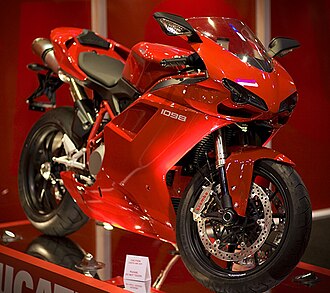
Ducati 1098: The Italian Superbike That Brought Ducati Back to Its Roots
The Ducati 1098 occupies a special place in the history of Italian superbikes. Introduced for the 2007 model year, it replaced the controversial 999 and represented a deliberate return to the design philosophy that had made the Ducati 916, 996 and 998 so influential. With its compact proportions, single-sided swingarm, under-seat exhausts, aggressive fairing and unmistakable Italian character, the 1098 looked instantly familiar to Ducati enthusiasts while incorporating a new generation of engine and chassis technology. Ducati itself described the motorcycle as an attempt to balance performance and tradition, drawing heavily on technologies developed through its racing program.
Yet the Ducati 1098 was not simply a nostalgic exercise. Its 1,099 cc Testastretta Evoluzione L-twin produced around 160 hp in road trim and 122 Nm of torque, while the relatively low weight, sophisticated suspension and powerful Brembo brakes gave it the hardware to compete with the world’s most serious superbikes. The model also formed the basis for the 1098 S and 1098 R, the latter eventually receiving a 1,198 cc engine and becoming an important bridge between the 1098 generation and the later 1198. On the racing side, the 1098’s significance became even greater when Troy Bayliss won the 2008 World Superbike Championship on the factory 1098 F08.
The Birth of the Ducati 1098
A return to the classic Ducati superbike formula
The arrival of the 1098 was significant because Ducati had taken a considerable stylistic risk with the 999. Pierre Terblanche’s 999 was technologically sophisticated and exceptionally successful in racing, but its radical appearance divided Ducati’s traditional audience. The 1098 went in a different direction. Ducati’s designers brought back several visual elements that enthusiasts strongly associated with the company’s superbike heritage, while still creating a modern motorcycle rather than simply copying the 916.
The result was an extraordinarily cohesive design. The front fairing was compact and purposeful, the tail rose sharply behind the rider, the exhaust silencers were tucked beneath the seat and the single-sided swingarm immediately recalled the great Ducati superbikes of the previous decade. Ducati specifically highlighted these features as defining characteristics of the 1098, while explaining that the motorcycle had been stripped back to essentials in an effort to control weight and maximize performance.
This approach worked remarkably well. The 1098 looked expensive, aggressive and unmistakably Italian without relying on excessive decoration. Even years later, its proportions remain one of the strongest aspects of the motorcycle. It is a machine whose visual identity comes from the arrangement of its mechanical components and bodywork rather than from unnecessary styling details.
More than just a pretty motorcycle
Although the 1098 was clearly designed to appeal to Ducati’s traditional audience, the engineering underneath the bodywork was thoroughly modern for its era. The motorcycle was built around a steel tubular trellis frame and a 90-degree V-twin, or L-twin in Ducati terminology, with liquid cooling and four desmodromically actuated valves per cylinder.
The engine displaced 1,099 cc, using a 104 mm bore and 64.7 mm stroke. Ducati’s service documentation gives a homologated maximum output of 113 kW, or approximately 156 CV, at 9,750 rpm, while acceleration-bench testing could produce approximately 160 CV. Maximum torque was listed at 116 Nm at 8,000 rpm, with the acceleration bench recording approximately 122 Nm.
Those numbers tell only part of the story. The appeal of the 1098 engine comes from the way its torque and firing character combine with the chassis. Instead of the extremely high-revving personality associated with many four-cylinder superbikes, the Ducati delivers substantial acceleration from its large-capacity twin while retaining a strong surge toward the upper part of the rev range.
The Ducati 1098 Engine
Testastretta Evoluzione performance
The 1098’s engine is one of its defining achievements. Its 1,099 cc displacement was a major step from the 998 cc engine used by the earlier 999, and the larger capacity gave Ducati an opportunity to increase torque while retaining the characteristic Testastretta architecture. The engine uses a 90-degree cylinder arrangement, dual overhead camshafts, four valves per cylinder and Ducati’s desmodromic valve actuation.
The desmodromic system is particularly important to Ducati’s identity. Rather than relying on a conventional spring to close each valve, the Ducati system mechanically controls both the opening and closing movements. This technology had been closely associated with Ducati’s racing motorcycles for decades, and on the 1098 it contributed to the motorcycle’s distinctive engineering character.
Fuel injection is electronically controlled, and the motorcycle uses a six-speed gearbox and hydraulic dry multi-plate clutch. The dry clutch became one of the familiar signatures of Ducati superbikes from this period, producing the characteristic mechanical rattle at idle that many enthusiasts either love or find unusual.
Torque that defines the riding experience
The 1098’s 122 Nm peak torque figure, depending on the measurement method cited, is arguably more important to the road-riding experience than its headline horsepower. The motorcycle has enough low- and mid-range strength to accelerate forcefully without requiring the rider to constantly chase the final few thousand revolutions.
That characteristic makes the 1098 feel very different from many contemporary inline-four superbikes. The Ducati encourages the rider to use the engine’s torque when exiting corners, while the relatively light chassis allows that acceleration to translate into rapid changes of direction. On a winding road, this combination can be more memorable than a simple comparison of peak horsepower figures.
Chassis and Handling
Trellis frame and single-sided swingarm
The Ducati 1098 uses a tubular steel trellis frame, one of the company’s most recognizable engineering signatures. The frame and engine work together as the structural heart of the motorcycle, while the single-sided swingarm contributes both practical and visual advantages.
The swingarm is particularly important to the 1098’s appearance. It leaves the rear wheel exposed on one side, giving the motorcycle the distinctive mechanical look that had become synonymous with Ducati’s premium superbikes. It also makes rear-wheel removal relatively convenient, particularly in racing or workshop environments.
The wheelbase is approximately 1,430 mm, while the steering head angle is listed at 24 degrees 30 minutes in Ducati’s technical documentation. These dimensions help explain why the motorcycle can feel both stable and highly responsive.
Suspension designed for serious riding
The standard 1098 was equipped with a fully adjustable Showa 43 mm upside-down front fork, with adjustment for compression, rebound and spring preload. At the rear, a Showa shock absorber works through a progressive linkage and provides adjustment for compression, rebound and spring preload. Ducati documentation lists approximately 127 mm of wheel travel at both ends.
The 1098 S moved the equipment further toward the premium end of the spectrum, receiving Öhlins suspension and other upgraded components. That distinction is worth remembering when comparing used examples, because a standard 1098 and a 1098 S may look similar while offering noticeably different hardware.
For an experienced rider, the adjustability of the chassis is one of the motorcycle’s strongest qualities. Correct suspension setup can transform a superbike, and the 1098 provides enough adjustment to allow owners to tailor the machine to road riding, track days, rider weight and tire choice.
Braking and Wheels
Brembo stopping power
The Ducati 1098 was equipped with high-performance Brembo braking hardware, including twin front discs with radial-mount four-piston calipers and a rear disc brake. Contemporary technical data lists 330 mm front discs and a 245 mm rear disc.
This braking system suits the motorcycle’s character perfectly. The 1098 is capable of arriving at corners at speeds that demand serious stopping performance, and the combination of large front discs, high-specification calipers and a relatively light chassis gives the rider considerable braking authority.
The motorcycle also uses a 120/70 front tire and a 190/55 rear tire in the commonly documented specification. The wide rear tire complements the Ducati’s substantial torque while maintaining the visual proportions expected of a modern superbike.
Ducati 1098 S and 1098 R
The 1098 S
For riders who wanted something more specialized, Ducati offered the 1098 S. It retained the fundamental architecture of the standard motorcycle but added premium equipment. Among the most important upgrades were Öhlins suspension and lighter components, allowing the S to provide a more sophisticated track-oriented package.
The 1098 S also became available in the distinctive Tricolore specification. Ducati’s heritage material identifies the 1098 S Tricolore as a 2007 return of the company’s famous three-color special-edition tradition.
The extraordinary 1098 R
The 1098 R took the concept much further. Its engine was enlarged to 1,198 cc, and the motorcycle was developed as the high-performance homologation model associated with Ducati’s World Superbike ambitions. The R therefore occupies a different position from the standard 1098 and should not be treated simply as a more powerful trim level.
The 1098 R became particularly important because the World Superbike rules of the period allowed a 1,200 cc limit for twin-cylinder motorcycles, enabling Ducati to field a larger-displacement V-twin against four-cylinder competitors. The racing 1098 F08 subsequently used a 1,198 cc engine, with Ducati listing 198 hp at 11,000 rpm and a dry weight of 168 kg under the relevant racing specification.
Ducati 1098 in World Superbike Racing
Troy Bayliss and the 2008 championship
The 1098’s racing story is one of the most important parts of its legacy. Ducati developed the 1098 F08 as the replacement for the 999 in World Superbike racing, with the factory machine making its public debut at the 2007 World Ducati Week at Misano. Ducati explained that the racing motorcycle was designed to comply with the new World Superbike regulations and, importantly, used a road-bike-derived frame.
The following season produced one of the defining moments in the 1098’s history. Troy Bayliss won the 2008 World Superbike Riders’ Championship aboard the factory Ducati. Ducati records that he achieved 11 victories during the season and became the first rider to win three World Superbike Riders’ titles on three different generations of Ducati machinery: the 996 R, 999 and 1098.
This championship gave the 1098 something beyond showroom appeal. It demonstrated that the new motorcycle was not simply designed to satisfy customers who missed the appearance of the 916. It was a genuine continuation of Ducati’s superbike racing philosophy.
What Makes the Ducati 1098 Special Today?
A modern classic
The Ducati 1098 has aged exceptionally well. Part of that comes from its styling, which successfully combined classic Ducati themes with contemporary proportions. Unlike some motorcycles from the same period that now look unmistakably tied to their era, the 1098 retains a strong visual presence.
Its importance also comes from where it sits in Ducati’s history. The 1098 represented a return to the traditional superbike formula after the unusual 999, while the later 1198 developed the same basic concept with further increases in displacement and performance. The 1098 therefore forms an important link between two generations of Ducati superbikes.
For collectors, original condition is increasingly significant. Exhaust systems, fairings, wheels, suspension components and electronics can all be expensive to replace, while a well-documented service history is particularly valuable on a motorcycle with sophisticated mechanical systems. A carefully maintained 1098 can be far more desirable than a heavily modified example, especially when the modifications have removed original equipment.
The ownership experience
Owning a Ducati 1098 is about more than transportation. It is a motorcycle for riders who appreciate mechanical character and are willing to accept some of the compromises that accompany a focused superbike. The riding position is aggressive, the engine is highly responsive and the motorcycle’s dimensions are optimized for performance rather than relaxed commuting.
Maintenance also deserves attention. The engine’s desmodromic valve system and belt-driven camshafts require proper servicing, and prospective owners should pay close attention to documented maintenance rather than judging a used motorcycle purely by appearance. A neglected example can become an expensive project, while a properly maintained machine can provide a remarkably rewarding ownership experience.
Ducati 1098 Technical Specifications
The table below summarizes the principal specifications of the standard 2007 Ducati 1098. Figures can vary slightly by market, model year and measurement method; the engine output figures below distinguish Ducati’s homologation figure from the higher acceleration-bench result documented in the service material.
| Specification | Ducati 1098 |
|---|---|
| Model generation | 1098 |
| Introduction | 2007 |
| Engine type | 90° L-twin, four-stroke |
| Cooling | Liquid-cooled |
| Valve system | Desmodromic, 4 valves per cylinder |
| Displacement | 1,099 cc |
| Bore × stroke | 104 × 64.7 mm |
| Compression ratio | 12.5:1 |
| Maximum power | Approx. 156 CV / 113 kW @ 9,750 rpm |
| Acceleration-bench power | Approx. 160 CV @ 9,750 rpm |
| Maximum torque | 116 Nm homologated; approx. 122 Nm on acceleration bench |
| Maximum engine speed | 10,700 rpm |
| Fuel system | Electronic fuel injection |
| Gearbox | 6-speed |
| Clutch | Hydraulic dry multi-plate |
| Primary drive | Gear |
| Final drive | Chain |
| Frame | Steel tubular trellis |
| Front suspension | 43 mm fully adjustable Showa USD fork |
| Rear suspension | Fully adjustable Showa shock with progressive linkage |
| Front wheel travel | Approx. 127 mm |
| Rear wheel travel | Approx. 127 mm |
| Front brakes | Twin 330 mm discs, radial 4-piston calipers |
| Rear brake | 245 mm disc, 2-piston caliper |
| Front tire | 120/70 |
| Rear tire | 190/55 |
| Wheelbase | Approx. 1,430 mm |
| Seat height | Approx. 820 mm |
| Fuel capacity | Approx. 15.5 litres |
| Dry weight | Approx. 173 kg |
| Weight in riding order, without fuel | Approx. 188 kg |
Final Verdict: Why the Ducati 1098 Remains Iconic
The Ducati 1098 succeeded because it managed to combine several qualities that rarely come together so effectively. It looked like a traditional Ducati superbike, but it was not merely an exercise in nostalgia. It contained a powerful new-generation Testastretta engine, a sophisticated adjustable chassis, serious Brembo braking hardware and the lightweight, focused character expected of a machine designed to perform on both road and track.
Its racing career strengthened that reputation considerably. The 2008 World Superbike Championship victory with Troy Bayliss gave the 1098 an extraordinary place in Ducati history, particularly because Bayliss completed his remarkable achievement of winning three championships with three generations of Ducati superbikes. (ducati.com)
Perhaps most importantly, the Ducati 1098 feels like a motorcycle created with a clear purpose. It was designed to be beautiful, but beauty was not its only objective. It was engineered around the idea that a superbike should be light, powerful, mechanically distinctive and capable of delivering a genuine racing experience to its owner.
That is why the Ducati 1098 remains so appealing today. It sits at the intersection of Ducati tradition and modern superbike performance, combining the visual language of the legendary 916 family with the technological development of a new era. For enthusiasts searching for a motorcycle that captures the essence of classic Italian superbike design without feeling like a museum piece, the Ducati 1098 remains one of the most compelling machines Ducati has ever produced.
