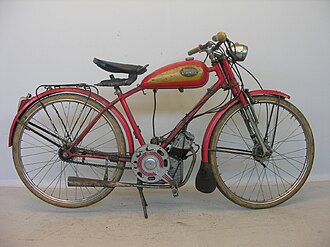
Ducati Cucciolo: The Tiny Motorcycle That Helped Build Ducati
The Ducati Cucciolo is one of the most important small engines in motorcycle history, not because it was powerful or fast, but because it helped transform Ducati from an electronics manufacturer into a motorcycle company. Introduced in the difficult years immediately following the Second World War, the Cucciolo was a tiny four-stroke engine designed to turn an ordinary bicycle into affordable powered transportation. Its name, meaning “puppy” in Italian, reflected the distinctive little barking sound of its exhaust. More importantly, the machine answered an urgent need in post-war Italy: people needed inexpensive, economical and dependable transportation at a time when fuel, materials and money were scarce. Ducati recognized the opportunity and became deeply involved in producing the engine, eventually developing its own versions and using the Cucciolo’s engineering as a foundation for its first complete motorcycles.
Today, the Cucciolo is remembered as a landmark in Ducati’s history. It was radically different from the high-performance motorcycles that would eventually make the Bologna manufacturer famous, but its importance is arguably just as great. The Cucciolo introduced Ducati to motorcycle engineering, demonstrated the company’s ability to manufacture compact power units on a large scale and eventually led toward motorcycles such as the Ducati 60. Its story is therefore not simply the story of a small engine; it is the story of how a company found a new direction during one of Italy’s most challenging periods.
The Origins of the Ducati Cucciolo
The story of the Cucciolo began outside Ducati. The original concept came from Aldo Farinelli, a Turin-based technical enthusiast who worked with the small engineering company S.I.A.T.A. Farinelli wanted to create a compact engine that could be attached to an ordinary bicycle, providing inexpensive motorized transportation without requiring the owner to purchase a complete motorcycle. Engineer Aldo Leoni helped develop the concept, and the prototype was running in Turin during 1944. (Wikipedie)
The timing was remarkably important. Italy was emerging from war, its infrastructure had suffered enormous damage, and private transportation was far from accessible to everyone. A small auxiliary engine made enormous practical sense. Instead of requiring a rider to buy a motorcycle, the Cucciolo could provide motor assistance to a bicycle that they already owned. It was lightweight, economical and mechanically uncomplicated compared with a conventional motorcycle engine.
The name Cucciolo, translated as “puppy,” came from the characteristic sound produced by the little engine. Although the name might sound charming today, it became associated with a genuinely significant piece of engineering. The original concept demonstrated that mobility did not necessarily require a large engine, and that principle was particularly valuable in an era of fuel shortages and economic hardship.
How Ducati Became Involved
Ducati was already an established name before it built motorcycles. The company had become known for radio, electrical and precision-engineering products, but the destruction suffered by its Borgo Panigale factory during the war created a serious challenge. Post-war reconstruction forced Ducati to reconsider how its facilities and workforce could be used, and the Cucciolo provided an opportunity to enter an entirely new market.
In 1946, Ducati manufactured the first ten Type 1 Cucciolo engines under license from S.I.A.T.A., and the engines were presented at the Milan Trade Fair later that year. Ducati subsequently developed increasingly sophisticated versions of the design. This relationship was crucial because the Cucciolo gave Ducati a practical route into motorized transportation at precisely the moment when the company needed a new direction.
The commercial success was considerable. Production expanded rapidly, with Ducati’s output eventually reaching hundreds of engines per day. The Cucciolo was also exported internationally, demonstrating that the little engine had appeal beyond Italy. Ducati itself describes the machine as the first step it took into the motorcycle sector and an important part of the company’s post-war renaissance.
The Engineering Behind the Cucciolo
The Cucciolo’s technical specification was modest by modern standards, but its engineering was remarkably sophisticated for such a small auxiliary engine. The original design used a 48 cc single-cylinder four-stroke engine with overhead valves operated through pull rods. Unlike the two-stroke engines commonly associated with many lightweight cyclemotors, the Cucciolo’s four-stroke layout emphasized economy and mechanical efficiency.
The period specifications provide a bore of 39 mm and a stroke of 40 mm, giving approximately 48 cc of displacement. Compression was around 6.24:1 in the period documentation, while output was approximately 1.25 horsepower at a maximum engine speed of about 5,200 rpm. The engine used a magneto flywheel ignition system and a carburetor, while lubrication was separately managed.
The small dimensions were central to the Cucciolo’s concept. The engine could be mounted to a bicycle without turning the machine into an excessively heavy or unwieldy vehicle. Contemporary documentation gives the engine weight at roughly 17.5 pounds, illustrating how carefully Ducati and its partners had to manage mass.
A Four-Stroke When Economy Mattered
One of the Cucciolo’s most interesting features was its four-stroke cycle. Four-stroke engines are mechanically more complex than simple two-strokes, but they can provide excellent fuel economy, and that was particularly valuable in post-war Europe. Ducati’s historical material states that the Cucciolo could cover approximately 100 kilometres on a litre of fuel under appropriate conditions.
Period documentation gives similarly remarkable fuel-consumption figures, with approximately 250–300 miles per imperial gallon under recommended riding conditions. Such figures illustrate why the Cucciolo was more than a novelty. For someone rebuilding their life after the war, an engine that could provide powered transportation while consuming very little fuel had genuine practical value.
From Bicycle Engine to Motorcycle
The Cucciolo initially existed primarily as an auxiliary engine rather than a conventional motorcycle. The concept was straightforward: take a normal bicycle, install the compact engine, add the necessary controls and fuel supply, and the rider suddenly had motorized transportation.
As Ducati refined the design, however, it became clear that the engine could form the basis of something more substantial. Ducati developed its own versions, beginning with the T2 and subsequently the T3. The T2 incorporated important improvements in efficiency, durability and construction, including a redesigned removable cylinder and improved access to the drive mechanism. Ducati also experimented with sportier versions capable of approximately 2 horsepower and speeds approaching 60 km/h.
The T3, introduced in 1948, represented another important stage. Ducati describes it as its first engine entirely designed internally. It retained the basic Cucciolo philosophy but introduced a three-speed gearbox and other engineering improvements. This development was a crucial step toward Ducati becoming a motorcycle manufacturer in its own right.
The Ducati 60
The transition from engine manufacturer to motorcycle manufacturer became particularly clear with the arrival of the Ducati 60. In 1949, Caproni designed a tubular frame with rear suspension for the Cucciolo-derived engine. The motorcycle was developed further in Borgo Panigale and became the Ducati 60, described by Ducati as the company’s first light motorcycle.
This was a major milestone. The Cucciolo had originally been a way of adding an engine to an existing bicycle, but Ducati was now producing a motorcycle designed as an integrated machine. The company’s later history would move toward increasingly sophisticated engines, frames and competition motorcycles, eventually producing some of the most famous motorcycles in the world.
In that sense, the Ducati 60 can be viewed as one of the direct descendants of the Cucciolo philosophy.
The Cucciolo T2 and T3
The terms T1, T2 and T3 are important when discussing Cucciolo history because the engine evolved considerably during its production life. The early Type 1 represented the licensed production phase, while the T2 introduced significant Ducati engineering development. The T3 then moved further toward Ducati’s own designs.
The T3 is particularly interesting because sources identify it as a 60 cc development using a three-speed gearbox. Historical specifications give the T3 a bore of approximately 43.8 mm and displacement of 60 cc. The subsequent Ducati 60 used a related engine concept but incorporated a purpose-built motorcycle chassis.
This gradual development illustrates how motorcycle engineering often progresses: rather than jumping immediately from a tiny bicycle engine to a large motorcycle, Ducati gained experience through incremental improvements. Each version provided knowledge about manufacturing, lubrication, valve operation, transmission design, frames and suspension.
The Importance of the Cucciolo to Ducati
The Cucciolo’s greatest achievement was not its speed. It was its role in Ducati’s transformation.
Before the Cucciolo, Ducati was primarily associated with electrical and precision-engineering products. After the Cucciolo, the company had developed substantial experience in internal-combustion engines and had established a market for its transportation products. The company’s historical account explicitly describes the Cucciolo as both Ducati’s first step into the motorcycle sector and a contributor to its post-war recovery.
That makes the little 48 cc engine an essential part of the company’s identity. Every later Ducati motorcycle—from lightweight singles to the famous V-twins and modern superbikes—belongs to a much larger story that began with relatively humble engineering.
The contrast is fascinating. Modern Ducati motorcycles are associated with immense performance, sophisticated electronics and advanced chassis technology. The Cucciolo, by comparison, produced roughly 1.5 horsepower and was designed to motorize a bicycle. Yet without the early experience gained through machines like the Cucciolo, Ducati’s subsequent development as a motorcycle manufacturer would have followed a very different path.
Riding the Cucciolo
It is tempting to judge the Cucciolo by modern motorcycle standards, but doing so misses the point. Its approximately 50 km/h top speed was perfectly meaningful for its intended purpose, particularly when compared with an ordinary bicycle. Ducati’s own historical specification lists a maximum speed of 50 km/h and approximately 1.5 horsepower at 5,500 rpm.
The experience would have been fundamentally different from riding a modern motorcycle. The engine was compact, the bicycle-based chassis was lightweight and the rider remained closely connected to the mechanical operation of the machine. Period instructions emphasized conservative speeds because a normal unsprung bicycle frame was not designed for sustained high-speed travel.
That simplicity is precisely what makes surviving Cucciolos so fascinating today. The machine provides a glimpse into a period when personal transportation was becoming motorized one small step at a time.
The Cucciolo as a Collector’s Motorcycle
Today, the Ducati Cucciolo occupies an important place in the world of historic motorcycle collecting. Its value comes from several factors: its rarity, its unusual engineering, its connection with Ducati’s origins and its place in post-war European transportation history.
A surviving Cucciolo is not simply an old small motorcycle. It represents a transitional moment between the traditional bicycle and the mass-market motorcycle. It also embodies the beginning of Ducati’s motorcycle story, making it historically significant even when compared with much larger and more powerful Ducati models.
Collectors also appreciate the engineering details. The tiny single-cylinder engine, pull-rod valve operation, magneto ignition, small carburetor and compact gearbox are reminders of an era when manufacturers had to extract useful performance from extremely limited resources.
Ducati Cucciolo Technical Specifications
The table below focuses primarily on the classic 48 cc Cucciolo engine and early Ducati specification. Because the Cucciolo evolved through several versions, exact figures can differ between Type 1, T2, T3 and later complete-machine applications. Ducati’s own heritage material lists 48 cc, 1.5 hp at 5,500 rpm and a 50 km/h maximum speed for the historical Cucciolo. Period manuals provide additional mechanical specifications.
| Specification | Ducati Cucciolo |
|---|---|
| Manufacturer | Ducati |
| Original production period | From 1946 |
| Engine type | Single-cylinder, four-stroke |
| Valve arrangement | Overhead valves, pull-rod operated |
| Cooling | Air-cooled |
| Displacement | 48 cc |
| Bore | 39 mm |
| Stroke | 40 mm |
| Compression ratio | Approximately 6.24:1 |
| Maximum power | Approximately 1.25–1.5 hp |
| Peak-power speed | Approximately 5,200–5,500 rpm |
| Carburetion | Small carburetor |
| Ignition | Flywheel magneto |
| Transmission | Two-speed on early Cucciolo |
| Later T3 transmission | Three-speed |
| Final drive | Chain |
| Lubrication | Separate/automatic lubrication system |
| Fuel economy | Approximately 100 km/l claimed by Ducati |
| Maximum speed | Approximately 50 km/h |
| Engine weight | Approximately 17.5 lb / 8 kg for period engine |
| Original application | Auxiliary bicycle engine |
| Later development | Ducati T2, T3 and Ducati 60 |
The Lasting Legacy of the Ducati Cucciolo
The Ducati Cucciolo is a reminder that important engineering does not always begin with enormous engines or record-breaking performance. Sometimes a company’s future can be changed by a tiny machine designed to solve a very ordinary problem. In post-war Italy, that problem was mobility. People needed a cheap way to travel, and the Cucciolo offered an ingenious answer.
For Ducati, however, the consequences went far beyond inexpensive transportation. The company gained manufacturing experience, developed its own engine designs and eventually created complete motorcycles. The T2 and T3 represented increasingly sophisticated stages of that development, while the Ducati 60 demonstrated that the company could move from auxiliary engines to genuine motorcycles.
The Cucciolo therefore deserves its place at the beginning of Ducati’s motorcycle story. Its 48 cc engine may seem impossibly small when compared with today’s superbikes, but its historical significance is enormous. It was economical, compact, clever and perfectly suited to the world for which it was created.
More than seven decades later, the little “puppy” remains one of Ducati’s most charming and historically important machines. It represents a period of rebuilding and innovation, when practical engineering mattered enormously and a small engine could make a transformative difference to everyday life. Most importantly, it marks the moment when Ducati began its journey from an electronics company to one of the world’s most recognizable motorcycle manufacturers. (Ducati)
