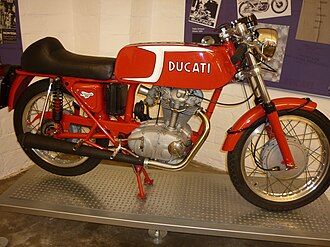
Ducati 24 Horas: The Spanish-Built Classic Inspired by Endurance Racing
The Ducati 24 Horas is one of the most fascinating motorcycles to emerge from Ducati’s Spanish history. Built by MotoTrans in Barcelona under licence from Ducati, the 250 24 Horas was introduced in 1966 as a road-going sports motorcycle inspired by Ducati’s successes in the demanding 24 Horas de Montjuïc endurance races. Although its name and styling suggested competition, this was not simply a racing motorcycle with lights added for the road. It was a carefully developed production machine that combined Ducati’s bevel-drive single-cylinder engineering with MotoTrans’s own manufacturing experience and the distinctive requirements of the Spanish market. Production continued through 1974, with the model evolving through several series and becoming one of the most recognizable and desirable Spanish Ducatis.
The 24 Horas is particularly interesting because its story crosses national and technological boundaries. Ducati supplied the underlying engineering heritage, while MotoTrans developed and manufactured the motorcycle in Spain. The result was not identical to an Italian-built Ducati of the same period. The Spanish machine used a 69 x 66 mm bore-and-stroke combination, a five-speed transmission, locally sourced components and a chassis tailored to the motorcycle’s sporting purpose. With approximately 25 horsepower from 247 cc and a claimed top speed around 160 km/h, the lightweight single could offer impressive performance for its era. Its café-racer styling, low weight and racing-derived image helped make it one of the defining motorcycles of MotoTrans.
The Origins of the Ducati 24 Horas
To understand the 24 Horas, it is necessary to look at MotoTrans, the Barcelona-based company that manufactured Ducati motorcycles under licence. MotoTrans began producing Ducati-derived motorcycles in Spain in the late 1950s, eventually establishing a substantial manufacturing operation and adapting Ducati designs to local production requirements. Its motorcycles were related to their Italian counterparts but often incorporated Spanish-made components, different engine dimensions and other changes.
The connection with endurance racing was especially important. Ducati had competed successfully in the 24 Hours of Montjuïc in Barcelona, winning the event in 1957, 1958 and 1960. After Ducati withdrew from direct participation, MotoTrans continued the racing effort and achieved further success, including victories in 1962 and 1964. The 1964 victory was particularly significant because the competing machine used a tuned and enlarged version of the 250 cc engine, bored to approximately 285 cc. That competition success provided the inspiration for the road-going 24 Horas.
From Montjuïc Racing to the Road
The 24 Horas was first presented at exhibitions in Barcelona in December 1965 and Madrid in January 1966, before entering production during 1966. Its name was a direct reference to the endurance-racing achievements at Montjuïc, giving buyers a tangible connection with Ducati’s competition heritage. The production motorcycle was styled in the spirit of a café racer, with a relatively compact silhouette, sporting tank, low handlebars and rear-set controls.
The model was initially expected to be a relatively limited production exercise, with approximately 500 motorcycles planned for the first series. Instead, demand and continued development kept the 24 Horas in production until 1974. Around 2,000 examples are generally cited for total production, making it considerably rarer than the mass-produced motorcycles that would follow it.
A Ducati Single With a Spanish Identity
The engine of the Ducati 24 Horas was a 247 cc, single-cylinder, air-cooled four-stroke with Ducati’s characteristic bevel-driven overhead camshaft. The engine was derived from the narrow-case Ducati 250 architecture, but MotoTrans used a different bore and stroke from the Italian machines. Instead of the 74 x 57.8 mm dimensions used by certain Italian 250s, the Spanish motorcycles employed a 69 mm bore and 66 mm stroke. This longer-stroke configuration had been adopted for Spanish production partly because of manufacturing limitations surrounding the required cylinder liners.
The engine’s compact dimensions were accompanied by a remarkably sporting specification. Contemporary and surviving technical documentation gives a compression ratio of around 10:1 and a maximum output of approximately 25 horsepower at 9,000 rpm. The engine used two valves per cylinder and a single overhead camshaft driven through Ducati’s traditional bevel-gear arrangement. This was sophisticated engineering for a small road motorcycle of the 1960s.
The Bevel-Drive Overhead Camshaft
The bevel-drive camshaft is one of the details that makes the 24 Horas unmistakably connected to classic Ducati engineering. Rather than using a chain or belt to drive the camshaft, the system uses shafts and bevel gears to transfer rotational motion from the crankshaft to the cylinder head. The arrangement was mechanically elegant and became one of the defining features of many classic Ducati singles and later V-twin engines.
On the 24 Horas, the system complemented the motorcycle’s high-revving sporting character. A 247 cc single producing approximately 25 horsepower was impressive for the period, particularly when combined with a dry weight commonly quoted at around 118 kg. The result was a machine in which engine performance and low mass worked together rather than relying on displacement alone.
Performance That Matched the Racing Image
The Ducati 24 Horas was not merely styled as a racing motorcycle; its performance figures gave the appearance some substance. The commonly quoted specification is approximately 25 bhp at 9,000 rpm, with a claimed maximum speed of about 160 km/h. A 118 kg dry weight meant that the motorcycle had an excellent power-to-weight relationship for its class.
The five-speed gearbox was equally important. A close-ratio transmission allowed the rider to make better use of the single-cylinder engine’s relatively narrow high-performance range. Power was transmitted through a wet multi-plate clutch, with a chain final drive to the rear wheel. The combination was conventional in principle but well suited to the lightweight sporting motorcycle.
The engine’s character would have been quite different from a modern multi-cylinder motorcycle. Instead of effortless acceleration across a broad rev range, the rider had to work with the characteristics of a high-revving single. Gear selection, engine speed and momentum were all important, which contributed to the involvement that made lightweight motorcycles of this era so entertaining.
The Café-Racer Styling
Visually, the 24 Horas is among the most distinctive motorcycles produced by MotoTrans. Its styling reflected the influence of endurance racing and the café-racer culture of the period. Early examples were equipped with a racing-style tank, clip-on handlebars, rear-set footrests and a megaphone-style exhaust. The combination created a purposeful appearance that was considerably more aggressive than that of a conventional commuter motorcycle.
The lightweight construction was not only aesthetically appropriate but also functionally important. The motorcycle’s low mass helped compensate for its modest displacement and allowed the engine to deliver lively performance without requiring enormous power. The relatively narrow proportions also emphasized the motorcycle’s single-cylinder character.
Later versions received changes to details such as the seat, headlight, electrical system and braking components. This means that two apparently original 24 Horas motorcycles can have noticeably different equipment depending on production series. Enthusiasts researching a particular example therefore need to distinguish between first-, second- and third-series specifications rather than assuming that every 24 Horas was identical.
Development Through Three Series
The 24 Horas evolved during its long production run. The first series, introduced in 1966, was characterized by its sporting specification and the original component arrangement. Approximately 500 examples are associated with this initial production run. The model subsequently received a second series in 1968, bringing significant changes to the brakes and bodywork.
One of the most important changes was the introduction of larger brakes. The original machines used 180 mm drum brakes, while the second series adopted 200 mm units, with a twin-leading-shoe arrangement at the front. The second series also gained a more pronounced racing-style seat hump and a revised headlight and instrument arrangement.
The Final Series
A third series appeared in 1973–74, near the end of production. Later motorcycles used an Amal Concentric carburetor rather than the earlier Amal Monobloc arrangement. Other components also changed over the years as MotoTrans adapted to available parts and manufacturing requirements. Spanish enthusiasts have documented variations involving the fuel tank, seat, fork, lighting, footrests and electrical system.
This evolutionary approach was typical of motorcycle production during the period. Manufacturers frequently changed components according to supplier availability, production improvements and technical requirements. As a result, originality can be complicated when restoring a 24 Horas. A part that appears incorrect at first glance may actually belong to another legitimate production series.
The 24 Horas and Montjuïc
The motorcycle’s name is inseparable from the 24 Horas de Montjuïc, an endurance race held in Barcelona. The event was one of Spain’s important motorcycle competitions and provided a natural platform for manufacturers to demonstrate durability and performance.
Ducati’s victories in the event gave the company considerable prestige, while MotoTrans’s continued participation strengthened the connection between the Spanish manufacturer and endurance racing. The 1964 victory by the enlarged 285 cc Ducati was especially influential in creating the concept behind the production 24 Horas.
The road motorcycle did not simply reproduce the racing machine, of course. A competition motorcycle could be extensively modified, stripped down and tuned for a specific event, whereas the production 24 Horas needed to be reliable and usable on public roads. Nevertheless, the racing connection gave owners something more than transportation: it gave the motorcycle a story.
The Famous “24 Horrors” Reputation
The Ducati 24 Horas also has a less flattering chapter in its history. When some Spanish-built motorcycles were imported into Britain in the early 1970s, reports emerged of failures involving camshafts and valve-train components. The problem was associated with the quality of some Spanish-made camshaft components, and at least one reported example suffered camshaft failure after relatively little mileage. The motorcycle subsequently acquired the unfortunate nickname “24 Horrors” among some British enthusiasts.
This episode has become part of the model’s folklore, but it should not be confused with the entire history of the motorcycle. The 24 Horas was produced for years, and surviving examples are now valued precisely because of their rarity and historical importance. The period quality-control issue is nevertheless relevant to collectors because the condition and provenance of individual engines can vary considerably.
Riding Character and Lightweight Performance
One of the defining characteristics of the 24 Horas is its relatively low weight. At approximately 118 kg dry, the motorcycle is remarkably light by modern standards. That figure changes the way the available 25 horsepower should be understood. Modern riders accustomed to much larger engines may initially see 25 horsepower as modest, but a lightweight chassis with a high-revving single-cylinder engine can produce a surprisingly engaging riding experience.
The five-speed gearbox gives the rider an important role in maintaining momentum. Rather than relying on abundant torque, the rider needs to keep the engine in its effective operating range. This creates the kind of involved riding experience that made small-capacity sporting motorcycles so popular during the 1960s and 1970s.
The motorcycle’s narrow dimensions also contribute to its character. With a wheelbase of approximately 1,285 mm and an approximately 750 mm seat height, the 24 Horas is compact compared with many contemporary motorcycles. Its sporting ergonomics, however, mean that it was designed around active riding rather than relaxed touring.
The Ducati 24 Horas as a Classic Today
Today, the 24 Horas is regarded as one of the most desirable motorcycles produced by the Spanish Ducati operation. Its appeal comes from a combination of rarity, design, racing history and technical interest. MotoTrans produced only around 2,000 examples during the model’s entire production life according to commonly cited historical sources, and the motorcycle occupies a particularly important place in Spanish motorcycle history.
Restoration can be complicated because of the multiple production series and changes made during the motorcycle’s life. Collectors need to pay attention to details such as the correct tank, seat, headlight, brakes, forks, electrical system and engine components. Surviving motorcycles have often been modified, repaired or assembled from parts belonging to different production years. Enthusiast documentation confirms that even apparently small details can help identify the particular series of an individual motorcycle.
For a historically minded collector, that complexity is part of the fascination. The 24 Horas is not merely an old Ducati; it is an example of how a licensed manufacturer developed its own identity while remaining connected to the engineering and sporting heritage of the original Italian company.
Ducati 24 Horas Technical Specifications
The following table summarizes commonly documented specifications for the Ducati/MotoTrans 250 24 Horas. Some details, particularly equipment and power figures, vary between production series and historical sources. The dimensions and performance figures below are principally associated with the later documented specification.
| Specification | Ducati 250 24 Horas |
|---|---|
| Manufacturer | MotoTrans, under licence from Ducati |
| Production | 1966–1974 |
| Category | Lightweight sports / café racer |
| Engine | Air-cooled single-cylinder four-stroke |
| Valve arrangement | SOHC, 2 valves |
| Camshaft drive | Bevel gear / shaft |
| Displacement | 246.8–247 cc |
| Bore × stroke | 69 × 66 mm |
| Compression ratio | Approximately 10:1 |
| Maximum power | Approximately 25 hp @ 9,000 rpm |
| Carburetor | Amal Monobloc 376/27; Amal Concentric on later models |
| Lubrication | Pressure-fed wet-sump system |
| Ignition | Battery and coil |
| Clutch | Multi-plate wet clutch |
| Transmission | 5-speed |
| Final drive | Chain |
| Frame | Single-cradle steel frame |
| Front suspension | Telescopic fork |
| Rear suspension | Swingarm with twin shock absorbers |
| Front brake | 180 mm drum, later 200 mm twin-leading-shoe |
| Rear brake | 180/200 mm drum depending on series |
| Front tyre | 2.75 × 18 |
| Rear tyre | 2.75 × 18 |
| Wheelbase | 1,285 mm |
| Seat height | Approximately 750 mm |
| Fuel capacity | 14 litres |
| Dry weight | Approximately 118 kg |
| Claimed top speed | Approximately 160 km/h |
| Production series | Three principal series |
| Approximate production | Around 2,000 examples |
The Legacy of the Ducati 24 Horas
The Ducati 24 Horas represents a particularly fascinating intersection between Italian engineering, Spanish motorcycle manufacturing and endurance racing. Its story began with Ducati’s racing success at Montjuïc, continued through MotoTrans’s licensed production in Barcelona and eventually produced a motorcycle that developed its own identity within the Ducati family.
Its 247 cc bevel-drive single was sophisticated, its low weight gave it impressive performance for the period and its café-racer styling made the connection with racing visually obvious. Yet the motorcycle’s greatest importance lies in what it represents. The 24 Horas demonstrates that Ducati’s history was not confined to Bologna and that the company’s engineering influence extended into Spain, where MotoTrans adapted Ducati technology to local manufacturing conditions and created motorcycles that have become classics in their own right. (Wikipedia)
The model’s long production run from 1966 to 1974, its multiple series and its relatively limited production numbers have made it increasingly interesting to collectors. Surviving examples tell a story of a period when a 250 cc single-cylinder motorcycle could be a serious sporting machine, when a 160 km/h claimed top speed was remarkable for such a lightweight motorcycle, and when endurance racing could directly influence the design and marketing of a road-going machine.
Ultimately, the Ducati 24 Horas is much more than a small-displacement classic. It is a motorcycle born from competition, shaped by Spanish manufacturing and preserved by enthusiasts who recognize its unusual place in Ducati history. Its bevel-driven single-cylinder engine, distinctive café-racer proportions and direct connection with the Montjuïc endurance races give it an identity that few motorcycles of its era can match. For anyone interested in classic Ducati motorcycles, Spanish motorcycle history or the evolution of lightweight performance machines, the 24 Horas remains an especially compelling chapter in the story of Ducati.
