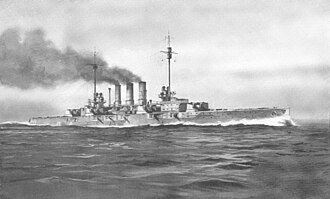
SMS Helgoland (1909): The German Dreadnought That Entered the First World War
When the German battleship SMS Helgoland was launched in September 1909, the naval world was undergoing one of the most dramatic transformations in maritime history. The arrival of HMS Dreadnought only a few years earlier had made older battleship designs appear almost instantly obsolete, and the major naval powers were racing to build larger, faster, more heavily armed warships. Germany responded with its own generation of dreadnoughts, and Helgoland became the lead ship of a class that represented a significant step forward from the preceding Nassau-class battleships. Armed with twelve 30.5 cm guns, protected by heavy Krupp armor, and capable of more than 20 knots, she was designed to form part of the battle line of the Imperial German Navy’s High Seas Fleet.
Yet Helgoland‘s story is not simply one of impressive specifications. Like many battleships of the High Seas Fleet, she spent much of the First World War preparing for and participating in operations that rarely produced the decisive fleet engagement German planners hoped for. She took part in North Sea operations, supported German forces in the Baltic, fought at the Battle of Jutland, and ultimately survived the war only to be surrendered and scrapped. Her career therefore offers a fascinating glimpse into the changing nature of battleship warfare during the early twentieth century and the strategic dilemma faced by the Imperial German Navy.
The Birth of the Helgoland Class
Germany’s Second Generation of Dreadnoughts
Helgoland was conceived as the successor to the Nassau class, Germany’s first generation of dreadnought battleships. The new design retained several features of its predecessor but increased the power of the main battery from 28 cm guns to 30.5 cm weapons. This was a significant change because the 12-inch caliber had become something of an international standard among the major naval powers. The Helgoland class also carried a stronger secondary battery and heavier protection, reflecting the German emphasis on creating ships capable of absorbing punishment while maintaining their fighting power.
The keel of Helgoland was laid down at Howaldtswerke in Kiel on 11 November 1908. She was launched on 25 September 1909 and commissioned into the Imperial German Navy on 23 August 1911. The ship was named after Heligoland, the North Sea island whose strategic importance had grown considerably after Germany acquired it from Britain in 1890. The construction cost was reported at approximately 46.2 million marks, an enormous investment that reflected the importance attached to battleships during the naval arms race between Germany and Britain.
A Formidable Combination of Guns and Armor
At 167.2 meters long and 28.5 meters wide, Helgoland was a massive vessel by the standards of her era. Her designed displacement was approximately 22,808 tonnes, rising to around 24,700 tonnes at full load. Beneath her armored hull were three four-cylinder triple-expansion steam engines driving three propeller shafts. Fifteen water-tube boilers supplied the steam necessary to produce roughly 28,000 horsepower, giving the battleship a maximum speed of about 20.8 knots.
The ship’s main armament consisted of twelve 30.5 cm SK L/50 guns mounted in six twin turrets. Their unusual arrangement placed one turret forward, one aft, and four in wing positions along the sides of the ship. This arrangement reflected design practices inherited from the Nassau class and gave the ship a powerful broadside, although it was less straightforward than the all-centerline arrangements that became increasingly common on later battleships. Fourteen 15 cm SK L/45 guns formed the secondary battery, while fourteen 8.8 cm guns provided defense against smaller surface craft and torpedo boats. Six 50 cm submerged torpedo tubes gave the ship another, though secondary, offensive capability.
Protection was one of the defining characteristics of the German battleship philosophy. The central armored belt reached approximately 300 mm in thickness, while the main turrets and their supporting structures were similarly heavily protected. The armored deck was approximately 60–63.5 mm thick depending on the section and source used. The conning tower received particularly heavy protection, with some specifications giving armor thicknesses of up to 400 mm. This emphasis on armor was intended to allow German battleships to survive sustained combat at relatively close ranges in the North Sea.
Service Before the First World War
After entering service in 1911, Helgoland joined the High Seas Fleet and became part of Germany’s growing battle fleet. Her peacetime career was relatively brief, but it was important in establishing the operational experience of the crews who would later take the ship into wartime service. The Imperial German Navy had been built with the possibility of a major confrontation with the Royal Navy in mind, and battleships such as Helgoland represented the core of the fleet’s striking power.
The ship’s design also reflected a transitional period in naval engineering. Unlike the later German Kaiser-class battleships, which adopted steam turbines, Helgoland relied on triple-expansion engines. These were proven and reliable machines, but turbine propulsion was rapidly becoming dominant in new capital ships. In this sense, Helgoland occupied an interesting position between the earliest dreadnoughts and the increasingly sophisticated battleships that followed.
SMS Helgoland During the First World War
Operations in the North Sea
When the First World War began in 1914, Helgoland became part of the operational High Seas Fleet. German strategy was complicated by Britain’s superior overall naval strength and by the danger of losing major battleships in an unfavorable fleet engagement. As a result, the German fleet frequently operated cautiously, conducting sorties and sweeps designed to challenge British naval forces without unnecessarily exposing the entire battle fleet to destruction.
Helgoland participated in several such North Sea operations. These sorties were often connected with the activities of German battlecruisers and reconnaissance forces. The battleship’s enormous guns and heavy armor made her a valuable component of the battle line, but the operational circumstances meant that she did not enjoy the kind of continuous combat experience that might be expected from a ship of her size and power.
The Baltic and the Battle of the Gulf of Riga
The ship was also involved in German operations in the Baltic Sea. In August 1915, Helgoland formed part of the German force supporting the Battle of the Gulf of Riga, an operation intended to challenge Russian naval forces and assist German military operations in the region. The Baltic demonstrated another important aspect of the dreadnought’s role: although designed primarily for fleet combat, a battleship could also provide long-range gunfire and intimidation in operations against coastal and naval targets.
The operation did not transform the naval balance in the Baltic, but it demonstrated the flexibility of the German battle fleet. Helgoland and her sister ships could be redeployed when strategic circumstances required, even though their enormous size and logistical requirements made them very different from cruisers and smaller warships.
The Battle of Jutland
A Battleship in the Center of the German Line
The most famous action of Helgoland‘s career came during the Battle of Jutland, fought on 31 May and 1 June 1916. This was the largest surface fleet battle of the First World War and one of the largest battleship engagements in naval history. The German High Seas Fleet attempted to challenge Britain’s Grand Fleet, resulting in a sprawling battle involving battleships, battlecruisers, cruisers, and destroyers.
Helgoland was present as part of the German battle line. However, her position meant that she was not among the German battleships most heavily engaged during the opening phases of the battle. The newer König– and Kaiser-class ships nearer the front of the German formation bore more of the fighting. Helgoland nevertheless contributed to the German battle line and demonstrated the value of the heavily armored dreadnoughts that had been built during the pre-war naval race.
Jutland also illustrated how rapidly naval warfare had evolved since Helgoland was designed. Battleships could still deliver devastating gunfire, but their effectiveness depended on scouting, communications, formation tactics, visibility, fire control, and the presence of faster battlecruisers and destroyers. The battle did not produce the decisive destruction of the British Grand Fleet that some German planners had hoped for, and the High Seas Fleet subsequently remained largely constrained by Britain’s command of the wider maritime environment.
The End of SMS Helgoland
From Warship to War Prize
Following the end of the First World War in November 1918, the fate of the surviving German battleships was determined by the terms imposed upon Germany. Helgoland was decommissioned on 16 December 1918 and later struck from the German naval register on 5 November 1919. In 1920 she was ceded to Great Britain as part of the postwar settlement.
Her final chapter was remarkably undramatic compared with the ambitions surrounding her construction. Rather than fighting another major fleet engagement, the once-powerful dreadnought became a source of valuable scrap metal. She was broken up in the early 1920s, with sources generally placing the dismantling in 1921 or noting that the process was completed at Morecambe by 1924.
The Legacy of SMS Helgoland
SMS Helgoland is important not because she sank a famous enemy battleship or because she met a spectacular end, but because she represents an entire stage in the development of naval warfare. She was Germany’s second-generation dreadnought, larger and more heavily armed than the Nassau class while still carrying design features that would soon be overtaken by newer approaches to battleship construction.
Her twelve 30.5 cm guns, substantial armor, and 20.8-knot speed made her a formidable fighting ship when commissioned in 1911. Yet within only a few years, battleship technology had advanced again. Larger guns, improved propulsion, better fire-control systems, aircraft, submarines, and increasingly sophisticated naval tactics were changing the strategic environment. The Helgoland class consequently became part of a rapidly aging generation of capital ships even while the vessels themselves remained extremely powerful.
The story of Helgoland also illustrates the strange paradox of the dreadnought era. Nations spent enormous sums constructing battleships capable of destroying one another, yet strategic circumstances often made commanders reluctant to risk those very ships. Helgoland spent the First World War as a powerful instrument of deterrence and fleet strength, but relatively little of her career involved the spectacular battles that popular histories sometimes associate with battleships.
In the end, Helgoland survived the First World War and avoided the fate of many warships that were sunk in combat. Her destruction came instead through the political consequences of defeat. The ship that had once symbolized German naval ambition was handed over to Britain and ultimately dismantled. Her career therefore traces the complete arc of the dreadnought age: from technological revolution and naval competition, through industrialized war, to the decline of the battleship as the unquestioned centerpiece of maritime power.
SMS Helgoland Technical Specifications
The following figures summarize the commonly cited specifications for SMS Helgoland. Minor variations appear among historical references, particularly concerning crew strength, draft, armor measurements, and machinery output.
| Specification | Details |
|---|---|
| Ship | SMS Helgoland |
| Class | Helgoland-class dreadnought battleship |
| Builder | Howaldtswerke, Kiel |
| Keel laid | 11 November 1908 |
| Launched | 25 September 1909 |
| Commissioned | 23 August 1911 |
| Decommissioned | 16 December 1918 |
| Struck from register | 5 November 1919 |
| Fate | Ceded to Great Britain in 1920; scrapped in the early 1920s |
| Length | 167.2 m |
| Beam | 28.5 m |
| Maximum draft | Approximately 8.94 m |
| Designed displacement | 22,808 tonnes |
| Full-load displacement | Approximately 24,700 tonnes |
| Propulsion | 3 triple-expansion steam engines |
| Boilers | 15 water-tube boilers |
| Propeller shafts | 3 |
| Power | Approximately 28,000–31,258 shp, depending on reference |
| Maximum speed | Approximately 20.8 knots |
| Range | About 5,500 nautical miles at 10 knots |
| Main armament | 12 × 30.5 cm SK L/50 guns |
| Secondary armament | 14 × 15 cm SK L/45 guns |
| Anti-torpedo-boat armament | 14 × 8.8 cm guns, later modified in part for anti-aircraft use |
| Torpedo armament | 6 × 50 cm submerged torpedo tubes |
| Main belt armor | Up to 300 mm |
| Turret armor | Up to 300 mm |
| Deck armor | Approximately 60–63.5 mm |
| Crew | Approximately 1,070–1,113 officers and enlisted personnel |
Conclusion
SMS Helgoland was a product of a remarkable moment in naval history: a period when battleship design was advancing so quickly that a vessel could be revolutionary at the beginning of its construction and already part of an older generation only a few years later. As the lead ship of the Helgoland class, she embodied Germany’s determination to build a battle fleet capable of confronting the world’s most powerful navy. Her twelve 30.5 cm guns, heavy armor, and substantial speed made her a formidable dreadnought, while her service with the High Seas Fleet placed her at the center of Germany’s naval strategy during the First World War.
Her career ultimately demonstrates that technical power alone does not determine a warship’s historical importance. Helgoland saw the North Sea, the Baltic, and the great fleet action at Jutland, but she was never destroyed in combat. Instead, she passed from active service into the complicated political aftermath of the First World War and finally disappeared beneath the shipbreaker’s torch. What remains is the historical significance of a battleship that stood at the intersection of German naval ambition, the dreadnought arms race, and the transformation of twentieth-century naval warfare.
