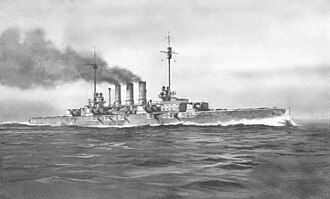
SMS Thüringen: The German Dreadnought That Fought at Jutland
SMS Thüringen was one of the most powerful battleships of the Imperial German Navy when she entered service in 1911. Built during the intense naval competition between Germany and Great Britain, she belonged to the Helgoland class, the second generation of German dreadnought battleships. With twelve 30.5 cm guns, thick armor, a displacement of nearly 25,000 tonnes at full load, and a top speed of around 21 knots, Thüringen was designed to fight at the heart of a modern battle fleet. Her career would take her from the pre-war naval exercises of the Kaiserliche Marine to operations in the North Sea and Baltic, the enormous Battle of Jutland, and finally the confused aftermath of Germany’s defeat in 1918.
What makes Thüringen particularly interesting is that she survived the First World War without suffering the spectacular destruction that befell some other famous capital ships. She was one of the German battleships that emerged from Jutland still operational, but the political settlement that followed Germany’s defeat ensured that her future would be very different from what her designers had imagined. Delivered to France as a warship under the postwar reparations arrangements, she was eventually used as a target and broken up. Her story consequently illustrates both the extraordinary capabilities of the dreadnought battleship and the rapid disappearance of the naval world for which she had been created.
The Birth of SMS Thüringen
Germany’s Second Dreadnought Generation
The Helgoland class was developed as the successor to Germany’s Nassau class. The earlier Nassau battleships had been Germany’s first response to Britain’s revolutionary HMS Dreadnought, but German naval designers quickly recognized that the new international standard was moving toward larger main guns. The Helgoland class therefore received twelve 30.5 cm guns instead of the 28 cm weapons carried by the Nassau class. Armor and underwater protection were also strengthened, making the new ships formidable members of the High Seas Fleet.
The design nevertheless retained several characteristics of the earlier ships. Most conspicuous was the unusual hexagonal arrangement of the main gun turrets. One twin turret was positioned forward, another aft, while four additional turrets were arranged in pairs on the ship’s flanks. This arrangement gave the battleship a tremendous theoretical broadside but was less efficient than the centerline and superfiring turret layouts that appeared on later dreadnoughts. Only two-thirds of the main guns could be brought to bear on a broadside, an issue that German naval designers would subsequently address in newer classes.
Thüringen was constructed by AG Weser in Bremen. Her keel was laid down on 2 November 1908, and she was launched on 27 November 1909. She was commissioned into the Imperial German Navy in 1911, with German sources giving 10 September as her formal commissioning date, while some English-language references list 1 July for entry into service. Her name came from the historic German region and former state of Thuringia. Construction cost approximately 46.3 million marks, an indication of the enormous financial resources required to create a modern dreadnought.
A Heavily Armored Battleship
Dimensions and Machinery
Thüringen was 167.2 meters long and 28.5 meters wide, with a maximum draft of approximately 8.94 meters. Her designed displacement was about 22,808 tonnes, while her full-load displacement approached 24,700 tonnes. A crew of roughly 1,100 men was required to operate the ship, maintain her machinery, handle the artillery, and perform the numerous tasks necessary to keep such a large warship operational.
Unlike the later German Kaiser-class battleships, Thüringen was powered by conventional triple-expansion steam engines rather than steam turbines. Three four-cylinder triple-expansion engines drove three propeller shafts, with steam supplied by fifteen marine water-tube boilers. Contemporary and historical sources give somewhat different figures for the precise power generated, with German references listing approximately 34,944 horsepower for Thüringen, while class-wide figures are often around 31,258 horsepower. Her maximum speed was approximately 21 knots.
This propulsion system was already approaching the end of its era when Thüringen entered service. Steam turbines were becoming increasingly attractive for new battleships because they offered advantages in power and high-speed operation. The Helgoland class was therefore significant as the last German battleship class to use triple-expansion machinery rather than turbines. The decision reflected both technological considerations and the German Navy’s caution about adopting powerful turbine machinery for very large warships.
Protection Built for Fleet Combat
Armor was central to the German approach to battleship design, and Thüringen was no exception. Her waterline belt armor ranged from approximately 120 to 300 mm, with the thickest protection concentrated around the central citadel. Her gun turrets were protected by armor reaching 300 mm, while the armored deck varied according to location. The conning tower received particularly substantial protection, with the forward command position reported as having armor ranging up to 400 mm. A separate torpedo bulkhead provided additional defense against underwater explosions.
This emphasis on protection reflected German expectations about how a major fleet battle would unfold. The High Seas Fleet was not expected simply to exchange fire at extreme ranges until one side disappeared. German naval thinking placed considerable importance on the ability of battleships to withstand punishment and remain in formation. Extensive subdivision, heavy armor, and underwater protection were consequently considered essential elements of the design.
The result was a warship that could absorb extraordinary punishment. The experience of the Helgoland class during the First World War would reinforce the reputation of German battleships for structural strength and survivability.
The Armament of SMS Thüringen
Twelve 30.5 cm Guns
The centerpiece of Thüringen‘s offensive power was her twelve 30.5 cm SK L/50 guns. Mounted in six twin turrets, these weapons represented a substantial increase over the main battery of the preceding Nassau class. The guns were capable of engaging enemy capital ships at considerable distances and were supported by sophisticated range-finding and fire-control arrangements for their period.
A broadside could theoretically bring eight of the twelve main guns into action. The unusual turret layout was partly inherited from the Nassau design philosophy, but the limitations of the arrangement became increasingly apparent as naval architecture evolved. Later German battleships adopted much more efficient centerline layouts, allowing nearly all of their main guns to fire in a broadside.
Secondary Weapons and Torpedoes
The main battery was supplemented by fourteen 15 cm SK L/45 guns mounted in casemates. These weapons were intended to engage cruisers, destroyers, and other smaller vessels that might threaten the battle line. Fourteen 8.8 cm guns provided additional protection against torpedo boats, while six 50 cm torpedo tubes gave Thüringen a close-range weapon capable of threatening enemy capital ships.
The 8.8 cm battery was subsequently modified during the war, reflecting the increasing appearance of aircraft as a threat to major surface vessels. Two of the weapons were converted to anti-aircraft roles, an early indication of the technological changes that were beginning to reshape naval warfare.
SMS Thüringen Before the First World War
After commissioning, Thüringen became part of the High Seas Fleet and was assigned to its 1st Battleship Squadron. Her early years were dominated by exercises, training cruises, and fleet maneuvers. These activities were far from glamorous, but they were essential to the development of the German Navy as a modern fighting force. Battleships needed to practice formation keeping, signaling, gunnery, navigation, damage control, and coordinated maneuvers before they could be trusted in a major fleet action.
The years before 1914 were also characterized by the continuing naval rivalry between Germany and Britain. Every new dreadnought represented an enormous industrial and financial investment, and the construction of ships such as Thüringen demonstrated Germany’s determination to maintain a battle fleet capable of challenging Britain’s naval supremacy. Yet the strategic situation remained difficult. Britain possessed a larger fleet and controlled crucial maritime routes, while Germany’s principal naval base at Wilhelmshaven and the North Sea coast were relatively constrained geographically.
This strategic imbalance would influence the entire wartime career of Thüringen. Rather than fighting constantly, she would spend much of the conflict waiting for opportunities to bring the High Seas Fleet into action under favorable circumstances.
SMS Thüringen During the First World War
Operations in the North Sea
The outbreak of war in 1914 transformed Thüringen from a peacetime symbol of naval power into an operational weapon. She served with the 1st Battleship Squadron and participated in the major fleet operations conducted by the High Seas Fleet. These sorties were intended to challenge British forces, support German strategic objectives, and seek opportunities to reduce Britain’s numerical advantage.
German naval commanders faced a difficult calculation. A successful major battle against the British Grand Fleet could potentially transform the strategic situation, but the destruction of the High Seas Fleet would leave Germany’s coast exposed and eliminate one of its most important strategic assets. Consequently, German fleet operations were often carefully planned and conducted with an awareness that avoiding catastrophic losses was almost as important as inflicting them.
Thüringen was part of this powerful but constrained battle fleet. Her twelve heavy guns gave her enormous destructive potential, but the ship’s strategic value also depended on keeping her afloat.
The Baltic Campaign
The Helgoland-class battleships were not confined exclusively to the North Sea. In August 1915, Thüringen participated with her sisters in the German operation in the Gulf of Riga. The operation formed part of Germany’s wider attempt to challenge Russian naval forces and support operations on the Eastern Front.
The Baltic presented different tactical and geographical conditions from the open North Sea. Shallow waters, coastal defenses, mines, and restricted passages created hazards for large capital ships. Nevertheless, the presence of dreadnoughts provided considerable firepower and demonstrated the flexibility of the High Seas Fleet.
For Thüringen, these operations were another indication that her role was not limited to the theoretical battle between the German and British battle fleets. A battleship could also serve as a mobile heavy artillery platform, a deterrent, and a tool for influencing operations ashore.
The Battle of Jutland
Into the Greatest Fleet Battle of the War
The defining event of Thüringen‘s career was the Battle of Jutland on 31 May and 1 June 1916. The engagement was the largest surface fleet battle of the First World War and brought the German High Seas Fleet into direct confrontation with Britain’s Grand Fleet.
Thüringen was part of the German battle line and therefore operated in the center of the action as the fleets maneuvered across the North Sea. The battle was characterized by long-range artillery fire, rapidly changing formations, torpedo attacks, poor visibility, and the enormous difficulty of coordinating hundreds of ships.
German battleships demonstrated considerable resilience during the battle. The Helgoland class was not among the most heavily damaged groups, and Thüringen survived the engagement. The German fleet eventually withdrew toward its bases rather than attempting to destroy the British Grand Fleet outright. The tactical outcome remains debated, but strategically the battle did not break Britain’s control of the North Sea.
For Thüringen, Jutland demonstrated the qualities for which the ship had been designed. She was a heavily armored component of a coordinated battle line, carrying enough artillery to threaten enemy capital ships while possessing the protection necessary to survive a major fleet engagement.
A Survivor of the Dreadnought Era
The survival of the Helgoland class at Jutland is particularly noteworthy. Although the ships were exposed to intense naval gunfire, the class as a whole suffered comparatively limited damage. The experience reinforced contemporary perceptions of German battleship construction as robust and heavily protected.
Yet Jutland also revealed the limitations of battleship warfare. Despite the enormous forces involved, the battle did not produce the decisive annihilation that either side might have hoped for. The High Seas Fleet remained largely confined by Britain’s overall maritime superiority, while the British Grand Fleet remained capable of maintaining the blockade. The battleships had demonstrated their power, but the strategic problem remained unsolved.
The End of the German Battleship Fleet
Germany’s Defeat in 1918
The final year of the war brought political collapse within Germany. The High Seas Fleet remained a formidable collection of warships, but the country itself was exhausted. In October and November 1918, orders for another major fleet operation contributed to a mutiny among German sailors, and the subsequent revolution helped bring down the imperial government.
Unlike many of the more modern German capital ships, Thüringen was not interned at Scapa Flow. The Helgoland class therefore avoided the spectacular mass scuttling that destroyed much of the High Seas Fleet in June 1919. Instead, the surviving battleships were ultimately distributed among the victorious Allied powers as reparations.
Thüringen was decommissioned on 16 December 1918 and struck from the German naval register on 5 November 1919. In 1920 she was ceded to France. Her military career was effectively over, but her final chapter had not yet been written.
The Final Fate of SMS Thüringen
From Dreadnought to Target Ship
The fate of Thüringen was considerably less dramatic than that of her sister Ostfriesland, which was famously sunk by American aircraft during bombing experiments in 1921. France instead acquired Thüringen and subsequently used the former German battleship as a target ship.
This was an appropriate but melancholy end for a vessel created to represent the future of naval warfare. Instead of leading a battle squadron, Thüringen became an object for weapons testing. Her armor and construction could be examined under controlled conditions, while the once-powerful ship was gradually reduced to the status of an expendable naval target.
She was eventually broken up for scrap at Gâvres-Lorient, with dismantling taking place between 1923 and 1933 according to historical references. (Wikipedia)
Her disappearance marked the end of a remarkably short historical cycle. Launched in 1909, she represented the cutting edge of battleship technology. Within barely fourteen years she had become obsolete, a victim not of an enemy fleet but of the political and technological transformations brought about by the First World War.
The Legacy of SMS Thüringen
SMS Thüringen is often overshadowed by more famous ships such as HMS Dreadnought, HMS Warspite, SMS Bismarck, or the battlecruisers that exploded spectacularly at Jutland. Nevertheless, her career is important because she represents the core of the German High Seas Fleet during its most consequential period.
She embodied the German approach to battleship construction: heavy armor, extensive internal subdivision, powerful artillery, and an emphasis on survivability. Her twelve 30.5 cm guns made her a formidable opponent, while her substantial belt and turret armor allowed her to withstand the dangers of a major fleet action. The design was also a transitional one, retaining triple-expansion machinery and an older turret arrangement even as naval architecture was rapidly moving toward more advanced solutions.
Her wartime record is equally significant. Thüringen took part in major High Seas Fleet operations, served in the Baltic campaign, and fought at Jutland. She survived the war, unlike many ships that became famous precisely because they were destroyed. Yet survival did not guarantee a future. Germany’s defeat transformed her from an instrument of imperial power into a reparations asset, and her transfer to France brought an unceremonious end to her career.
In this sense, Thüringen represents the strange fate of many dreadnoughts built during the naval arms race. They were constructed at enormous expense for battles that rarely occurred, spent years preparing for decisive engagements that remained elusive, and then became obsolete remarkably quickly as aviation, submarines, improved fire control, and new naval technologies changed the nature of warfare.
SMS Thüringen Technical Specifications
| Specification | Details |
|---|---|
| Ship | SMS Thüringen |
| Class | Helgoland-class dreadnought battleship |
| Builder | AG Weser, Bremen |
| Keel laid | 2 November 1908 |
| Launched | 27 November 1909 |
| Commissioned | 1911 |
| Decommissioned | 16 December 1918 |
| Struck from German naval register | 5 November 1919 |
| Postwar fate | Ceded to France in 1920; used as a target ship |
| Scrapping | Gâvres-Lorient, 1923–1933 |
| Length | 167.2 m |
| Beam | 28.5 m |
| Draft | 8.94 m |
| Designed displacement | 22,808 tonnes |
| Full-load displacement | Approximately 24,700 tonnes |
| Propulsion | 3 × four-cylinder triple-expansion steam engines |
| Boilers | 15 × marine water-tube boilers |
| Propeller shafts | 3 |
| Power | Approximately 34,944 hp in German references |
| Maximum speed | Approximately 21 knots |
| Range | Approximately 5,500 nautical miles at 10 knots |
| Main armament | 12 × 305 mm SK L/50 guns |
| Main turrets | 6 × twin turrets |
| Secondary armament | 14 × 150 mm SK L/45 guns |
| Anti-torpedo-boat armament | 14 × 88 mm guns |
| Anti-aircraft armament | 2 × 88 mm guns after wartime modification |
| Torpedo armament | 6 × 500 mm submerged torpedo tubes |
| Belt armor | Approximately 120–300 mm |
| Turret armor | Up to 300 mm |
| Deck armor | Approximately 55–80 mm |
| Torpedo bulkhead | Approximately 30 mm |
| Forward conning tower armor | Up to approximately 400 mm |
| Crew | Approximately 1,113 |
Conclusion
SMS Thüringen was a product of the great dreadnought race and one of the principal fighting ships of Imperial Germany’s High Seas Fleet. From the moment her keel was laid at AG Weser in 1908, she was intended to be part of a modern battle fleet capable of confronting the world’s most powerful navy. Her twelve 30.5 cm guns, heavy armor, extensive underwater protection, and roughly 21-knot speed made her an imposing warship when she entered service.
Her career during the First World War demonstrated the strengths of that design. She participated in major fleet operations, served in the Baltic, and entered the Battle of Jutland as part of the German battle line. She survived the war and escaped the fate of the ships destroyed at Scapa Flow, but Germany’s defeat made her continued service impossible.
Ultimately, Thüringen became a target ship in French hands and was dismantled during the 1920s and 1930s. Her physical disappearance was unremarkable, but her historical significance remains. She represents the peak of one particular school of battleship design and the enormous resources invested in the belief that fleets of armored gunships would determine the fate of nations. The First World War proved that the reality was far more complicated.
For naval historians, Thüringen is therefore valuable precisely because she was not a spectacular wreck. She was a survivor—a heavily armored veteran of Jutland whose existence stretched from the height of the dreadnought arms race into the uncertain naval world that followed the First World War. Her story captures the rise, combat service, survival, and eventual disappearance of the Imperial German battleship fleet.
