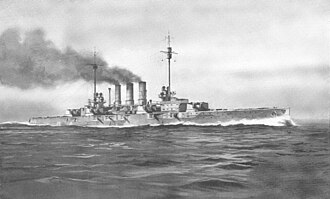
SMS Oldenburg (1910): The Last Dreadnought of the Helgoland Class
SMS Oldenburg was the fourth and final battleship of Germany’s powerful Helgoland class, a group of dreadnoughts built during one of the most intense periods of naval competition in modern history. Launched in 1910 and commissioned into the Imperial German Navy in 1912, Oldenburg represented a significant stage in the rapid development of German battleship design. Armed with twelve 30.5 cm guns, protected by armor as thick as 300 mm in vital areas, and capable of more than 20 knots, she was built to fight in the battle line of the High Seas Fleet against the Royal Navy’s Grand Fleet.
Although Oldenburg never became as famous as battleships such as SMS Bismarck or the battlecruisers that were destroyed at Jutland, her career was closely connected with some of the most important naval operations of the First World War. She participated in major German fleet sorties in the North Sea, operated in the Baltic during the campaign against Russia, and fought at the Battle of Jutland in May and June 1916. Unlike many warships whose careers ended dramatically in battle, Oldenburg survived the First World War only to become one of the spoils of Germany’s defeat. She was ceded to Japan in 1920 and subsequently sold to a British shipbreaking company, eventually being dismantled at Dordrecht in 1921.
The Construction of SMS Oldenburg
Germany’s Helgoland-Class Dreadnoughts
The Helgoland class was Germany’s second generation of dreadnought battleships and the direct successor to the Nassau class. The appearance of HMS Dreadnought in 1906 had fundamentally altered naval architecture. Instead of mixing several calibers of heavy artillery, the new British battleship concentrated its striking power in a battery of large guns. Germany responded with the Nassau class, but the Imperial German Navy quickly recognized that its first dreadnoughts were already being overtaken by the international movement toward larger main batteries.
The Helgoland class consequently introduced twelve 30.5 cm guns, compared with the 28 cm weapons of the Nassau class. The ships retained the unusual hexagonal arrangement of their main turrets, however. One twin turret stood forward, another aft, while four additional turrets were positioned on the sides of the hull. This arrangement gave the ships a powerful broadside but was less efficient than the centerline and superfiring arrangements adopted by many later battleships. Nevertheless, the combination of heavy artillery, substantial armor, and strong underwater protection made the class formidable opponents.
Oldenburg was laid down at the Schichau-Werke shipyard in Danzig on 1 March 1909. She was launched on 30 June 1910 and commissioned on 1 May 1912, making her the last of the four Helgoland-class battleships to enter service. Her name referred to the Grand Duchy of Oldenburg, a German state with a long history and close connections to the German Empire. Construction cost approximately 45.8 million marks, demonstrating the enormous industrial and financial commitment involved in constructing a modern dreadnought.
A Battleship Built for the Battle Line
Oldenburg was 167.2 meters long and 28.5 meters wide, with a maximum draft of 8.94 meters. Her designed displacement was approximately 22,808 tonnes, while full-load displacement reached around 24,700 tonnes. She carried a crew of more than 1,000 men, with approximately 42 officers and more than 1,000 enlisted personnel required to operate the ship, maintain her machinery, handle her artillery, and perform damage-control duties.
Her propulsion system was characteristic of the transitional period in which she was designed. Three four-cylinder triple-expansion steam engines drove three propeller shafts, with steam generated by fifteen water-tube boilers. The machinery was rated at roughly 28,000 horsepower in commonly cited specifications, while German references provide somewhat higher trial or measured figures. Her designed top speed was approximately 20.8 knots, although some sources give a slightly higher maximum speed achieved under particular conditions. With a large coal supply, she could travel roughly 5,500 nautical miles at 10 knots, giving her the endurance necessary for North Sea fleet operations.
The choice of triple-expansion engines is particularly interesting because naval engineering was already moving toward steam turbines. Germany had experimented with turbine propulsion before Oldenburg was built, and the subsequent Kaiser class adopted turbines. The Helgoland class therefore represented one of the last major German battleship designs to use reciprocating steam engines. In retrospect, Oldenburg stood at the boundary between two generations of naval engineering: she was a modern dreadnought in terms of armament and protection, but her propulsion belonged to an older technological tradition.
The Armament of SMS Oldenburg
Twelve 30.5 cm Main Guns
The most important weapons aboard Oldenburg were her twelve 30.5 cm SK L/50 guns. Arranged in six twin turrets, these weapons provided the battleship with the firepower necessary to engage enemy dreadnoughts. The guns were approximately twelve inches in caliber and represented a major increase in power over the main batteries of Germany’s earlier Nassau-class ships.
The turret arrangement was unusual by later standards. Two turrets were positioned on the centerline, one forward and one aft, while four were arranged as wing turrets. The design permitted a powerful broadside, but the wing turrets imposed limitations on how many guns could fire directly ahead or astern. As battleship design developed, naval architects increasingly preferred centerline arrangements that allowed more of the main battery to fire in any direction.
Nevertheless, when Oldenburg entered service, twelve 305 mm guns made her a formidable capital ship. Her weapons were supported by German fire-control and range-finding equipment, allowing the ship to engage targets at distances far beyond the practical range of the smaller secondary guns.
Secondary Battery and Torpedoes
The main battery was supported by fourteen 15 cm SK L/45 guns mounted in casemates along the sides of the hull. These weapons were primarily intended for use against cruisers, destroyers, and other lighter vessels. Fourteen 8.8 cm guns provided additional protection against torpedo boats and smaller surface targets. During the war, some of these smaller weapons were adapted for anti-aircraft duties as the threat from aircraft increased.
Oldenburg also carried six 50 cm torpedo tubes. Four were installed on the sides of the ship, while one was located toward the bow and another toward the stern. Torpedoes gave the battleship an additional weapon against enemy capital ships, although their practical use required the ship to close to much shorter ranges than those normally preferred for heavy-gun engagements.
Armor and Survivability
Protection for a North Sea Battle
The German Navy placed enormous emphasis on survivability. A battleship such as Oldenburg was expected to absorb heavy gunfire and remain capable of fighting, making armor and internal subdivision as important as the main battery itself. Her main waterline belt reached approximately 300 mm in its thickest sections, protecting the central machinery and ammunition spaces. Armor thickness varied elsewhere according to the importance of the protected area.
The main turrets were protected by armor ranging from approximately 100 to 300 mm, while the casemates protecting the secondary battery received armor around 170 mm thick. The protective decks varied from approximately 55 to 80 mm, and a torpedo bulkhead approximately 30 mm thick helped protect the interior of the ship against underwater explosions. The forward conning tower received exceptionally heavy protection, with some sections reaching approximately 400 mm.
This system of protection reflected the German expectation that a fleet battle would involve sustained exchanges of heavy artillery. A battleship could not rely on speed alone. Instead, it needed to continue fighting after receiving hits, protect its magazines and machinery, and limit flooding if its underwater hull was damaged. The robust construction of the Helgoland class contributed to the reputation of German battleships for toughness during the First World War.
SMS Oldenburg Before the First World War
After commissioning in May 1912, Oldenburg joined the High Seas Fleet. Her peacetime career consisted largely of exercises, training cruises, fleet maneuvers, and preparations for the possibility of war with the Royal Navy. These activities were essential because the effective use of a dreadnought required much more than simply possessing powerful guns. Crews had to learn formation maneuvering, signaling, navigation, gunnery procedures, communications, and damage control.
The international environment in which Oldenburg entered service was dominated by the Anglo-German naval rivalry. Germany had built the High Seas Fleet as a means of challenging Britain’s traditional naval supremacy, while Britain responded by maintaining a larger fleet and concentrating substantial naval forces in home waters. Oldenburg was therefore not merely another battleship; she was part of a broader strategic contest in which the possession of modern capital ships was itself a political statement.
Yet the strategic situation was unfavorable to Germany. Britain could draw on a larger fleet and a worldwide network of bases, while Germany’s main naval forces were concentrated in the North Sea. This meant that the High Seas Fleet had to seek opportunities carefully rather than simply engaging the British fleet whenever it wished.
SMS Oldenburg in the First World War
Operations in the North Sea
When war broke out in 1914, Oldenburg became part of the operational battle line of the High Seas Fleet. Together with her three sister ships, Helgoland, Ostfriesland, and Thüringen, she participated in major German fleet operations against British naval forces. The objective was not necessarily to destroy the entire Royal Navy in one battle but to create favorable opportunities to reduce British numerical superiority and challenge the blockade.
These operations frequently involved German battlecruisers conducting raids or reconnaissance missions while the main battleships remained ready to support them. The High Seas Fleet’s battleships were enormously powerful, but their commanders understood that losing even one modern dreadnought could have serious strategic consequences. The result was a war at sea characterized by cautious fleet maneuvering punctuated by moments of intense violence.
Oldenburg participated in the major North Sea fleet sorties and was therefore repeatedly placed in situations where a clash with the British Grand Fleet was possible. Her heavy armor and twelve-gun main battery made her a valuable component of the German battle line, but her greatest strategic contribution was often simply her continued availability as part of the fleet’s strength.
Operations in the Baltic
The Helgoland class also operated in the Baltic Sea. In August 1915, Oldenburg took part in the German attempt to enter the Gulf of Riga and challenge Russian naval forces. The operation was complicated by mines, coastal defenses, narrow waters, and the presence of Russian forces. Although the German effort did not immediately achieve all of its objectives, the deployment demonstrated the flexibility of the High Seas Fleet.
For a battleship designed primarily with the North Sea battle line in mind, operating in the Baltic presented a different set of challenges. Large ships had to navigate waters that were less forgiving of mistakes, while mines and coastal defenses posed serious dangers. Nevertheless, the heavy artillery carried by Oldenburg and her sisters gave Germany an important advantage when operating against lighter naval forces.
The Battle of Jutland
Entering the Great Fleet Engagement
The most important battle of Oldenburg‘s career occurred on 31 May and 1 June 1916, when the High Seas Fleet encountered the British Grand Fleet off the Danish coast. The resulting Battle of Jutland was the largest naval battle of the First World War and remains one of the most important fleet actions in maritime history.
Oldenburg entered the battle as part of the German battle line. The engagement rapidly developed into a complicated series of maneuvers involving battleships, battlecruisers, cruisers, destroyers, and torpedo attacks. Visibility varied dramatically, communications were difficult, and commanders had to make decisions based on incomplete information.
During the battle, Oldenburg came under fire and was involved in engagements with British destroyers. According to the Jutland Centenary Initiative, she suffered eight men killed and fourteen wounded, while 22 men were taken prisoner. Her captain, Wilhelm Höpfner, was also involved in a dramatic episode when he took over the steering after the ship’s command arrangements were disrupted.
The battle demonstrated the tremendous power of the German battleships while also revealing the strategic limitations of the High Seas Fleet. German ships inflicted severe losses on British forces, but the Grand Fleet remained capable of maintaining its overall superiority. The High Seas Fleet consequently returned to its bases rather than attempting to force another decisive encounter.
A Survivor of Jutland
Oldenburg survived Jutland and remained part of the German battle fleet. Her survival was representative of the resilience of the Helgoland class. These ships had been designed with substantial armor and underwater protection, and their ability to withstand battle damage was an important element of German naval doctrine.
Yet survival did not mean that the battle changed Germany’s strategic position. Britain continued to dominate the wider maritime environment, and the German fleet remained increasingly constrained. The enormous dreadnoughts that had been built at tremendous cost were still powerful, but Germany was unable to use them to break the British naval blockade.
The End of SMS Oldenburg
The Collapse of Imperial Germany
By late 1918, Germany’s military and political situation had deteriorated beyond recovery. The High Seas Fleet was still formidable on paper, but the war had exhausted the country and morale within the navy had deteriorated. Plans for another major fleet operation contributed to the naval mutiny that helped trigger the German Revolution.
The Helgoland-class battleships avoided internment at Scapa Flow, where many other German capital ships were eventually scuttled by their crews. Instead, Oldenburg remained in Germany until the postwar settlement determined her fate. She was struck from the German naval register on 5 November 1919 and subsequently allocated to Japan as a war reparation.
This transfer was largely symbolic because Japan had little practical reason to incorporate the obsolete German battleship into its fleet. Instead, the ship was sold to a British shipbreaking firm in 1920. She was subsequently dismantled at Dordrecht in the Netherlands and broken up for scrap in 1921.
The Legacy of SMS Oldenburg
SMS Oldenburg illustrates how quickly the dreadnought age transformed naval warfare. When her keel was laid in 1909, the battleship was at the center of Germany’s strategy for challenging Britain. By the time she was scrapped in 1921, the strategic environment had changed dramatically. Aircraft, submarines, mines, improved fire-control systems, and the experience of total industrial war had all altered the assumptions on which pre-war battleship construction had been based.
She nevertheless represented an impressive achievement in naval engineering. At nearly 25,000 tonnes fully loaded, she was an enormous armored fighting machine, capable of more than 20 knots and carrying twelve 305 mm guns. Her thick belt armor and protected gun turrets gave her considerable resistance to enemy fire, while her large crew and extensive internal subdivision allowed her to operate as a self-contained floating weapons system.
Her wartime career also reveals an important truth about battleship history: the most powerful ships did not necessarily have the most dramatic careers. Oldenburg did not sink a famous enemy battleship or meet a spectacular end in combat. Instead, she performed the less glamorous but strategically important work of remaining ready for fleet operations, participating in major sorties, fighting at Jutland, and helping maintain the strength of the High Seas Fleet.
Her final fate was almost anticlimactic. A ship built for a decisive battle between empires was transferred to a country that never seriously intended to operate her, sold to a private breaker, and dismantled within a few years. The contrast between her enormous construction cost and her brief postwar existence demonstrates just how completely the First World War had transformed the strategic value of the dreadnought.
SMS Oldenburg Technical Specifications
| Specification | Details |
|---|---|
| Ship | SMS Oldenburg |
| Class | Helgoland-class dreadnought battleship |
| Builder | Schichau-Werke, Danzig |
| Keel laid | 1 March 1909 |
| Launched | 30 June 1910 |
| Commissioned | 1 May 1912 |
| Struck from register | 5 November 1919 |
| Postwar fate | Ceded to Japan in 1920; sold for scrapping |
| Scrapped | Dordrecht, 1921 |
| Length | 167.2 m |
| Beam | 28.5 m |
| Draft | 8.94 m |
| Designed displacement | 22,808 tonnes |
| Full-load displacement | Approximately 24,700 tonnes |
| Propulsion | 3 × triple-expansion steam engines |
| Boilers | 15 × water-tube boilers |
| Propeller shafts | 3 |
| Power | Approximately 28,000 hp; higher trial figures are reported in some German references |
| Maximum speed | Approximately 20.8–21.3 knots |
| Range | Approximately 5,500 nautical miles at 10 knots |
| Main armament | 12 × 30.5 cm SK L/50 guns |
| Main turrets | 6 × twin turrets |
| Secondary armament | 14 × 15 cm SK L/45 guns |
| Light/anti-torpedo armament | 14 × 8.8 cm guns |
| Anti-aircraft armament | 2 × 8.8 cm guns after wartime modification |
| Torpedo armament | 6 × 50 cm submerged torpedo tubes |
| Main belt armor | 120–300 mm |
| Turret armor | Approximately 100–300 mm |
| Deck armor | Approximately 55–80 mm |
| Casemate armor | Approximately 170 mm |
| Torpedo bulkhead | Approximately 30 mm |
| Forward conning tower armor | Up to approximately 400 mm |
| Crew | Approximately 42 officers and 1,027 enlisted personnel |
Conclusion
SMS Oldenburg was the final member of the Helgoland class and one of the major battleships that formed the backbone of the Imperial German Navy during the First World War. Built at a time when Germany was attempting to challenge Britain’s naval supremacy, she combined twelve powerful 30.5 cm guns with heavy armor, extensive underwater protection, and enough speed to operate effectively with the High Seas Fleet.
Her career took her through the tense years before the war, the major German operations of the First World War, the Baltic campaign, and ultimately the Battle of Jutland. At Jutland she experienced the reality of modern fleet warfare and emerged as a survivor, although the battle did not fundamentally alter the strategic balance in Britain’s favor.
The end came not through combat but through defeat and diplomacy. Germany’s surrender made the survival of its dreadnought fleet politically impossible, and Oldenburg was eventually handed over to Japan. Within a year she had been sold for scrap and dismantled at Dordrecht.
That unceremonious ending is perhaps the most fitting reminder of the extraordinary speed of naval change during the early twentieth century. Oldenburg had been conceived as one of the most powerful weapons available to the German Empire, yet her active career lasted only a little more than six years. Her history captures the rise of the dreadnought, the reality of the First World War at sea, and the rapid decline of the world in which massive armored battleships represented the ultimate expression of national power.
