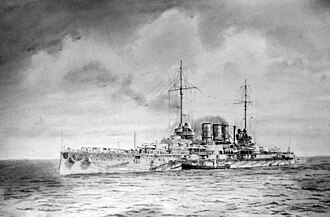
SMS Ostfriesland: The German Dreadnought That Became a Symbol of Air Power
SMS Ostfriesland was one of the most powerful battleships of the Imperial German Navy when she entered service in 1911. Built during the intense naval rivalry between Germany and Great Britain, she represented the second generation of German dreadnought battleships and embodied the German preference for heavy armor, strong underwater protection, and a powerful main battery. As the second ship of the Helgoland class, Ostfriesland was a formidable combination of twelve 305 mm guns, substantial armor, and a displacement approaching 25,000 tonnes when fully loaded. She would serve through the First World War, participate in the great fleet actions of the period, survive the conflict, and eventually meet an extraordinary fate thousands of miles from the North Sea: she was deliberately sunk by American aircraft during the famous naval bombing experiments of July 1921.
The story of Ostfriesland is therefore much larger than the career of a single battleship. She provides a window into the naval arms race before 1914, the operational challenges faced by Germany’s High Seas Fleet, the enormous clash at Jutland, and the revolutionary question of whether aircraft could replace battleships as the dominant weapon of naval warfare. Her eventual destruction became one of the most widely discussed demonstrations of air power in the early interwar period, although the circumstances of the test and its interpretation were considerably more complicated than the famous images of a battleship disappearing beneath the waves might suggest.
The Construction of a German Dreadnought
The Helgoland-Class Battleships
Ostfriesland belonged to the Helgoland class, Germany’s second class of true dreadnought battleships. The ships were developed as successors to the Nassau class, which had represented Germany’s first answer to Britain’s revolutionary HMS Dreadnought. The principal improvement was the adoption of twelve 305 mm main guns in place of the smaller 283 mm weapons carried by the Nassau class. The basic arrangement remained recognizable, however, with the main turrets distributed in a distinctive hexagonal pattern rather than the more efficient superfiring arrangements that would become common on later battleships.
The keel of Ostfriesland was laid down at the Imperial Dockyard in Wilhelmshaven on 19 October 1908. She was launched on 30 September 1909 and entered commissioned service on 1 August 1911. Her name referred to East Frisia, the historic coastal region of northwestern Germany. According to the Deutsche Digitale Bibliothek, the ship became part of the 1st Squadron soon after commissioning and was later designated the squadron flagship. Her construction cost was approximately 43.6 million gold marks, illustrating the extraordinary financial commitment involved in Germany’s attempt to build a modern battle fleet.
A Heavily Protected Fighting Ship
Measuring 167.2 meters in length and 28.5 meters across the beam, Ostfriesland was an enormous vessel by contemporary standards. At full load she displaced approximately 24,700 tonnes. Her machinery consisted of three four-cylinder triple-expansion steam engines supplied by fifteen water-tube boilers, with each engine driving its own propeller. Depending on the source and method of measurement, her machinery developed roughly 28,000 to 31,000 horsepower and gave her a maximum speed of approximately 20.8 to 21.2 knots. Her range was around 5,500 nautical miles at 10 knots.
Protection was one of the defining features of the ship. Her main belt armor reached approximately 300 mm in its thickest sections, while the main gun turrets and barbettes were also protected by armor up to 300 mm thick. Her protective deck was roughly 63.5 mm thick in the commonly cited specifications, while additional armor protected important internal areas and command positions. The German design philosophy emphasized not merely preventing penetration but creating a ship capable of remaining operational after suffering serious damage. This was particularly evident in the extensive subdivision and underwater protection incorporated into the design.
The Armament of SMS Ostfriesland
Twelve 305 mm Main Guns
The principal offensive weapon of Ostfriesland was her battery of twelve 30.5 cm SK L/50 guns. These were mounted in six twin turrets, giving the ship a formidable broadside. The arrangement reflected the transitional character of the Helgoland class: it provided tremendous firepower but was less efficient in terms of firing arcs and turret placement than the centerline superfiring layouts adopted by later German battleships.
The 305 mm guns were designed to engage enemy capital ships at considerable range, while the ship’s substantial armor was intended to withstand return fire. In an era before aircraft carriers, radar, and modern guided weapons, the combination of large-caliber artillery and heavy armor represented the ultimate expression of naval power. A battleship such as Ostfriesland was essentially a mobile armored fortress whose strategic purpose was to threaten the enemy’s fleet while surviving the same kind of punishment herself.
Secondary Guns and Torpedoes
The main battery was supported by fourteen 150 mm SK L/45 guns, primarily intended for engaging cruisers, destroyers, and other smaller targets. Fourteen 88 mm guns provided additional protection against torpedo boats and other light vessels, although the exact configuration of the smaller weapons changed during the war. The ship also carried six 500 mm torpedo tubes.
This mixture of weapons reflected the tactical assumptions of the pre-First World War battleship era. A capital ship was expected to fight other battleships with its main battery, while its secondary weapons dealt with smaller warships attempting to approach the battle line. Torpedoes offered another potential method of damaging heavily armored opponents, although using them effectively required getting considerably closer to the enemy than a battleship normally wanted.
SMS Ostfriesland in the First World War
The High Seas Fleet
When the First World War began in 1914, Ostfriesland joined the operational core of Germany’s High Seas Fleet. Along with her sister ships Helgoland, Thüringen, and Oldenburg, she formed part of the German battle line. The fleet faced a fundamental strategic problem: Britain possessed a larger navy and controlled vital maritime routes, while Germany needed to preserve its battle fleet rather than risk its destruction in an unfavorable engagement.
Consequently, the High Seas Fleet conducted a series of sorties and operations intended to challenge British naval forces, support German strategy, and create opportunities to reduce the numerical advantage of the Royal Navy. Ostfriesland participated in the major fleet operations in the North Sea and also operated in the Baltic. In August 1915 she took part in the German attempt to penetrate the Gulf of Riga, an operation that demonstrated how battleships could be employed in support of wider military campaigns as well as traditional fleet warfare.
The Battle of Jutland
The defining battle of Ostfriesland‘s wartime career came on 31 May and 1 June 1916, when the High Seas Fleet encountered the British Grand Fleet in the Battle of Jutland. The battle was the largest fleet engagement of the First World War and one of the largest clashes between battleships in naval history.
Ostfriesland formed part of the German battle line during the confrontation. The battle demonstrated both the immense destructive power and extraordinary resilience of contemporary dreadnoughts. German ships suffered heavy punishment but generally proved difficult to destroy, while British battlecruisers suffered catastrophic losses. Ostfriesland herself survived the battle, although the retreat of the German fleet was not entirely without danger. During the return journey she struck a mine but managed to reach port under her own power, an incident later cited as evidence of the strength of the ship’s underwater protection. Contemporary U.S. Navy analysis emphasized the quality of German subdivision and noted that Ostfriesland had been designed with substantial internal protection against mines and torpedoes.
Jutland did not produce the decisive destruction of the British Grand Fleet that Germany would have needed to fundamentally change the naval balance. The High Seas Fleet therefore remained a powerful force, but one operating under significant strategic constraints. For Ostfriesland, the battle would prove to be her greatest conventional naval engagement.
The End of the High Seas Fleet
Germany’s Defeat
The final year of the war brought increasing political and military difficulties for Germany. By November 1918, the German Empire had collapsed, and the armistice brought the active career of the High Seas Fleet to an end. A large portion of the German fleet was interned at Scapa Flow, where many of its ships were subsequently scuttled by their own crews in June 1919.
The Helgoland-class battleships, however, were not among the ships interned at Scapa Flow. Ostfriesland was decommissioned on 16 December 1918 and struck from the German naval register on 5 November 1919. Under the postwar settlement, she was ultimately transferred to the United States as a war reparation.
Her new American career was extremely brief. Renamed USS Ostfriesland, she was taken over by the United States Navy in April 1920, but she was never intended to become a permanent operational battleship. Instead, she was selected for weapons experiments designed to examine the vulnerability of large warships to aerial attack.
The Bombing of Ostfriesland in 1921
A New Era of Naval Warfare
The sinking of Ostfriesland on 21 July 1921 became one of the most famous demonstrations in the history of military aviation. American aircraft attacked the former German battleship off the Virginia Capes as part of a series of naval bombing experiments. The tests were closely associated with Brigadier General Billy Mitchell and his campaign to demonstrate the destructive potential of air power against naval vessels.
The experiments were conducted in stages rather than as a simple unrestricted attack. Earlier bombing with 600-pound weapons produced damage but did not immediately sink the battleship. Subsequent attacks using 1,000-pound bombs also failed to produce an immediate dramatic result. The decisive phase came on 21 July, when aircraft employed 2,000-pound bombs. Contemporary U.S. Navy reporting described bombs detonating close to the hull and producing severe underwater effects.
The final attack has often been simplified in popular accounts into the statement that aircraft simply bombed a battleship and proved that battleships were obsolete. The historical reality was more complicated. Ostfriesland was a stationary, unmanned target rather than a fully operational warship maneuvering under combat conditions. The test also involved a carefully controlled sequence of attacks and was not equivalent to a wartime air strike against a moving fleet.
Nevertheless, the result was dramatic. Contemporary accounts reported that after the heavy-bomb attacks the ship developed serious flooding and eventually capsized and sank. One contemporary U.S. Naval Institute account described the vessel turning over on her beam ends roughly twenty minutes after a major bomb impact and sinking shortly afterward.
What the Sinking Really Demonstrated
The sinking of Ostfriesland was unquestionably significant, but its meaning has been debated ever since. It demonstrated that sufficiently powerful aerial bombs could inflict catastrophic damage on a large, heavily armored battleship, particularly through underwater blast and flooding. It also provided an important demonstration of the potential reach of land-based aircraft against major naval targets.
At the same time, the experiment did not by itself prove that aircraft had made battleships useless. Ostfriesland was not maneuvering, shooting back, using damage-control teams in wartime conditions, or operating as part of a fleet protected by fighter aircraft and anti-aircraft defenses. Indeed, contemporary U.S. Navy commentary emphasized the unusual nature of the damage and suggested that the large bombs had produced underwater effects significantly different from those caused by conventional torpedoes or mines.
The significance of the experiment therefore lies partly in what it represented. Naval warfare was changing. Aircraft could search enormous areas of ocean, attack ships from the air, and potentially deliver weapons against targets previously considered the exclusive domain of battleships and torpedo craft. Within two decades, aircraft carriers and naval aviation would play decisive roles in the Pacific War, while battleships increasingly became supporting rather than dominant instruments of naval power.
The Legacy of SMS Ostfriesland
SMS Ostfriesland occupies a fascinating position in naval history because her career connects two very different eras. She was conceived during the great dreadnought race, when naval power was measured primarily in battleship numbers, gun caliber, armor thickness, and fleet strength. She then fought in the largest surface fleet engagement of the First World War before becoming a target in an experiment that helped publicize the emerging power of aviation.
Her wartime survival was itself evidence of the effectiveness of contemporary German battleship construction. She endured the Battle of Jutland and even survived a mine strike during the fleet’s return to Germany. Contemporary analysis specifically praised the underwater subdivision of German battleships, highlighting how the ship had been designed to remain afloat after severe underwater damage.
Yet less than three years after the end of the war, this heavily protected dreadnought was lying on the seabed off the American coast. The contrast could hardly have been more striking. A ship designed to resist the guns and torpedoes of rival battleships was defeated not by another battleship but by aircraft delivering large bombs near her hull.
That is what makes Ostfriesland so historically compelling. She was neither simply the triumph of the battleship nor proof, by herself, of its immediate obsolescence. Instead, she was a bridge between two technological ages. Her construction reflected the peak of pre-1914 battleship thinking, her combat experience demonstrated the strengths of that philosophy, and her final destruction foreshadowed the growing importance of air power.
SMS Ostfriesland Technical Specifications
| Specification | Details |
|---|---|
| Ship | SMS Ostfriesland |
| Class | Helgoland-class dreadnought battleship |
| Builder | Kaiserliche Werft, Wilhelmshaven |
| Keel laid | 19 October 1908 |
| Launched | 30 September 1909 |
| Commissioned | 1 August 1911 |
| Decommissioned | 16 December 1918 |
| Struck from German register | 5 November 1919 |
| Transferred to United States | 1920 |
| Final fate | Sunk as a target during U.S. aerial bombing trials, 21 July 1921 |
| Length | 167.2 m |
| Beam | 28.5 m |
| Draft | 8.94 m |
| Standard displacement | Approximately 22,808 tonnes |
| Full-load displacement | Approximately 24,700 tonnes |
| Propulsion | 3 × triple-expansion steam engines |
| Boilers | 15 × water-tube boilers |
| Propeller shafts | 3 |
| Power | Approximately 28,000–31,000 shp, depending on source and rating |
| Maximum speed | Approximately 20.8–21.2 knots |
| Range | Approximately 5,500 nautical miles at 10 knots |
| Main armament | 12 × 305 mm guns in 6 twin turrets |
| Secondary armament | 14 × 150 mm guns |
| Light/anti-torpedo armament | 14 × 88 mm guns, with wartime modifications |
| Torpedo armament | 6 × 500 mm torpedo tubes |
| Maximum belt armor | Approximately 300 mm |
| Turret armor | Up to approximately 300 mm |
| Barbette armor | Up to approximately 300 mm |
| Protective deck | Approximately 63.5 mm |
| Crew | Approximately 1,070–1,110 officers and enlisted personnel |
Conclusion
SMS Ostfriesland began life as a symbol of German naval ambition and ended it as a symbol of technological change. When commissioned in 1911, she was among the most formidable warships afloat, carrying twelve 305 mm guns and protected by armor and underwater defenses designed to keep her fighting under conditions of extreme violence. She served with the High Seas Fleet, participated in operations in both the North Sea and Baltic, and fought at Jutland, where the German and British battle fleets tested the limits of dreadnought warfare.
Her final chapter was radically different. Transferred to the United States after the First World War, she became the centerpiece of aerial bombing experiments and was sunk by aircraft in July 1921. The event did not single-handedly make the battleship obsolete, but it offered a powerful glimpse of the future. Naval warfare was moving toward a world in which aircraft could locate, attack, and potentially destroy ships at ranges far beyond the reach of traditional naval guns.
For that reason, Ostfriesland remains one of the most interesting dreadnoughts of the early twentieth century. She was born in the age of the battleship, tested in the greatest surface fleet battle of the First World War, and ultimately sacrificed in an experiment that helped announce the arrival of the age of naval aviation. Few warships illustrate the transformation of maritime warfare quite so dramatically.
