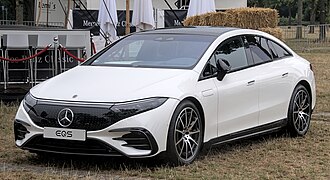
Mercedes-Benz EQS as a Used Car
The Mercedes-Benz EQS was conceived as the electric equivalent of the brand’s flagship luxury saloon, and that makes it a particularly interesting proposition on the used-car market. When new, the EQS occupied a price bracket that put it firmly among premium executive cars, but depreciation has changed the equation considerably. A well-equipped, relatively young EQS can now offer levels of comfort, refinement, technology and long-distance capability that would have required a very substantial budget when the car was new. For buyers willing to make the switch to electric driving, it can therefore look remarkably attractive as a second-hand luxury car.
The EQS arrived in Europe in 2021 and was built around Mercedes-Benz’s dedicated electric architecture rather than being a conventional combustion model converted to electric power. The result is a large, aerodynamic five-door liftback with a spacious cabin, a substantial battery and a strong emphasis on quietness and comfort. The EQS 450+ is particularly interesting as a used purchase because its rear-wheel-drive layout and efficient single-motor drivetrain prioritize range rather than outright performance. More powerful versions such as the EQS 580 4MATIC add all-wheel drive and considerably more performance, but they also introduce more equipment and complexity.
Why the EQS makes sense as a used car
A luxury-car experience for less money
The most obvious reason to consider a used EQS is depreciation. Luxury cars tend to lose value quickly, and large electric vehicles have experienced particularly significant depreciation as newer EVs have arrived with improved batteries, charging technology and software. That can work strongly in the buyer’s favour when looking at a used EQS.
Instead of paying for the prestige of owning a brand-new flagship, a second-hand buyer is primarily paying for the car’s remaining usefulness. The EQS still offers the fundamentals that made it expensive when new: excellent sound insulation, a sophisticated suspension, a high-quality interior, extensive driver assistance and an exceptionally aerodynamic body. The fact that another owner has already absorbed a substantial portion of the original depreciation can make the economics much more interesting.
Exceptional refinement
Refinement is arguably the EQS’s strongest characteristic. Electric propulsion is naturally quiet, but Mercedes-Benz went further by concentrating heavily on insulation, aerodynamics and ride comfort. At motorway speeds, the EQS can feel almost detached from the outside world, particularly when fitted with the more sophisticated suspension and larger equipment packages.
This matters even more on the used market because the EQS is not simply an electric car with luxury equipment. It was designed from the outset as a luxury EV. That distinction is important: the seating position, cabin architecture, acoustic insulation, electric drivetrain and aerodynamic shape all work together to create a relaxed long-distance car.
Battery and range
The battery is the key component to inspect
The EQS 450+ sold from 2021 to 2023 has a nominal battery capacity of approximately 120 kWh and a usable capacity of 107.8 kWh. EV Database estimates a real-world range of about 635 km for this version, although actual range naturally varies substantially with temperature, speed, weather, terrain, heating or air-conditioning use and driving style.
That large battery is one of the reasons the EQS remains attractive as a used vehicle. Battery degradation is an important concern when buying any second-hand EV, but the EQS’s relatively large original capacity means that even some loss of capacity does not necessarily make the car impractical. Nevertheless, buyers should not simply accept the dashboard range figure as proof of battery health.
A battery-health report or an independent diagnostic check is much more useful. It is also worth examining the vehicle’s charging history where available and checking whether the battery warranty remains valid. EV Database lists a 10-year/250,000-km battery warranty for the EQS 450+ specification it covers, although warranty terms can vary by market and individual vehicle, so the original Mercedes-Benz documentation should always be checked.
Charging is still competitive
The early EQS 450+ supports AC charging at up to 11 kW and DC fast charging at up to roughly 207 kW, with EV Database estimating about 28 minutes for a 10–80% charge under suitable conditions.
That means the EQS is much better suited to long journeys than its enormous dimensions and luxury-car character might initially suggest. At home, an 11 kW three-phase connection can replenish a large amount of energy overnight, while rapid charging can add hundreds of kilometres during a typical motorway stop.
It is important, however, to distinguish peak charging power from sustained charging performance. A car advertised with more than 200 kW does not necessarily charge at that power throughout the session. Battery temperature, state of charge and the particular charging station all influence the result. Preconditioning the battery before a rapid-charge stop can also make a significant difference.
What is it like to drive?
The EQS 450+ is not intended to behave like a sports saloon. Its character is much closer to that of a traditional Mercedes-Benz luxury cruiser, only with an electric powertrain. The single motor drives the rear wheels, and the car combines substantial power with a very smooth delivery.
The official numbers tell only part of the story. Instant electric torque makes the EQS feel effortless when accelerating onto a motorway or overtaking, but its greatest strength is the way it covers distance. The low aerodynamic drag, large battery and quiet cabin make it particularly well suited to sustained high-speed travel.
The more powerful EQS 580 4MATIC is a different proposition. It uses two motors and all-wheel drive, with EV Database listing a 0–100 km/h time of around 4.3 seconds for the 2023–2024 version. For a used buyer, however, the 450+ can be appealing precisely because it provides the core EQS experience without prioritizing maximum acceleration.
Interior, equipment and practicality
A remarkably modern cabin
The interior is one of the EQS’s biggest attractions. Depending on specification, the car can feature Mercedes-Benz’s large MBUX infotainment system, multiple displays, premium materials, advanced navigation and a long list of comfort and driver-assistance functions. Some examples are considerably more lavishly equipped than others, so buyers should pay close attention to the actual specification rather than assuming every EQS has every available feature.
The enormous dashboard display architecture can make the car feel technologically advanced even several years after its introduction. At the same time, this complexity is something a used buyer needs to consider. Software, displays, sensors, cameras and electronic control units all add potential sources of faults that are less common in a simpler vehicle.
Space and comfort
The EQS is a large car, and passengers benefit from that. Rear-seat accommodation is generous, while the liftback body gives the car useful luggage-carrying flexibility. The large footprint can make parking in older city centres more challenging, but many examples have extensive parking assistance and camera systems.
The ride quality is particularly dependent on specification. Air suspension was an important part of the EQS’s luxury-car character, and a prospective buyer should therefore test the suspension carefully rather than assuming that all examples will feel identical. Uneven ride height, warning messages or unusual noises deserve investigation before purchase.
What should you check before buying?
Battery condition and charging
The battery should be at the top of the inspection list. Ask for evidence of its condition and, where possible, obtain an independent battery-health report. Test both AC and DC charging if the seller permits it. A car that charges normally at both speeds provides considerably more confidence than one where charging behaviour is unexplained.
Suspension and tyres
The EQS is heavy, so tyres and suspension components have to deal with considerable loads. Inspect the tyres carefully for uneven wear and check that the car sits correctly when parked. Air suspension is excellent when functioning properly, but repairs can be expensive outside warranty.
Wheel condition also deserves attention. Large alloy wheels can be vulnerable to kerb damage, and replacing premium tyres on a heavy luxury EV is not inexpensive.
Electronics and software
Spend time using the car rather than simply taking a short test drive. Operate the infotainment system, displays, cameras, climate controls, electric seats, charging controls and driver-assistance systems. Check for warning messages and make sure that features listed in the advertisement actually work.
A Mercedes-Benz dealer or EV specialist can also check the vehicle’s diagnostic system for stored faults. This is especially valuable on a highly electronic car such as the EQS.
Service history and recalls
A complete history is preferable, even though an electric car does not require the same engine-related maintenance as a petrol or diesel vehicle. Confirm that scheduled inspections have been carried out and that any relevant software campaigns, technical updates or recalls have been completed.
The VIN should be checked with Mercedes-Benz or an authorized dealer so that the exact factory specification, campaign history and warranty status can be established.
Running costs
One of the EQS’s advantages is the relative mechanical simplicity of its electric drivetrain. There is no conventional combustion engine, exhaust system, clutch or multi-speed transmission requiring the same type of maintenance associated with a traditional luxury saloon.
That does not make the EQS cheap to run in every respect. Its weight, sophisticated suspension, large wheels, premium tyres and extensive electronics can all create significant repair bills. Insurance costs may also reflect the vehicle’s original price and replacement-part costs.
The biggest potential financial mistake is therefore to buy an exceptionally cheap EQS without investigating why it is cheap. A low purchase price can be attractive, but the condition of the battery, suspension, electronics and bodywork matters much more than a small difference in asking price.
Verdict: is a used Mercedes-Benz EQS a good idea?
A used Mercedes-Benz EQS can be an unusually compelling proposition for someone who wants a genuinely luxurious electric car rather than simply an economical EV. Its enormous battery, impressive motorway range, quiet cabin and sophisticated ride make it particularly well suited to long-distance travel. The rapid depreciation that affected many luxury EVs can also transform the EQS from an expensive new-car purchase into a much more accessible used vehicle.
The important qualification is that the EQS remains a technologically complex flagship Mercedes-Benz. Buyers should approach it more like a used luxury car than a cheap electric hatchback. A thorough inspection, documented service history, battery-health assessment and confirmation of warranty coverage are all worthwhile.
For many buyers, the EQS 450+ represents the most rational version to investigate because its single-motor drivetrain combines strong performance with excellent efficiency and range. The EQS 580 4MATIC is considerably quicker and adds all-wheel drive, but its additional performance is not essential to the fundamental EQS experience.
Ultimately, the best used EQS is not necessarily the cheapest one. It is the example with a transparent history, healthy battery, properly functioning suspension and electronics, sensible mileage and a specification that suits its next owner. Find one in that condition, and the EQS can deliver a level of electric luxury that remains impressive even as a second-hand car.
Mercedes-Benz EQS 450+ technical specifications
| Specification | EQS 450+ (2021–2023) |
|---|---|
| Body style | 5-door luxury liftback |
| Drive | Rear-wheel drive |
| Electric motor | Single electric motor |
| Battery type | Lithium-ion |
| Battery capacity, nominal | Approx. 120 kWh |
| Battery capacity, usable | 107.8 kWh |
| Electrical architecture | 400 V |
| Real-world range estimate | Approx. 635 km |
| AC charging | Up to 11 kW |
| DC fast charging | Up to approx. 207 kW |
| Estimated DC 10–80% | Approx. 28 minutes |
| 0–100 km/h | Approx. 6.2 seconds |
| Battery warranty* | Up to 10 years / 250,000 km |
| Charging connector | Type 2 / CCS |
| Battery preconditioning | Yes |
| Vehicle character | Luxury / long-distance EV |
*Warranty terms depend on market, model year and the individual vehicle’s original registration and should be confirmed with Mercedes-Benz. The battery and charging figures above are based primarily on the 2021–2023 EQS 450+ specification; later versions received battery and drivetrain updates.
