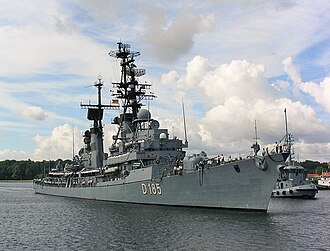
The German destroyer Lütjens (D185) was a guided-missile destroyer that served the West German Navy and, following German reunification, the German Navy from 1969 until 2003. Built in the United States by Bath Iron Works, she was the lead ship of the Lütjens class, a German adaptation of the American Charles F. Adams-class destroyers. Designed during the Cold War, the ship combined high-speed steam propulsion, naval guns, anti-aircraft missiles, anti-submarine weapons, and sophisticated radar systems to provide escort and fleet-defense capabilities in the North Atlantic, the North Sea, and other operational areas important to NATO. Her service career spanned more than three decades, during which naval technology, international security, and Germany’s position within the Western alliance changed substantially. Although she was ultimately decommissioned in December 2003 and scrapped in Turkey in 2012, Lütjens remains an important example of the guided-missile destroyers that helped shape West Germany’s postwar maritime defense.
Unlike the German warships that fought during the Second World War, Lütjens belonged to a new generation of naval vessels developed to meet the challenges of the nuclear age and the increasingly sophisticated threats faced by NATO fleets. Her mission was not limited to surface combat; she was designed to detect and engage aircraft, protect other ships from hostile submarines, attack surface targets, and contribute to coordinated fleet operations. These capabilities were particularly important in the North Atlantic, where NATO planners expected naval forces to protect sea lines of communication and reinforce the alliance’s ability to operate in the event of a major conflict. Lütjens therefore represented both a technological investment and a strategic commitment: she was part of the effort to create a modern West German navy capable of working alongside the United States and other NATO members.
The Origins of the Lütjens-Class Destroyers
West Germany’s need for a modern navy
Following the Second World War, Germany’s naval forces underwent a fundamental transformation. The former Kriegsmarine had been dismantled as part of the postwar settlement, and the emerging Federal Republic of Germany faced a different security environment from the one that had existed before 1945. As Cold War tensions increased, West Germany became a strategically important member of the Western alliance, situated near the Baltic Sea, the North Sea, and the approaches to the North Atlantic. Protecting maritime routes, supporting allied naval formations, and contributing to the defense of northern Europe required a modern fleet with capabilities that could complement those of NATO partners. The Bundesmarine, established in the 1950s, initially relied on a mixture of older vessels and equipment obtained from allied countries, but its long-term development required newer ships designed for the demands of contemporary naval warfare.
Destroyers were especially important in this context because they could perform several roles within a fleet. They could escort convoys and larger warships, engage hostile aircraft, search for submarines, attack surface vessels, and provide flexible combat capability during joint operations. By the 1960s, guided missiles and increasingly capable radar systems were transforming these missions. Traditional gun-armed destroyers were giving way to ships equipped to detect threats at greater distances and engage them with specialized weapons. West Germany needed vessels that could participate effectively in this changing environment, and the decision to procure three American-designed guided-missile destroyers provided a relatively direct route to acquiring an established and proven design. The resulting ships became the Lütjens class, comprising Lütjens (D185), Mölders (D186), and Rommel (D187).
Why West Germany selected the Charles F. Adams design
The American Charles F. Adams class was developed around the requirements of modern fleet escort and air-defense operations. These destroyers combined steam-turbine propulsion with guided-missile systems, naval guns, and anti-submarine weapons, offering a flexible platform for protecting larger naval formations. For West Germany, adopting a modified version of this design meant that the new destroyers could benefit from an established American engineering approach while incorporating modifications appropriate to German requirements. The ships were built in the United States rather than at a German shipyard, reflecting the close defense relationship between the two countries and the importance of acquiring modern naval capability during a period of rapid technological change.
The German ships were not exact copies of their American counterparts. Their configuration incorporated changes involving accommodation, communications and navigation equipment, and the arrangement of certain systems. One notable difference concerned the positioning of the sonar dome, which was arranged in a forward bulbous projection rather than in the same configuration used on the original American design. The German modifications also affected the arrangement of the ship’s upper structures and exhaust systems. These changes illustrate how an imported naval design could be adapted to the preferences and operational requirements of the purchasing navy without abandoning the basic engineering characteristics of the original class. Lütjens consequently represented both American shipbuilding expertise and West Germany’s effort to establish a modern, interoperable fleet.
Construction and Commissioning of Lütjens
Construction at Bath Iron Works
The keel of Lütjens was laid down on 1 March 1966 at Bath Iron Works in Bath, Maine, United States, under the construction number associated with the American designation DDG-28. Her construction formed part of the West German order for three guided-missile destroyers, with each vessel intended to provide a similar set of capabilities within the Bundesmarine. Bath Iron Works had experience building complex naval vessels, and the shipyard’s involvement allowed West Germany to acquire destroyers based on an established American design while avoiding the delay that might have accompanied the development of a completely new class from the ground up. The ship was launched on 11 August 1967, marking the transition from hull construction to the remaining work required to prepare her for naval service.
The naming ceremony reflected the historical and personal significance attached to the ship. Lütjens was named after Admiral Günther Lütjens, a German naval commander who had served during the Second World War and who died aboard the battleship Bismarck in May 1941. Gerda Lütjens, the admiral’s daughter-in-law, served as the ship’s sponsor at the launch ceremony, while Karl Carstens, then a senior official in the West German defense administration, delivered the ceremonial address according to published German ship histories. Naming a modern destroyer after a wartime admiral connected the emerging West German Navy to Germany’s naval traditions, while the ship’s actual role was firmly grounded in the strategic and technological conditions of the Cold War.
Delivery and commissioning in 1969
After construction and trials in the United States, Lütjens was prepared for transfer to the West German Navy. She was commissioned on 22 March 1969 and received the hull designation D185. Her commissioning marked the beginning of a service career that would continue through the final decades of the Cold War and into the period following German reunification. Once operational, she became part of the Bundesmarine’s 1st Destroyer Squadron, based at Kiel, where her principal responsibilities included contributing to the maritime defense of West Germany and supporting NATO operations. Her arrival represented an important improvement in the navy’s capabilities because she could combine air defense, anti-submarine warfare, and surface combat within one modern platform.
Lütjens’s early career also included an unusual incident during her arrival in German waters. According to German naval histories, the ship ran aground near Friedrichsort in Kiel Fjord after her transatlantic passage, damaging the sonar dome beneath the hull. The incident has been associated with confusion arising from the use of different measurement conventions during navigation, with depths or measurements from American trials being interpreted incorrectly when the vessel entered German waters. Although the ship was subsequently repaired and entered regular service, the episode illustrates the practical difficulties involved in transferring a sophisticated warship between countries, particularly when navigation procedures, technical documentation, and operating conventions must be reconciled. It was an early reminder that even a modern guided-missile destroyer depended on careful navigation, reliable information, and well-coordinated procedures as much as on advanced weapons and sensors.
Design and Technical Characteristics
Hull dimensions and displacement
Lütjens was a large destroyer by the standards of many contemporary European navies, with an overall length of approximately 134.4 meters, a beam of around 14.4 meters, and a deep-load draft generally reported as approximately 6.1 meters, although some technical references give a smaller draft figure under different measurement conditions. Her displacement is likewise reported differently depending on the source and whether the figure represents standard, full-load, or another loading condition. Commonly cited figures place her full-load displacement at roughly 4,500–4,720 metric tonnes, making her a substantial platform for a combination of missile launchers, guns, radar equipment, sonar, and the machinery needed to power the ship at high speed. These dimensions gave the vessel sufficient internal volume for weapons, command spaces, crew accommodation, fuel, and technical equipment, while her long hull supported the high-speed performance expected of a fleet destroyer.
The design reflected the priorities of Cold War naval warfare. A destroyer had to be capable of accompanying larger warships, responding quickly to emerging threats, and operating for extended periods away from its home port. Its hull therefore needed to accommodate not only propulsion machinery but also a complex network of sensors, weapon systems, communications equipment, and supporting electrical systems. The ship’s dimensions also reflected the demands of high-speed steam propulsion, which required substantial boiler and turbine spaces. Unlike a modern vessel designed around compact gas turbines or integrated electric propulsion, Lütjens carried a traditional steam plant that occupied considerable internal volume but delivered the power necessary for rapid movement across large areas of ocean.
Steam-turbine propulsion
One of Lütjens’s defining technical characteristics was her steam-turbine propulsion system. Four high-pressure boilers supplied steam to two geared steam turbines, which drove two propeller shafts. The combined output is commonly listed at approximately 70,000 shaft horsepower, or around 52 megawatts, allowing the ship to attain speeds exceeding 30 knots. Depending on the reference and the precise performance figure being quoted, her maximum speed is listed at approximately 33–36 knots. Her published operational range was about 4,500 nautical miles at 20 knots, a useful combination of speed and endurance for a destroyer expected to operate across the North Atlantic and North Sea.
The advantages of this arrangement included high power output and the ability to sustain the speed required for fleet operations. A destroyer operating with a carrier group or other naval formation might need to reposition rapidly, intercept a contact, or maneuver to protect a high-value unit. Steam turbines could deliver the necessary power, but the system also imposed substantial maintenance requirements. Boilers, turbines, fuel systems, and associated machinery required specialized technical knowledge, and generating high speeds demanded considerable fuel consumption. Lütjens’s propulsion system consequently reflected the engineering priorities of the period in which she was designed: dependable high-speed performance was central to her mission, even though later naval generations would increasingly adopt gas turbines and other propulsion arrangements that offered different maintenance and operating characteristics.
Range, endurance, and operational mobility
A destroyer’s maximum speed is only one part of its performance. Equally important are the distances it can travel between refueling stops, the time it can remain at sea, and its ability to maintain useful speed in different weather conditions. Lütjens’s commonly cited range of approximately 4,500 nautical miles at 20 knots gave her the ability to undertake extended deployments, although actual endurance depended on fuel reserves, machinery condition, operating speed, weather, and the demands of the mission. Higher speeds increased fuel consumption considerably, so the ship could not simply travel at maximum speed throughout an entire deployment without reducing her practical range. This trade-off was particularly relevant during NATO exercises, when a destroyer might need to move quickly for a limited period and then continue operating for days or weeks at a more economical speed.
Her range and mobility made Lütjens suitable for the maritime geography of northern Europe. The North Sea, the Baltic approaches, and the North Atlantic required naval forces to operate across large areas while protecting sea lines of communication and coordinating with allied ships and aircraft. The ability to move quickly between operating areas was valuable in a situation where the location and nature of a potential threat could change rapidly. Nevertheless, Lütjens was not intended to act alone in every circumstance. Her effectiveness depended on the wider naval system, including reconnaissance, maritime patrol aircraft, allied surface forces, logistics support, and shore-based command arrangements.
Armament: Missiles, Guns, and Anti-Submarine Weapons
The Mk 13 missile launcher and Tartar air defense system
Lütjens was built around a guided-missile air-defense concept that distinguished her from older gun-focused destroyers. Her original configuration included a single-arm Mk 13 launcher associated with the Tartar surface-to-air missile system, later using improved Standard Missile variants as the class was modernized. The launcher could engage airborne threats at ranges beyond those of the ship’s short-range guns, while the ship’s radar and fire-control equipment helped detect targets and guide engagements. The system was particularly important in the context of NATO fleet defense, where protecting ships from hostile aircraft and missile-carrying platforms was a central operational concern. Published descriptions list a magazine capacity of approximately 40 missiles for the original launcher, although the actual load carried on a particular deployment could vary with operational requirements.
The significance of guided missiles lay in their ability to extend a ship’s defensive reach. Conventional anti-aircraft guns required targets to enter relatively close engagement ranges, whereas missile systems allowed a destroyer to attack threats at greater distances, provided that detection and fire-control conditions were suitable. This capability did not make the ship invulnerable to air attack; missile performance depended on target characteristics, radar tracking, electronic interference, and the number and direction of incoming threats. However, the Tartar and later Standard Missile systems gave Lütjens a role in layered fleet defense, complementing the guns and electronic systems carried aboard the ship and the wider defenses of the naval formation.
The introduction of Standard Missiles
As the Cold War progressed, missile technology advanced and older air-defense systems required modernization. Lütjens underwent an upgrade to the Type 103A configuration between 1976 and 1977, with improvements to the missile and fire-control systems. The Standard Missile family provided an updated capability compared with the original Tartar missiles, helping extend the useful operational life of the destroyer without requiring a completely new hull. These changes were part of a wider effort to maintain the combat effectiveness of ships whose basic design had been established in the 1960s but which remained valuable into later decades.
Modernization was particularly important for a ship intended to serve in a technology-intensive role. Radar systems, missile guidance, communications, and electronic warfare evolved rapidly, and a destroyer built to operate against the threats anticipated in the 1960s could not necessarily retain the same level of effectiveness indefinitely without modification. Updating the missile system and its supporting electronics helped Lütjens remain relevant to the changing requirements of NATO. The modernization did not erase the limitations of the original design, but it demonstrates how navies extend the service lives of major warships by replacing or upgrading important components rather than abandoning the entire platform at the first sign of technological change.
The Rolling Airframe Missile upgrade
A further important stage in Lütjens’s development came with the introduction of the RIM-116 Rolling Airframe Missile, commonly known as RAM, in the mid-1990s. This short-range defensive missile was designed to provide a rapid-response layer against threats that might penetrate a ship’s longer-range defenses. The ship’s later configuration included RAM launchers, supplementing rather than simply replacing the longer-range air-defense capability. The system was especially relevant to the changing nature of naval threats, as anti-ship missiles and other fast-moving targets placed increasing demands on close-in defensive systems.
The addition of RAM illustrates the principle of layered defense. A ship might first detect a threat with its surveillance radar, assess it through its combat system, and engage it with a longer-range missile when conditions permitted. If the threat continued to approach, shorter-range weapons could provide another opportunity to intercept it. No defensive system could guarantee success in every scenario, and the performance of the overall arrangement depended on detection, reaction time, engagement geometry, and the characteristics of the incoming weapon. Nevertheless, the addition of a modern close-in missile system gave Lütjens a defensive capability that was more appropriate to the later stages of her service than the original configuration alone.
The 127 mm naval guns
In addition to her missile systems, Lütjens carried two 127 mm (5-inch) Mk 42 naval guns, one forward and one aft. These guns could engage surface targets and provide naval gunfire support, while also offering a degree of capability against certain airborne targets within their engagement limits. The Mk 42 was a widely used American naval gun design, and its presence aboard Lütjens reflected the broader influence of the Charles F. Adams-class design on the German ship. The guns gave the destroyer a weapon that could be used without expending guided missiles, an important consideration for surface engagements, warning shots, and other situations in which conventional naval gunfire was appropriate.
Naval guns remained useful even as guided missiles became central to modern destroyer design. Missiles were expensive, depended on specialized launch and guidance systems, and were not necessarily the most appropriate weapon for every task. A gun could deliver repeated fire against a surface target and could be useful in circumstances where the tactical situation did not require a missile engagement. The two Mk 42 mounts therefore provided Lütjens with a complementary capability, allowing the ship to perform a range of surface-combat and support tasks in addition to her principal air-defense and anti-submarine missions.
ASROC and anti-submarine warfare
Anti-submarine warfare was another central part of Lütjens’s role. Her original configuration included an eight-cell RUR-5 ASROC launcher, which allowed the ship to deliver an anti-submarine weapon toward a suspected submarine contact at a distance beyond that of conventional torpedo tubes alone. ASROC combined a rocket-powered delivery method with an anti-submarine payload, reducing the time required to place a weapon near a target area once a submarine contact had been identified. The ship also carried six 324 mm torpedo tubes arranged in two triple mounts, with compatible lightweight torpedoes listed among her weapons. Together with the ship’s sonar, these systems provided a layered set of tools for detecting, tracking, and attacking submarines.
The importance of anti-submarine warfare was closely linked to NATO’s strategic concerns during the Cold War. Submarines could threaten merchant shipping, naval formations, and high-value units, while the North Atlantic’s maritime routes were vital to reinforcing Europe in the event of a major conflict. A destroyer equipped with sonar, torpedoes, and ASROC could contribute to the search for hostile submarines and coordinate with other ships and aircraft in a broader anti-submarine effort. Its effectiveness depended on environmental conditions, the quality of contact information, and cooperation with other forces, but these weapons gave Lütjens an important mission beyond air defense alone.
Electronic warfare and defensive countermeasures
As missile threats and electronic detection systems became more sophisticated, a destroyer’s survivability increasingly depended on electronic warfare and countermeasures. Lütjens’s later equipment included systems for electronic support and countermeasures, along with chaff and flare launchers intended to complicate the targeting of incoming weapons. Chaff can create radar-reflective decoys, while flares are primarily associated with infrared countermeasures; the effectiveness of such systems depends on the type of threat and the way the countermeasures are deployed. The ship was also fitted with a towed torpedo decoy, identified in published technical listings as the AN/SLQ-25 Nixie system, which was designed to divert or confuse certain incoming torpedoes.
These systems demonstrate how naval defense evolved beyond guns and missiles alone. A ship needed to detect threats, understand their characteristics, coordinate its response, and attempt to prevent hostile weapons from achieving a successful engagement. Electronic support equipment could help identify emissions and provide warning of potential threats, while decoys and jamming systems could interfere with an adversary’s ability to maintain a reliable target track. Lütjens’s changing electronic equipment reflected the increasing importance of these capabilities during the later decades of her career, when anti-ship missiles, radar-guided weapons, and more sophisticated electronic systems had become important considerations in naval planning.
Radar, Sonar, and the Ship’s Combat Information Systems
Air-surveillance and tracking radar
Lütjens carried a collection of radar systems designed to provide situational awareness and support the engagement of different target types. Published equipment lists identify the AN/SPS-40 air-surveillance radar, the AN/SPS-52 three-dimensional air-search radar, and the AN/SPS-67 surface-surveillance radar, alongside specialized fire-control radars. These systems served different purposes: broad surveillance helped identify contacts over a wide area, three-dimensional radar provided information on target altitude as well as bearing and range, and fire-control radars supplied more precise tracking information for weapon engagement. The exact combination of equipment changed as the ship was modernized, so the full list should be understood as describing her service-era configurations rather than implying that every sensor remained unchanged throughout her career.
The value of these sensors lay in the way they worked together. A destroyer could not effectively defend a fleet merely by carrying powerful weapons; it needed to detect potential threats early enough to evaluate them and respond. Radar information could be combined with communications from other ships and aircraft, while fire-control systems helped determine whether a target could be engaged. The development of three-dimensional air-surveillance radar was especially important because the altitude of an airborne target could affect the assessment of its threat and the selection of an appropriate response. In a NATO formation, this information could also contribute to a wider picture of the air and surface environment, supporting coordinated action across several units.
Sonar and underwater detection
Lütjens also carried sonar equipment for anti-submarine warfare, including the DSQS-21 series identified in later technical descriptions. Sonar enabled the ship to search for underwater contacts by using sound propagation in the ocean, an environment in which conventional radar could not directly detect submerged submarines. Active sonar transmits sound pulses and examines returning echoes, while passive sonar listens for sounds generated by other vessels. Both approaches have advantages and limitations: detection can be affected by water temperature, salinity, depth, background noise, seabed characteristics, and the acoustic behavior of the target. A destroyer therefore required trained operators and careful interpretation of sensor information rather than relying on a single instrument to provide a complete picture of underwater activity.
The sonar dome incident during Lütjens’s arrival in German waters provides an especially interesting connection between the ship’s technical design and her early operational history. The forward sonar installation was an important component of her anti-submarine capability, and damage to the dome affected a system that could not simply be replaced by the ship’s radar or guns. The incident illustrates how specialized sensors were integral to the destroyer’s mission and how damage to one component could compromise a particular area of combat capability. Her later service depended not only on keeping propulsion and weapons operational but also on maintaining the sensors that allowed those weapons to be used effectively.
The combat information center
The information collected by radar, sonar, electronic support systems, and communications equipment needed to be processed and interpreted before it could guide a tactical decision. A modern destroyer therefore relied on a combat information organization that brought together sensor operators, command personnel, and weapon-control specialists. The precise arrangement and equipment aboard Lütjens evolved over her decades of service, but the underlying task remained consistent: convert a mass of technical information into an understandable operational picture that allowed the commanding officer and the ship’s team to assess threats and coordinate action.
This aspect of the ship’s design is particularly important because it demonstrates that modern naval combat depends on information as much as on hardware. A missile launcher is only useful if the ship can detect an appropriate target, establish a reliable track, and authorize an engagement under the applicable rules and tactical circumstances. Similarly, an anti-submarine weapon depends on the quality of underwater contact information. Lütjens’s combination of surveillance radars, fire-control sensors, sonar, and communications equipment reflected the transition from the traditional gun-centered destroyer toward the integrated guided-missile combatant.
Modernization Throughout the Cold War
The Type 103A upgrade, 1976–1977
The first major modernization of Lütjens took place between August 1976 and August 1977, when the ship was upgraded to the Type 103A standard. The work was intended to improve her combat systems and extend the usefulness of a design that had entered service during the late 1960s. By the middle of the 1970s, guided-missile technology, radar equipment, and fire-control systems were developing rapidly, making modernization increasingly important for destroyers expected to remain operational for many years. Updating the ship’s equipment allowed the navy to preserve the advantages of her established hull and propulsion system while improving important parts of her combat capability.
Modernization was not simply a matter of installing newer weapons. A guided-missile system depended on supporting radar, fire-control equipment, electrical power, communications, and trained personnel. Changes to one component could therefore require adjustments to other parts of the ship’s combat organization. The Type 103A upgrade formed part of a continuing process through which the German Navy sought to maintain Lütjens’s usefulness without replacing the vessel entirely. The ship’s service life illustrates the practical balance faced by naval planners: new construction could deliver substantial technological improvements, but upgrading existing vessels could preserve valuable capabilities at a lower cost and with less disruption than building an entirely new fleet.
The Type 103B modernization, 1985–1986
A second major upgrade took place between April 1985 and March 1986, when Lütjens was converted to the Type 103B standard. This modernization further adapted the destroyer to the changing requirements of naval warfare during the later Cold War. One of the most notable developments associated with the Type 103B configuration was the addition of the Rolling Airframe Missile system in the following years, providing a modern short-range defensive layer. The upgrade also reflected the continuing need to maintain electronic systems and combat capabilities on ships that had been designed nearly two decades earlier.
The Type 103B period illustrates how the Lütjens class remained relevant through a combination of established engineering and incremental technological improvements. The hull, steam turbines, and basic arrangement of the ship remained rooted in the original American design, but changes to weapons and electronics allowed the vessel to adapt to new requirements. This approach had limitations: modernization could not completely eliminate the constraints of an older hull or a traditional steam propulsion plant, and the cost of keeping increasingly complex systems operational could rise over time. Nevertheless, the upgrade helped preserve Lütjens’s role as a capable guided-missile destroyer during the closing years of the Cold War.
A destroyer adapting to the end of the Cold War
The end of the Cold War transformed the strategic environment in which Lütjens operated. The collapse of communist governments across Eastern Europe, the reunification of Germany in 1990, and the dissolution of the Soviet Union in 1991 changed the assumptions that had shaped NATO’s maritime planning for decades. The North Atlantic and northern European waters remained important, but the immediate prospect of a large-scale naval confrontation between NATO and the Soviet-led Warsaw Pact diminished. German naval forces consequently had to adapt to a wider set of missions, including alliance exercises, maritime security, and international cooperation.
Lütjens remained in service through this transition, providing continuity between two very different strategic periods. Her equipment and operating procedures had been developed during the Cold War, but her later service took place in a more complex environment in which NATO members were reassessing the purposes and structure of their armed forces. The ship’s eventual retirement in 2003 reflected not only her age but also the continuing development of naval technology and the changing requirements of the German Navy. Her career thus provides a useful example of how a major warship can outlast the strategic circumstances for which it was originally designed.
Operational Service and NATO Commitments
The 1st Destroyer Squadron at Kiel
After commissioning, Lütjens became part of the 1st Destroyer Squadron, based at Kiel. This location was strategically important because it connected the German Navy with the Baltic Sea and the North Sea through the waters around Schleswig-Holstein. From Kiel, the ship could deploy into northern European operating areas and participate in NATO exercises intended to improve coordination between allied navies. Her role was particularly relevant to the defense of sea lines of communication and the protection of naval formations operating near the approaches to northern Europe.
Operating from Kiel also placed Lütjens within a wider German naval organization that included frigates, smaller combatants, support ships, and other specialized vessels. A destroyer could not perform every maritime mission independently, and its effectiveness depended on coordination with other units. In fleet exercises, the ship might contribute air-defense coverage, anti-submarine capabilities, communications, or other services depending on the scenario. These activities helped develop the skills needed to operate within a multinational naval force, where ships built by different countries had to coordinate procedures, exchange information, and work toward common objectives.
NATO exercises in the Atlantic and Mediterranean
Throughout her career, Lütjens participated in numerous NATO exercises and deployments. Published German ship histories associate the Lütjens class with the standing Atlantic and Mediterranean naval formations commonly known as STANAVFORLANT and STANAVFORMED. These multinational formations helped allied navies maintain a continuing presence at sea, practice combined operations, and develop familiarity with one another’s equipment and procedures. For West Germany, participation in these activities demonstrated that its modern destroyers were not merely national defense assets but also ships capable of contributing to collective alliance operations.
The importance of such exercises extended beyond the tactical performance of individual ships. Crews had to coordinate communications, navigation, formation maneuvers, replenishment procedures, air-defense activities, and anti-submarine exercises with vessels operating under different national commands. This work was particularly valuable during the Cold War, when NATO expected its naval forces to operate across wide geographic areas under demanding circumstances. By participating in these activities, Lütjens helped maintain the practical interoperability on which a multinational maritime alliance depended. The ship’s role was therefore both military and organizational: she contributed her own capabilities while also helping reinforce the ability of allied forces to operate together.
Operation Active Endeavour
In the years following the terrorist attacks of 11 September 2001, NATO increased its maritime security activities in the Mediterranean. Operation Active Endeavour was established to help deter terrorist activity and monitor maritime movements in the region. Lütjens’s later service included participation in this post-Cold War security environment, demonstrating how a destroyer originally designed for fleet defense against conventional military threats could be employed in a different operational context.
Maritime security missions differ in important ways from traditional naval warfare. Rather than concentrating exclusively on preparing for a large-scale engagement, ships may be tasked with surveillance, monitoring traffic, maintaining a visible presence, and cooperating with allied authorities. These activities still require capable sensors, communications, trained personnel, and reliable machinery, but their operational priorities may be quite different from those of a high-intensity fleet battle. Lütjens’s continued service in the early twenty-first century illustrates how existing warships could contribute to evolving alliance responsibilities even as the strategic environment that originally shaped their design changed.
The September 2001 Incident: A Symbol of German-American Solidarity
Meeting American destroyers at sea
One of the most widely remembered episodes in Lütjens’s history occurred on 14 September 2001, three days after the terrorist attacks in the United States. During an encounter with American naval vessels, Lütjens’s crew manned the rails, displayed an American flag, and unfurled a banner reading “We Stand By You.” The gesture was a visible expression of solidarity with the United States at a moment of national mourning and uncertainty. It became an especially memorable event in the ship’s history because it conveyed a political and human message through the traditional practices of naval service rather than through a formal declaration or a combat operation.
Manning the rails is a long-established naval custom in which crew members line the visible sides of a ship during certain ceremonial occasions or official encounters. The practice can be used to honor visiting officials, mark significant events, or demonstrate respect between vessels. In September 2001, the display aboard Lütjens gave the tradition a particularly poignant meaning. The American flag and the banner expressed support for the ship’s allies in the aftermath of the attacks, and the event became a reminder that naval service is shaped not only by weapons and operational orders but also by relationships among sailors and the nations they represent.
The wider significance of the gesture
The message displayed by Lütjens reflected the broader solidarity shown by Germany and other NATO members following the attacks. The alliance invoked Article 5 of the North Atlantic Treaty for the first time in its history, recognizing the attacks as an event that triggered the collective-defense principle. The destroyer’s gesture was not itself the legal or operational mechanism of that decision, but it provided a tangible illustration of the personal and institutional relationships underlying the alliance. For a German warship named after an admiral from the Second World War, the moment also reflected the transformation of Germany’s postwar military identity into that of a democratic state operating in close partnership with its former wartime adversaries.
The incident is often remembered because it captures a human dimension of naval history that technical specifications cannot convey. Lütjens was designed to detect threats, launch missiles, and support allied forces in maritime operations, yet one of her most recognizable moments involved a flag and a simple message of support. It demonstrates that a warship’s historical significance can arise from ceremonial encounters and acts of solidarity as well as from combat, technological innovation, or long deployments. The event became a lasting part of the ship’s legacy and a fitting example of how naval traditions can communicate shared purpose across national boundaries.
Life Aboard a Cold War Destroyer
The demands of a large ship’s crew
Operating Lütjens required a substantial crew, with published sources commonly listing a complement in the region of 330–340 personnel, although the precise figure varies by source and configuration. The crew included officers and enlisted sailors responsible for navigation, engineering, weapons, radar, sonar, communications, supply, medical support, and the many other tasks required to keep a complex warship operational. Unlike a small patrol vessel, a guided-missile destroyer carried multiple interconnected systems that had to remain ready for use during lengthy periods at sea. The ship’s operational effectiveness therefore depended on a combination of individual expertise, departmental coordination, and disciplined routines.
Life aboard a steam-powered destroyer also involved considerable engineering work. The propulsion plant required boiler and turbine specialists, while electrical systems, pumps, ventilation, sensors, and weapon equipment needed regular inspection and maintenance. Combat readiness depended on keeping all these systems available even when the ship was conducting routine patrols or participating in exercises rather than facing an immediate threat. A destroyer could spend much of its time training, sailing between operating areas, conducting maintenance, and preparing for future assignments, but it still had to be capable of responding to a rapidly developing situation. This combination of routine technical work and readiness for sudden action defined much of the professional life of the crew.
Training, discipline, and multinational cooperation
Training was central to Lütjens’s operational role because the ship’s capabilities depended on close coordination between many departments. Missile engagements required the interaction of radar operators, fire-control specialists, weapons personnel, and command staff. Anti-submarine warfare depended on sonar operators, tactical decision-making, and coordination with other ships or aircraft. Navigation and formation work demanded close attention to orders, communications, and the movements of neighboring vessels. Regular exercises helped ensure that these activities could be carried out effectively under pressure and in cooperation with allied forces.
Multinational operations added another layer of complexity. NATO ships might differ in equipment, language, communication procedures, and operational traditions, yet they were expected to exchange information and work toward common objectives. Lütjens’s participation in alliance exercises therefore required more than technical competence within the ship itself; it also depended on the crew’s ability to integrate with other units. This aspect of the ship’s service is important because interoperability is not achieved merely by purchasing compatible weapons. It must be developed through training, common procedures, practical experience, and sustained cooperation among personnel from different navies.
Decommissioning and the End of an Era
The final years of Lütjens
By the beginning of the twenty-first century, Lütjens had served for more than three decades. During that time, she had experienced the final years of the Cold War, German reunification, the restructuring of NATO, and the emergence of new maritime security missions. Although modernization had improved her combat systems, her basic hull and steam-turbine propulsion plant remained products of the 1960s. Maintaining an older destroyer required increasing attention to machinery, spare parts, equipment obsolescence, and the integration of aging systems with newer technology. These practical considerations became increasingly important as the German Navy developed newer vessels and reassessed the balance between maintaining existing ships and acquiring more modern platforms.
The ship’s lengthy career nevertheless demonstrated the value of a robust original design combined with periodic modernization. Lütjens had remained useful through major technological and political changes because her weapons, sensors, and defensive systems had been upgraded to meet evolving requirements. Her continued participation in NATO activities and post-2001 maritime security operations showed that an older platform could still contribute to naval missions when properly maintained and employed within its capabilities. However, modernization could not eliminate every limitation associated with a ship designed in the 1960s, and the decision to retire her reflected the practical realities of maintaining an aging combatant within a modern fleet.
The decommissioning ceremony of 18 December 2003
Lütjens was decommissioned on 18 December 2003, bringing to an end more than 34 years of commissioned service. She was the last steam-powered vessel and the last ship officially classified as a destroyer in the German Navy at the time of her retirement. Her departure marked a symbolic transition away from an era in which large steam-powered guided-missile destroyers had been a central part of West Germany’s maritime defense. The ship had served across the Cold War and beyond, but by 2003 the German Navy was moving toward a different fleet structure and newer classes of warships.
The end of Lütjens’s service was significant because she represented more than an individual vessel. She was the lead ship of a class that had helped establish the Bundesmarine as a modern naval force capable of operating alongside the United States and other NATO allies. Her retirement closed a chapter in German naval history that began with the rearmament and reconstruction of West Germany during the 1950s and 1960s. It also demonstrated how the development of naval technology gradually changes the role of older vessels: a ship that once represented advanced capability eventually becomes difficult to maintain economically when newer designs offer different combinations of sensors, weapons, automation, and operating efficiency.
Scrapping in Turkey
After her decommissioning, Lütjens was eventually sold for scrapping and taken to Turkey, where she was dismantled in August 2012 according to commonly cited ship histories. The end of her physical existence contrasted with the long period during which she had served as an operational warship. Unlike a preserved museum vessel, she did not survive intact as a public exhibit, meaning that her history must now be explored through written records, official histories, technical references, and archival photographs.
The dismantling of Lütjens also reflects a common outcome for large naval vessels once their active service ends. Preserving a destroyer requires significant resources, including suitable docking facilities, structural maintenance, environmental controls, and long-term funding. Many decommissioned warships are therefore recycled rather than retained as museums. Although scrapping removes the physical vessel, it does not erase the historical significance of her design and service. Lütjens remains a useful subject for understanding the evolution of guided-missile destroyers, the development of the West German Navy, and the changing requirements of NATO maritime defense.
The Lütjens Class and Its Place in Naval History
The three ships of the class
The Lütjens class consisted of three guided-missile destroyers built by Bath Iron Works in the United States for the West German Navy. Alongside Lütjens (D185), the class included Mölders (D186) and Rommel (D187). All three were based on the American Charles F. Adams design, adapted to meet German requirements. Their common characteristics included steam-turbine propulsion, guided-missile air defense, naval guns, and anti-submarine weapons, making them versatile combatants suited to the needs of NATO during the Cold War.
The service histories of the three ships also demonstrate how a class can share a common design while developing different operational records. Lütjens was commissioned first and gave her name to the class; Mölders and Rommel followed in 1969 and 1970. Their retirement dates differed, with Rommel leaving service in 1999, Mölders in 2003, and Lütjens in December 2003. These differences reflect the fact that individual ship careers are shaped by maintenance, modernization, operational requirements, and decisions about fleet replacement rather than by design characteristics alone. Together, the three destroyers formed a significant part of West Germany’s maritime combat capability for several decades.
From the Charles F. Adams class to modern German destroyers
The Lütjens class represented an important step in the development of the German Navy, but it was not the final stage of that development. Advances in radar, missile technology, electronic warfare, propulsion, and command systems gradually created new expectations for modern surface combatants. Newer German frigates and other warships adopted different combinations of sensors, weapons, and mission capabilities, while later naval programs increasingly emphasized digital integration and the ability to coordinate multiple functions through more advanced combat-management systems. Lütjens’s retirement in 2003 therefore formed part of a broader transition toward a new generation of naval platforms.
The comparison between Lütjens and later ships also highlights the pace of technological change in naval warfare. In the 1960s, a guided-missile destroyer with advanced radar and a powerful steam plant represented a major improvement over older gun-armed vessels. By the beginning of the twenty-first century, however, electronic systems, precision weapons, and evolving operational requirements had changed the criteria used to evaluate a modern combatant. The Lütjens class remained historically important not because it could satisfy every later requirement, but because it represented a successful generation of warships that helped bridge the gap between traditional destroyers and more modern surface combatants.
Summary Table of German Destroyer Lütjens Technical Specifications
The following table summarizes the principal technical characteristics of Lütjens (D185). Because the ship underwent several modernizations during her service, the listed armament and electronic systems reflect a combination of her original design and later configurations. Displacement, crew size, and maximum speed also vary slightly among published references, so approximate values are identified accordingly.
| Specification | Details |
|---|---|
| Official name | Lütjens |
| Hull number | D185 |
| Ship type | Guided-missile destroyer |
| Class | Lütjens class |
| Original design | Modified American Charles F. Adams class |
| Builder | Bath Iron Works |
| Construction location | Bath, Maine, United States |
| Construction number | 351 |
| Keel laid | 1 March 1966 |
| Launched | 11 August 1967 |
| Commissioned | 22 March 1969 |
| Decommissioned | 18 December 2003 |
| Namesake | Admiral Günther Lütjens |
| Home port | Kiel, West Germany/Germany |
| Standard displacement | Approximately 3,370–3,570 tonnes, depending on source |
| Full-load displacement | Approximately 4,500–4,720 tonnes |
| Overall length | Approximately 134.4 m |
| Beam | Approximately 14.4 m |
| Draft | Approximately 4.5–6.1 m, depending on reference and measurement |
| Propulsion | 4 high-pressure boilers and 2 geared steam turbines |
| Propeller shafts | 2 |
| Total power output | Approximately 70,000 shaft horsepower (52 MW) |
| Maximum speed | Approximately 33–36 knots |
| Range | Approximately 4,500 nautical miles at 20 knots |
| Crew complement | Approximately 330–340 personnel |
| Main guns | 2 × 127 mm (5-inch) Mk 42 naval guns |
| Original air-defense system | Mk 13 single-arm launcher with Tartar missiles |
| Later air-defense missiles | Standard Missile variants |
| Close-in missile defense | RIM-116 Rolling Airframe Missile (RAM), added during later service |
| Anti-submarine rocket system | 1 × eight-cell RUR-5 ASROC launcher |
| Torpedo armament | 2 × triple 324 mm torpedo tubes |
| Original radar systems | Included AN/SPS-40 air-surveillance radar and other tracking and fire-control systems |
| Later radar systems | Included AN/SPS-52 three-dimensional radar and AN/SPS-67 surface-surveillance radar |
| Sonar | DSQS-21 series, with configuration varying over time |
| Defensive countermeasures | Chaff and flare launchers, electronic warfare equipment, and torpedo decoy systems |
| First major modernization | Type 103A, 1976–1977 |
| Second major modernization | Type 103B, 1985–1986 |
| Major operational commitments | Cold War fleet defense, NATO exercises, Atlantic and Mediterranean deployments, later maritime security |
| Notable historical event | “We Stand By You” solidarity display following the September 11, 2001 attacks |
| Final disposition | Scrapped in Turkey in August 2012 |
Technical note: The table combines commonly cited characteristics from different periods of the ship’s career. It should not be interpreted as a claim that every listed weapon or sensor was fitted simultaneously in the original 1969 configuration.
Conclusion
The German destroyer Lütjens (D185) was a significant warship in the development of West Germany’s postwar navy and in NATO’s maritime defense during the Cold War. Built in the United States as a modified Charles F. Adams-class destroyer, she entered service in 1969 with a combination of high-speed steam propulsion, guided-missile air defense, naval guns, anti-submarine weapons, radar, and sonar. Her subsequent modernizations helped maintain her combat capabilities as technology and operational requirements evolved, allowing her to serve through the final decades of the Cold War and into the early twenty-first century.
Her career was defined by more than technical performance. Lütjens participated in NATO exercises, contributed to multinational naval operations, and remained in service during the transition from the Cold War to a different international security environment. The display of the American flag and the “We Stand By You” banner in September 2001 became one of her most memorable moments, demonstrating the human and diplomatic dimensions of naval service. Her decommissioning in December 2003 and eventual scrapping in Turkey marked the end of a vessel that had served for more than three decades, but her history continues to illuminate the evolution of guided-missile destroyers and the transformation of the German Navy.
Ultimately, Lütjens represents an important stage in the history of modern naval warfare. She combined the established engineering of the steam-powered destroyer with increasingly sophisticated missile and sensor systems, demonstrating how navies adapted existing designs to meet changing strategic needs. Her long service life, repeated modernization, and participation in allied operations make her a valuable subject for anyone interested in Cold War naval history, German military development, and the technological evolution of surface combatants.
