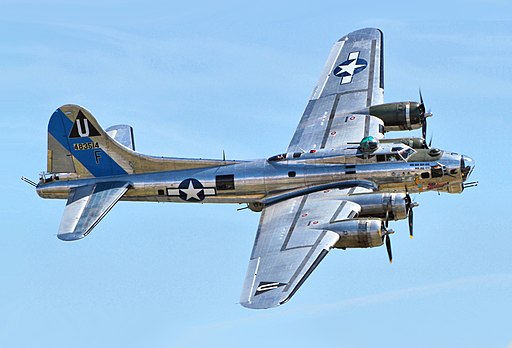
Boeing B-17 Flying Fortress
The Boeing B-17 Flying Fortress stands as an iconic symbol of American air power during World War II. Introduced in the 1930s, this legendary aircraft played a pivotal role in shaping the course of history. Renowned for its ruggedness, firepower, and long-range capabilities, the B-17 earned its moniker “Flying Fortress” through its ability to withstand extensive combat damage and return its crew safely home. Armed with machine guns positioned throughout its fuselage, the B-17 could deliver devastating firepower to enemy targets, earning it a fearsome reputation among adversaries.
One of the most notable characteristics of the B-17 was its ability to operate in daylight bombing raids over Nazi-occupied Europe—a strategy that showcased the aircraft’s resilience and effectiveness in combat. Flying in tight formations known as “combat boxes,” B-17 squadrons braved enemy fighter attacks and anti-aircraft fire to strike strategic targets deep within enemy territory. Despite facing formidable opposition, the B-17’s defensive armament and sturdy construction enabled it to press on with its missions, delivering precision strikes against key industrial and military sites.
Beyond its combat prowess, the B-17 played a crucial role in shaping the Allied victory in World War II. Its ability to conduct long-range bombing missions helped to cripple enemy infrastructure and morale, paving the way for Allied ground offensives and ultimately leading to the defeat of Nazi Germany. The B-17’s legacy extends far beyond the battlefield, earning it a place of honor in the annals of aviation history and the hearts of those who served aboard and supported these legendary aircraft.
Boeing B-17 Flying Fortress parameters
Here are the parameters of the Boeing B-17 Flying Fortress:
- Dimensions:
- Wingspan: Approximately 31.62 meters (104 feet)
- Length: Approximately 22.66 meters (74 feet 9 inches)
- Height: Approximately 5.82 meters (19 feet 1 inch)
- Weight:
- Empty Weight: Approximately 16,400 kilograms (36,000 pounds)
- Maximum Takeoff Weight: Approximately 29,500 kilograms (65,000 pounds)
- Engines:
- The Boeing B-17 was typically equipped with four Wright R-1820 Cyclone radial engines.
- Each engine produced around 1,200 to 1,200 horsepower.
- Performance:
- Maximum Speed: Approximately 287 miles per hour (462 kilometers per hour)
- Range: Around 2,000 miles (3,200 kilometers)
- Service Ceiling: Approximately 35,000 feet (10,670 meters)
- Armament:
- Defensive armament included various combinations of .50 caliber machine guns positioned throughout the aircraft, including nose, top, ball, and tail turrets.
- The B-17G variant, the most produced model, typically carried 13 machine guns.
- Capacity:
- Crew: The typical crew complement included a pilot, co-pilot, bombardier, navigator, radio operator, and gunners.
- The B-17 could carry a bomb load of up to 8,000 pounds (3,600 kilograms) internally and externally.
These parameters represent the general specifications of the Boeing B-17 Flying Fortress, which varied slightly depending on the model and modifications made throughout its production history.
.jpg)