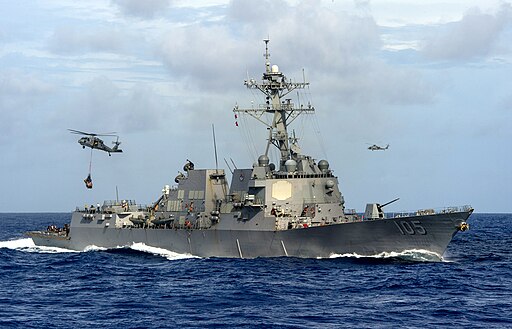
USS Dewey (DDG-105)
USS Dewey (DDG-105): A Force of Naval Excellence
The USS Dewey (DDG-105) is an Arleigh Burke-class guided-missile destroyer of the United States Navy, named in honor of Admiral George Dewey, one of the most famous naval commanders in U.S. history. The USS Dewey represents the culmination of years of naval technological advancements and strategic innovation. As a Flight IIA ship of the Arleigh Burke-class, it combines firepower, advanced sensors, and versatile operational capabilities, making it one of the most formidable surface combatants in the modern naval fleet.
Commissioned on December 16, 2005, the USS Dewey is part of a class that has defined naval power projection and maritime security for over two decades. This article takes an in-depth look at the ship’s design, operational history, capabilities, and significance within the broader context of U.S. naval strategy.
Design and Construction
The USS Dewey was constructed at Bath Iron Works in Bath, Maine, as part of the Arleigh Burke-class, a class of destroyers renowned for their impressive multi-mission flexibility and advanced combat systems. These ships were built with an emphasis on survivability, firepower, and versatility, allowing them to operate effectively in both defensive and offensive capacities.
Ship Specifications:
- Class and Type: Arleigh Burke-class guided-missile destroyer (Flight IIA).
- Displacement: 9,200 tons (full load).
- Length: 509 feet.
- Beam: 66 feet.
- Draft: 33 feet.
- Propulsion: Four General Electric LM2500 gas turbines driving two shafts, providing speeds in excess of 30 knots.
- Crew: Approximately 330 personnel, including officers and enlisted sailors.
Construction:
The USS Dewey’s keel was laid on October 28, 2003, and the ship was launched on October 19, 2004, before being commissioned into service on December 16, 2005. As part of the Flight IIA series of the Arleigh Burke-class, the Dewey features several enhancements over earlier variants, including a redesigned hull and more advanced equipment for detecting and engaging threats.
Namesake: Admiral George Dewey
The USS Dewey honors Admiral George Dewey, a naval hero most famously known for his victory in the Battle of Manila Bay during the Spanish-American War in 1898. On May 1, 1898, Dewey led the U.S. Asiatic Squadron to a decisive victory over the Spanish fleet, a victory that solidified his place in American military history.
Admiral Dewey’s leadership and decisive action in the Battle of Manila Bay were pivotal in establishing U.S. naval supremacy in the Pacific. His victory also marked the beginning of the United States’ expansion into global maritime influence. The USS Dewey, carrying his legacy, continues to embody his principles of naval leadership, strategy, and resilience.
Capabilities and Systems
The USS Dewey is equipped with cutting-edge technology and advanced combat systems, making it a versatile and powerful platform in a wide range of missions.
Combat Systems:
- Aegis Combat System: At the heart of the USS Dewey’s combat capabilities is the Aegis Combat System, one of the most advanced integrated naval weapon systems in the world. This system combines powerful radar, sensors, and software to track and engage targets at sea, in the air, and under the sea. The system is designed for ballistic missile defense, air defense, and surface warfare.
- SPY-1D Radar: The SPY-1D radar provides long-range detection and tracking capabilities, enabling the ship to identify and track multiple air, surface, and ballistic missile threats simultaneously.
- Vertical Launch System (VLS): The ship is equipped with the Mk 41 Vertical Launch System, capable of launching a wide range of missiles, including:
- Standard Missiles (SM-2/SM-6) for air defense and ballistic missile defense.
- Tomahawk cruise missiles for long-range strikes against land targets.
- RIM-116 Rolling Airframe Missiles (RAM) for point defense against anti-ship missiles.
- Phalanx CIWS (Close-In Weapon System): The Phalanx CIWS provides rapid-fire, last-line defense against incoming missiles, aircraft, or small surface threats.
- Harpoon Missiles: The USS Dewey is equipped with Harpoon anti-ship missiles, enabling it to target enemy ships from long distances.
- Sonar and Anti-Submarine Warfare: The ship features advanced sonar systems for detecting and neutralizing submarine threats, including the AN/SQS-53 sonar system. The ship can launch ASROC (Anti-Submarine Rocket) systems to engage submarines from the surface.
Operational Role and Missions
The USS Dewey is a multi-role destroyer capable of executing a wide variety of missions across the globe, including:
- Air Defense and Ballistic Missile Defense (BMD):
- With the Aegis Combat System, the USS Dewey is a key component of the U.S. Navy’s defense strategy, providing air defense against enemy aircraft, cruise missiles, and ballistic missiles.
- The ship plays an integral role in protecting high-value assets, such as aircraft carriers and amphibious assault ships, from aerial and missile threats.
- Surface Warfare (SUW):
- The USS Dewey can engage surface targets using its long-range Tomahawk missiles, Harpoon anti-ship missiles, and 5-inch/54 caliber gun.
- The ship’s radar and sensors provide the ability to track and target enemy ships, ensuring the Navy can maintain dominance over the seas.
- Anti-Submarine Warfare (ASW):
- The USS Dewey is equipped with sophisticated sonar systems and anti-submarine rockets (ASROC) to detect and eliminate submarines, ensuring safe navigation and the ability to protect naval task forces in contested waters.
- Humanitarian Assistance and Disaster Relief (HADR):
- While primarily a combat vessel, the USS Dewey is also capable of supporting humanitarian missions, including providing medical assistance and disaster relief in times of need.
- Power Projection and Deterrence:
- The USS Dewey’s presence in international waters serves as a visible symbol of U.S. power, capable of deterring adversaries and reassuring allies. Its global presence strengthens the Navy’s commitment to maintaining freedom of navigation and safeguarding international trade routes.
- Multinational Operations:
- The ship frequently participates in multinational exercises and operations, fostering interoperability with allied navies and strengthening maritime security partnerships around the world.
Operational History
Since its commissioning, the USS Dewey has participated in numerous deployments and missions around the world. Homeported in Yokosuka, Japan, as part of the U.S. Navy’s Seventh Fleet, the ship is strategically positioned to operate in the Pacific and Indian Oceans, regions vital to U.S. interests.
Notable Deployments:
- Western Pacific Operations: The USS Dewey has frequently operated in the South China Sea and the East China Sea, regions of heightened tension due to territorial disputes. The ship’s presence ensures the protection of vital international shipping lanes and reassures regional allies.
- Participating in Global Naval Exercises: The USS Dewey has taken part in numerous joint exercises, including RIMPAC (Rim of the Pacific Exercise), one of the world’s largest international maritime exercises, involving navies from across the globe.
- Freedom of Navigation Operations (FONOPS): The USS Dewey has conducted Freedom of Navigation Operations in the South China Sea to challenge excessive maritime claims and uphold international law.
Legacy and Future
The USS Dewey (DDG-105) continues to be a vital asset in the U.S. Navy’s surface fleet. Its advanced combat capabilities, highly skilled crew, and global presence ensure that it will remain a force for peace, security, and stability well into the future.
The ship honors the legacy of Admiral George Dewey, whose victory at the Battle of Manila Bay remains one of the most significant naval triumphs in U.S. history. The USS Dewey is a fitting tribute to his leadership and strategic vision, carrying on his tradition of ensuring U.S. naval dominance on the world stage.
Conclusion
The USS Dewey (DDG-105) exemplifies the U.S. Navy’s commitment to maintaining superiority in maritime combat. Its advanced technology, versatile mission capabilities, and strategic role in global operations make it an essential asset in the ongoing effort to maintain peace, ensure freedom of the seas, and project U.S. power across the globe. As it continues to serve with distinction, the USS Dewey carries forward the legacy of its namesake, Admiral George Dewey, and stands as a symbol of U.S. naval excellence.
