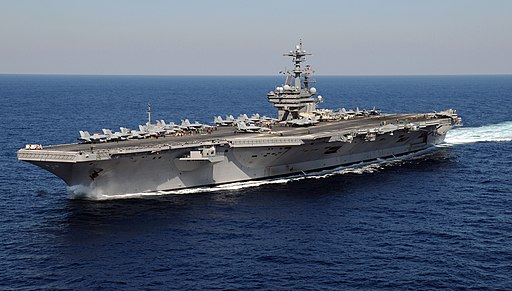
USS George H.W. Bush (CVN-77)
USS George H.W. Bush (CVN-77): The Final Nimitz-Class Aircraft Carrier
The USS George H.W. Bush (CVN-77) is the tenth and final aircraft carrier of the Nimitz-class, a cornerstone of the United States Navy’s ability to project power and maintain security around the globe. Named after the 41st President of the United States, George H.W. Bush, the carrier is a testament to his life of service, dedication, and leadership. Since its commissioning on January 10, 2009, the USS George H.W. Bush has been a symbol of American strength, operating across the world’s oceans to support military operations, humanitarian missions, and international alliances.
Designed with cutting-edge technologies and built with efficiency in mind, the USS George H.W. Bush represents the pinnacle of Nimitz-class design, bridging the gap between earlier carriers and the next-generation Gerald R. Ford-class. With its unmatched capabilities, this vessel plays a vital role in maintaining U.S. naval superiority in the 21st century.
Honoring a Legacy
The USS George H.W. Bush is named after one of the most remarkable leaders in American history. George Herbert Walker Bush was not only a president but also a naval aviator during World War II. At just 18 years old, Bush enlisted in the U.S. Navy and became the youngest naval aviator of his time. Flying TBM Avenger torpedo bombers, Bush participated in several critical battles in the Pacific theater. His service and bravery earned him the Distinguished Flying Cross and three Air Medals.
By naming CVN-77 after President Bush, the Navy honors both his military service and his lifetime commitment to public service. The ship’s motto, “Freedom at Work,” reflects the values that Bush upheld throughout his career, emphasizing the importance of global peace, freedom, and security.
Construction and Design
The USS George H.W. Bush was built by Northrop Grumman Shipbuilding (now Huntington Ingalls Industries) at Newport News Shipbuilding in Virginia. Construction began with the ship’s keel-laying on September 6, 2003, and it was christened on October 7, 2006 by Dorothy Bush Koch, the daughter of President Bush.
As the final Nimitz-class carrier, CVN-77 incorporates numerous design improvements over its predecessors, making it the most advanced carrier of its class. These enhancements focus on reducing maintenance costs, improving operational efficiency, and integrating modern combat systems.
Key Specifications:
- Length: 1,092 feet (333 meters)
- Beam: 252 feet (76.8 meters) at the flight deck
- Draft: 37 feet (11.3 meters)
- Displacement: Approximately 100,000 tons (full load)
- Propulsion: Two A4W nuclear reactors driving four steam turbines, generating virtually unlimited range and endurance
- Speed: Over 30 knots (35 mph)
- Crew: Approximately 3,200 sailors, plus 2,480 air wing personnel
Unique Design Features:
- Reduced Maintenance: Many of the ship’s systems, including its propulsion and electrical systems, were modernized to reduce the need for regular maintenance and extend their operational lifespan.
- New Island Design: The island, or the superstructure that houses the bridge and flight operations center, was redesigned to improve aerodynamics and enhance visibility for flight operations.
- Advanced Coatings: The ship features advanced materials and coatings to reduce maintenance requirements and improve corrosion resistance.
- Improved Aircraft Handling: The carrier boasts improved weapons and aircraft elevators, as well as an upgraded hangar deck for better aircraft management and repair capabilities.
Air Wing and Capabilities
The USS George H.W. Bush serves as the flagship of a Carrier Strike Group (CSG), which includes guided-missile cruisers, destroyers, and submarines. Its primary strength lies in its ability to launch, recover, and sustain a wide range of aircraft, making it a formidable force in any theater of operations.
Carrier Air Wing (CVW):
The carrier typically embarks a Carrier Air Wing that includes:
- F/A-18E/F Super Hornets: Multirole fighter jets capable of air superiority, ground attack, and reconnaissance.
- EA-18G Growlers: Electronic warfare aircraft that can jam enemy radars and communications.
- E-2D Hawkeyes: Airborne early warning and control (AEW&C) aircraft that provide situational awareness and threat detection.
- MH-60R/S Seahawk Helicopters: Versatile helicopters used for anti-submarine warfare, search and rescue, and logistics.
- C-2A Greyhounds: Carrier onboard delivery (COD) aircraft for transporting personnel and supplies.
These aircraft give the USS George H.W. Bush unparalleled strike, reconnaissance, and support capabilities, enabling it to operate effectively in any environment.
Defensive Systems:
To protect itself and its strike group, the carrier is equipped with advanced defensive systems, including:
- RIM-162 Evolved Sea Sparrow Missiles (ESSM): For medium-range air defense.
- Phalanx Close-In Weapon System (CIWS): Automated gun systems for close-range defense against incoming threats.
- Rolling Airframe Missiles (RAM): For point-defense against missiles and small surface threats.
Operational History
Since its commissioning in 2009, the USS George H.W. Bush has participated in numerous deployments and operations around the globe.
1. Maiden Deployment (2011):
The carrier’s first operational deployment took place in May 2011, when it sailed to the Mediterranean Sea and the Persian Gulf to support Operation Enduring Freedom in Afghanistan. The ship’s air wing flew thousands of combat missions, providing critical air support to coalition forces.
2. Operation Inherent Resolve (2014):
In 2014, the USS George H.W. Bush played a leading role in Operation Inherent Resolve, the U.S.-led campaign to combat ISIS in Iraq and Syria. Aircraft from the carrier conducted the first airstrikes against ISIS targets, including vehicles, supply lines, and command centers.
3. NATO Exercises and Global Presence:
In addition to combat operations, the USS George H.W. Bush has participated in joint military exercises with NATO allies, demonstrating U.S. commitment to international partnerships and collective security.
Humanitarian Missions
The USS George H.W. Bush is not only a warship but also a platform for humanitarian assistance and disaster relief. Its ability to generate fresh water, provide medical care, and deliver essential supplies makes it invaluable in responding to natural disasters and crises.
Training and Readiness
The USS George H.W. Bush serves as a vital training platform for sailors, aviators, and officers. Its state-of-the-art simulators and live training exercises ensure that all personnel are prepared for the complexities of modern naval warfare. The ship is also a testing ground for integrating new technologies, bridging the gap between the Nimitz-class and the Gerald R. Ford-class carriers.
A Bridge to the Future
As the final Nimitz-class carrier, the USS George H.W. Bush incorporates advanced features that informed the design of the next-generation Gerald R. Ford-class carriers. While it shares many similarities with its predecessors, its upgraded systems and reduced maintenance requirements make it a more efficient and capable vessel.
Legacy and Impact
The USS George H.W. Bush (CVN-77) is not just a testament to American naval power—it is a tribute to the life and legacy of the man whose name it bears. President Bush’s leadership, humility, and service to his country are embodied in every mission the ship undertakes.
As a critical component of the U.S. Navy’s fleet, the USS George H.W. Bush continues to protect national interests, uphold freedom of navigation, and foster international partnerships. With its advanced capabilities and dedicated crew, CVN-77 will remain a symbol of strength and resilience for decades to come.
In the words of President George H.W. Bush himself:
“Let future generations understand the burdens and blessings of freedom. Let them say, we stood where duty required us to stand.”
_is_underway_in_the_Atlantic_Ocean.jpg)