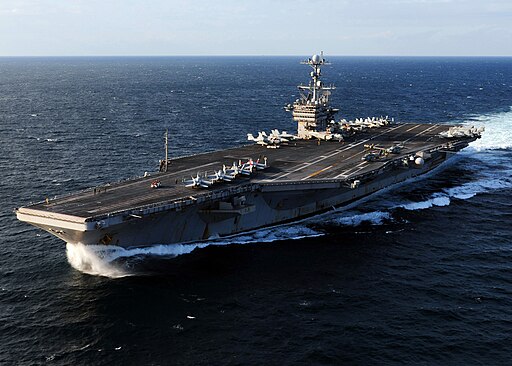
USS George Washington (CVN-73)
USS George Washington (CVN-73): The Legacy of a Nimitz-Class Aircraft Carrier
The USS George Washington (CVN-73) is a nuclear-powered aircraft carrier and one of the cornerstones of the U.S. Navy’s ability to project power and maintain a dominant presence around the globe. As the sixth ship in the Nimitz-class, the USS George Washington embodies the United States’ commitment to maintaining peace and security through unmatched naval superiority. Since its commissioning on July 4, 1992, this mighty vessel has played a pivotal role in a range of operations, from deterrence to combat missions, humanitarian aid, and joint military exercises. Named after George Washington, the first President of the United States and a revolutionary leader, the carrier serves as a living tribute to his enduring legacy.
A Symbol of Naval Power
As a nuclear-powered aircraft carrier, the USS George Washington (CVN-73) is more than just a warship—it is a floating city, a mobile airbase, and a symbol of technological innovation. Aircraft carriers like the USS George Washington are the backbone of the U.S. Navy’s power projection capability, allowing the U.S. to deploy military force and humanitarian assistance rapidly and effectively, anywhere in the world.
Design and Specifications
The USS George Washington belongs to the Nimitz-class, which represents one of the most advanced and powerful classes of aircraft carriers ever built. The design emphasizes durability, adaptability, and the ability to operate in the most demanding maritime environments.
Key Specifications:
- Length: 1,092 feet (333 meters)
- Beam: 252 feet (76.8 meters) at the flight deck
- Displacement: Over 100,000 tons (full load)
- Draft: 37 feet (11.3 meters)
- Speed: Over 30 knots (35 mph)
- Propulsion: Two Westinghouse A4W nuclear reactors powering four steam turbines and four shafts
- Crew: Approximately 3,200 personnel, plus 2,480 air wing personnel
Aircraft Capacity:
The ship’s expansive flight deck and hangar bays enable it to carry over 75 fixed-wing aircraft and helicopters, including:
- F/A-18 Hornet and F/A-18 Super Hornet strike fighters
- EA-18G Growler electronic warfare aircraft
- E-2D Hawkeye airborne early warning aircraft
- MH-60R/S Seahawk helicopters
This air wing gives the carrier unparalleled strike, reconnaissance, and support capabilities.
Key Features:
- Flight Deck: The carrier features four catapults and arrestor cables, enabling rapid and simultaneous launch and recovery of aircraft.
- Defensive Systems: It is equipped with advanced radar systems, the Phalanx Close-In Weapons System (CIWS), NATO Sea Sparrow missiles, and Rolling Airframe Missiles (RAM) for defense against incoming threats.
- Nuclear Propulsion: The ship’s two nuclear reactors allow it to operate continuously for over 20 years without refueling, giving it a virtually unlimited range and endurance.
Operational History
The USS George Washington has had a distinguished career since its commissioning. Below is a look at its notable milestones and deployments:
1. Commissioning and Early Years (1992–1994)
The USS George Washington was commissioned on July 4, 1992, at Naval Station Norfolk in Virginia. The date was fitting, symbolizing freedom and independence. The ship was constructed at Newport News Shipbuilding in Virginia, with its keel laid in August 1986. After sea trials and crew training, the carrier was ready to join the fleet, providing the Navy with a formidable new tool for power projection.
2. Operations in the 1990s
During the 1990s, the USS George Washington participated in several key missions:
- Operation Southern Watch: In the aftermath of the Gulf War, the carrier deployed to enforce the no-fly zone over southern Iraq, deterring Saddam Hussein’s forces from threatening neighboring countries or rebel groups.
- NATO Operations in the Balkans: The carrier supported NATO efforts during the Yugoslav Wars, participating in maritime patrols and providing air support for peacekeeping operations.
3. Role in the Global War on Terror (2001–2008)
Following the September 11, 2001, attacks, the USS George Washington played a crucial role in supporting the Global War on Terror. The carrier deployed to the Middle East as part of Operation Enduring Freedom, providing a platform for airstrikes against Taliban and Al-Qaeda forces in Afghanistan.
During this period, the carrier also participated in Operation Iraqi Freedom, supporting U.S. and coalition forces during the 2003 invasion of Iraq.
4. Transfer to the Pacific Fleet (2008)
In 2008, the USS George Washington became the first nuclear-powered aircraft carrier to be forward-deployed to Yokosuka, Japan, replacing the USS Kitty Hawk (CV-63). This marked a significant shift in the Navy’s strategy, underscoring the importance of the Pacific region in global security.
While operating in the Pacific, the carrier supported U.S. interests in the South China Sea, participated in joint exercises with allied nations, and responded to regional crises.
5. Humanitarian Missions
Beyond combat operations, the USS George Washington has been instrumental in delivering humanitarian aid. In 2013, after Typhoon Haiyan devastated the Philippines, the carrier was deployed as part of Operation Damayan, providing vital supplies, medical assistance, and disaster relief to affected communities.
Refueling and Complex Overhaul (RCOH)
Every Nimitz-class carrier undergoes a Refueling and Complex Overhaul (RCOH) midway through its service life. For the USS George Washington, this process began in 2017 at Newport News Shipbuilding. The RCOH includes refueling the ship’s nuclear reactors, overhauling critical systems, and upgrading technologies to ensure the carrier remains operationally relevant for decades to come.
The extensive upgrades during RCOH will enhance the ship’s combat systems, radar, and propulsion, enabling it to deploy with the latest aircraft and weaponry.
Strategic Importance
The USS George Washington plays a vital role in the U.S. Navy’s ability to project power across the globe. Its forward deployment to Japan enhances the Navy’s ability to respond quickly to crises in the Indo-Pacific region, where tensions over territorial disputes and freedom of navigation continue to pose challenges. The ship’s presence demonstrates the United States’ commitment to its allies and its resolve to maintain stability in key maritime regions.
As part of a carrier strike group, the USS George Washington operates alongside guided-missile cruisers, destroyers, and submarines, creating a versatile and formidable task force capable of handling any threat, from conventional warfare to humanitarian missions.
Legacy
The USS George Washington stands as a tribute to the leadership, vision, and legacy of its namesake. As the first President of the United States, George Washington embodied the ideals of courage, leadership, and commitment to service—qualities reflected in the carrier’s mission and its crew.
As it undergoes its refueling and overhaul, the USS George Washington is being prepared to continue its service into the 2040s, ensuring that it remains a cornerstone of American naval power. For over 30 years, this carrier has stood as a symbol of strength, resilience, and technological innovation, embodying the Navy’s motto: Non sibi sed patriae—”Not for self, but for country.”
In the decades to come, the USS George Washington will continue to play a vital role in defending the freedoms and interests of the United States and its allies, living up to the enduring legacy of the man it was named after.
_transits_the_East_China_Sea.jpg)