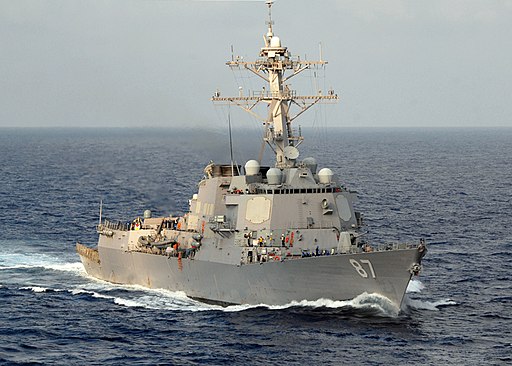
USS Mason (DDG-87)
The USS Mason (DDG-87) is not only a modern marvel of naval engineering but also a symbol rich in historical meaning. As an Arleigh Burke-class guided missile destroyer, Mason serves as a frontline combatant in the U.S. Navy. The ship carries forward a legacy of inclusion and honor, being named in remembrance of the courageous African-American crewmembers from the previous USS Mason (DE-529) who served during segregation-era challenges in the U.S. armed forces. Commissioned in 2003, the vessel is a product of several decades of evolving naval strategy, embodying systems and design philosophies that were conceived in the final years of the Cold War and have since matured into high-performance, multi-mission warfare platforms .
Design and Construction
Evolution of the Arleigh Burke-Class
The USS Mason is part of the Flight IIA modifications within the Arleigh Burke-class series. Constructed by Bath Iron Works, Mason’s build represents a confluence of legacy design elements and modern requirements. Beginning construction in January 2000, the ship was launched in June 2001 and was officially commissioned in April 2003. The Flight IIA variant brings several improvements over earlier flights, including enhanced aviation capability with a full-service helicopter hangar and an expanded vertical launching system (VLS). This evolution in design has empowered the modern destroyer to counter diverse threats in naval warfare .
Technical Innovations in Construction
Mason’s design does not boast the futuristic, radar-absorbent styling of some advanced land-based military platforms, but it remains a formidable asset due to its blend of robust construction and tactical flexibility. Its architecture, characterized by a sharply stepped hull superstructure and a raised bridge section, optimizes sensor placement and communication capabilities. The exposed main mast houses a suite of communications and radar sensors, ensuring that the ship is connected and highly situational aware, a critical factor in modern naval operations .
Technical Specifications
The technical prowess of the USS Mason (DDG-87) is underscored by its carefully engineered dimensions, propulsion, armament, and sensor systems. Below is a breakdown of its critical technical elements.
Dimensions and Displacement
- Length: Approximately 509 feet 6 inches (155.30 meters)
- Beam: 66 feet (20 meters)
- Draft: 31 feet (9.4 meters)
- Displacement: 9,200 tons
These dimensions afford the ship a balanced combination of seakeeping ability and structural integrity in rough maritime conditions. The displacement, in particular, highlights its capacity to house advanced weaponry and sensor suites while ensuring longevity .
Propulsion System
At the heart of USS Mason’s operational capability is its propulsion system. Powered by four General Electric LM2500-30 gas turbines arranged in a configuration that delivers a combined output of 100,000 shaft horsepower to two shafts, the ship achieves speeds in excess of 30 knots. This robust propulsion not only allows for rapid maneuvering but also grants the vessel an operational range of up to 4,400 nautical miles. Such attributes are vital for the extended patrol and rapid response missions in both open ocean and littoral environments .
Speed and Endurance
- Maximum Speed: Over 30 knots (approximately 35 mph or 56 km/h)
- Operational Range: 4,400 nautical miles
- Endurance: Optimized for prolonged deployments with a complement of around 380 officers and enlisted personnel
These performance metrics ensure that the USS Mason is capable of high-speed maneuvers during combat as well as sustained operations during long deployments, a balance that is fundamental to modern naval strategy .
Armament and Self-Defense Systems
The USS Mason is built to deliver a multi-faceted strike capability while maintaining robust self-defense measures.
Primary Guns and CIWS
- 5-inch/62 Mk 45 Mod 4 Gun: Mounted forward, this lightweight deck gun is the primary naval artillery piece used for shore bombardment and surface engagements.
- Close-In Weapon Systems (CIWS): The ship features a 20 mm Phalanx CIWS along with two 25 mm Mk 38 machine gun systems, reinforcing the vessel’s ability to counter close-range threats, including anti-ship missiles and small boat attackers.
- Additional Small Arms: It carries several .50-inch caliber machine guns for point defense .
Vertical Launching System (VLS)
The backbone of the ship’s missile capabilities is its Mk 41 VLS. The ship is configured with a combination of 32-cell and 64-cell modules, which cumulatively support up to 96 missile cells. This system is versatile, capable of launching:
- RIM-66M and RIM-156 Surface-to-Air Missiles: For defense against airborne threats.
- **RIM-174A Standard ERAM: **An advanced surface-to-air missile system designed to neutralize high-speed targets.
- RIM-161 Anti-Ballistic Missile: Enhances the ship’s capability to intercept ballistic missiles.
- RIM-162 ESSM (Quad-Packed): A short-range surface-to-air solution for layered defense.
- BGM-109 Tomahawk Cruise Missiles: These long-range precision strike missiles allow the ship to engage targets well ashore.
- RUM-139 Vertical Launch ASROC: An anti-submarine rocket offering additional underwater defense capabilities .
Torpedo Capabilities
For underwater threats, USS Mason is equipped with Mark 32 triple torpedo tubes capable of launching lightweight torpedoes such as the Mark 46, Mark 50, and Mark 54 variants. This feature rounds out the vessel’s capability to counter modern submarines in a layered defense strategy.
Sensor and Combat Systems
The Aegis Combat System
At the core of the destroyer’s operational capability is the Aegis Combat System. This state-of-the-art integrated system fuses radars, sensors, weapon systems, and command and control modules into a single, powerful network. The flagship sensor, the AN/SPY-1D 3D radar, continuously monitors an extensive area of the surrounding environment, providing simultaneous tracking and targeting of both air and surface threats. Auxiliary systems include surface search radars, fire-control systems, and advanced sonar suites that all work in concert to ensure the vessel maintains situational awareness under all combat conditions .
Electronic Warfare and Communications
The USS Mason features a sophisticated suite of electronic countermeasures and communications equipment. This includes:
- Electronic Support Measures (ESM): For threat detection and countermeasures.
- Self-Defense Systems: Automated systems that engage incoming projectiles and optimize the vessel’s readiness for high-intensity conflict.
- Robust Networking: Enabling secure and rapid information dissemination across the fleet, ensuring coordinated multi-domain operations.
These systems exemplify the blend of sensor synergy and robust electronic warfare capability that defines modern naval combat .
Crew and Habitability
Seamless Integration of Personnel
Despite its technological sophistication, the operational effectiveness of USS Mason is also rooted in its crew requirement. Housing around 380 officers and enlisted personnel, the vessel is designed with high efficiency in both work and living spaces. The streamlined crew quarters, integrated command centers, and state-of-the-art communication networks ensure that personnel can function effectively even under extreme pressure.
Aviation Capabilities
The Flight IIA design includes a full-service helicopter hangar and a helipad aft on the stern. This addition not only extends the operational envelope of the ship by providing anti-submarine warfare (ASW) capabilities through the MH-60R Seahawk helicopters but also plays a role in search and rescue operations and over-the-horizon targeting . The integration of aviation platforms within the hull design makes the USS Mason a versatile asset in both blue-water operations and littoral environments.
Operational History and Strategic Significance
Since its commissioning in 2003, the USS Mason (DDG-87) has participated in multiple deployments ranging from counter-terrorism operations to presence missions in strategic theaters such as the Persian Gulf. Its deployment history illustrates both its tactical versatility and the Navy’s commitment to maintaining readiness in a constantly evolving maritime threat landscape.
Engagements and Deployments
From providing real-time intelligence support to executing coordinated missile strikes using its Tomahawk capabilities, Mason’s operational record is marked by efficiency and determination. Her participation in operations against asymmetric threats has underscored the importance of fast, agile, and multi-role destroyers in modern naval warfare. The ship’s continuous upgrades and staff training ensure that it remains relevant against emerging threats in both conventional and hybrid war scenarios .
Legacy and the Future
By honoring the legacy of its namesake, the USS Mason also serves as a reminder of the Navy’s evolving values and legal milestones. This heritage not only bolsters crew morale but also highlights the importance of diversity and resilience in military history. As technology advances, the foundational design of the Arleigh Burke-class—embodied by USS Mason—continues to be a key component in maintaining a technological edge on the high seas .
Conclusion
The USS Mason (DDG-87) is a beacon of modern naval design—a complex integration of advanced propulsion, formidable armament, and state-of-the-art sensor arrays. Its robust construction and evolved combat systems empower it to face a myriad of contemporary threats in an unpredictable global maritime environment. More than just a guided missile destroyer, Mason symbolizes a historical progression toward inclusion, operational excellence, and technological innovation in the U.S. Navy.
With its blend of agile performance, layered defenses, and a heritage that honors sacrifice and progress, the USS Mason remains at the forefront of U.S. naval strategy, continuously adapting in an era of rapid technological change and global conflict transformation.
_steams_through_the_Atlantic_Ocean.jpg)