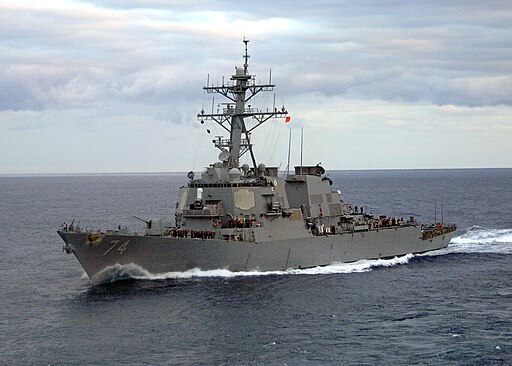
USS McFaul (DDG-74)
USS McFaul (DDG-74) is an Arleigh Burke-class guided missile destroyer that exemplifies American naval innovation and operational versatility. Named for U.S. Navy SEAL Chief Petty Officer Donald L. McFaul—whose life and service symbolize courage and sacrifice—this vessel carries forward a proud tradition of excellence in maritime combat. Commissioned in April 1998, McFaul has served as a vital asset in safeguarding freedom at sea while adapting to emerging threats in a rapidly evolving strategic landscape .
Design and Construction
Historical Context and Naming
The naming of USS McFaul honors a legacy of valor and dedication. Chief Petty Officer Donald L. McFaul left an enduring mark on U.S. military history through his service and sacrifice. This destroyer’s christening not only preserves his memory but also inspires the crew to embody the qualities of commitment and excellence that defined his life.
Hull Design and Build Quality
Constructed by Ingalls Shipbuilding in Pascagoula, Mississippi, USS McFaul is a product of meticulous engineering and robust design. Laid down on 26 January 1996 and launched on 18 January 1997, the vessel’s construction adheres to the rigorous standards of the Arleigh Burke-class. The hull is designed for exceptional seakeeping, ensuring stability and maneuverability in the roughest of oceanic conditions. Its integrated superstructure and carefully arranged sensor masts optimize situational awareness on the high seas .
Incorporating Advanced Technologies
As a Flight II variant of the class, USS McFaul brings together legacy design features with significant technological advancements. The integration of the Aegis Combat System, advanced radar, and a modular vertical launching system (VLS) exemplifies the balance between robustness and modern warfare capabilities. This fusion of tried-and-true design with cutting-edge technology ensures the destroyer remains a formidable multi-role platform capable of countering air, surface, and subsurface threats.
Technical Specifications
The USS McFaul’s specifications highlight its role as a versatile and agile combatant. Detailed below are the core technical attributes that define this formidable warship.
Dimensions and Displacement
- Length: Approximately 505 feet (154 meters)
- Beam: Approximately 59 feet (18 meters)
- Draft: Roughly 31 feet (9.4 meters)
- Displacement: About 8,637 long tons (full load)
These dimensions provide an excellent balance between space for advanced systems and the agility required for rapid maneuvers on the high seas. The considerable displacement enables the integration of an extensive array of weapons, sensors, and combat systems, ensuring that the destroyer is well-equipped for prolonged engagements .
Propulsion and Performance
- Propulsion System: 4 × General Electric LM2500-30 gas turbines
- Output: Combined 100,000 shaft horsepower (approximately 75,000 kW)
- Propulsion Layout: 2 shafts
- Maximum Speed: In excess of 30 knots (approximately 56 km/h or 35 mph)
- Range: Up to 4,400 nautical miles at 20 knots
The powerful gas turbine engine arrangement provides USS McFaul with rapid acceleration and high-speed capability, which is essential in combat scenarios and evasive maneuvers. Its operational range supports extended deployments far from home ports, ensuring persistent presence in strategically critical regions.
Armament and Defense Systems
The offensive and defensive capabilities of USS McFaul are defined by a suite of advanced weapon systems integrated into a multi-layered defense strategy.
Primary Guns and Close-In Weapon Systems (CIWS)
- Main Gun: 1 × 127 mm Mk 45 gun
- Close-In Weapon Systems:
- 2 × 20 mm Phalanx CIWS units – designed for rapid-fire defense against incoming missiles and small craft
- Additional machine gun systems (including 25 mm Mk 38) supplement the automated defense, along with several 12.7 mm machine guns for point defense
The primary gun provides precision for surface engagements and shore bombardment, while the close-in weapon systems establish a protective envelope against aerial and missile threats.
Vertical Launching System (VLS) and Missile Options
The Mk 41 Vertical Launch System (VLS) is the heart of USS McFaul’s missile capability:
- Configuration: Typically includes a combination of 29-cell and 61-cell modules, totaling around 90 cells
- Missile Loadout Capabilities:
- Surface-to-Air Missiles: RIM-66M, RIM-156, and the RIM-161 for advanced anti-air and anti-ballistic defense
- Precision Strike Missiles: BGM-109 Tomahawk cruise missiles for long-range land-attack missions
- Anti-Submarine Warfare: RUM-139 Vertical Launch ASROC to counter subsurface threats
This versatile missile suite allows USS McFaul to engage a broad spectrum of targets, ensuring layered and dynamic defense as well as offensive striking capability.
Torpedo Systems and Additional Armaments
- Torpedo Tubes: 2 × Mk 32 triple torpedo tubes
- Capable of launching lightweight torpedoes (such as the Mark 46, Mark 50, or Mark 54) for anti-submarine warfare
These torpedo systems provide an additional anti-submarine measure, complementing the ship’s comprehensive sensor and missile defense architecture.
Sensor and Combat Systems
Aegis Combat System and Radar Suite
At the core of USS McFaul’s combat capability lies the Aegis Combat System—a sophisticated, integrated network that synchronizes sensor inputs and weapon systems. Key components include:
- AN/SPY-1D Radar: A passive electronically scanned array (PESA) 3D radar that detects and tracks multiple targets simultaneously
- Fire Control Radar: Systems like the AN/SPG-62 guide missile engagements accurately
- Integrated Combat Suite: The Aegis system fuses radar, sonar, and combat management capabilities, providing real-time situational awareness for rapid decision making
This state-of-the-art sensor network is essential for maintaining superiority in the battlespace, enabling USS McFaul to counter both high-speed aerial threats and stealthy underwater adversaries.
Electronic Warfare and Communication Systems
Advanced electronic warfare capabilities are integral to USS McFaul’s design:
- Electronic Support Measures (ESM): Systems designed to detect and analyze hostile electronic emissions
- Decoy Launching Systems: Multiple decoy systems (such as the Mk 36 and Mk 53) provide a defensive layer against incoming missiles
- Secure Communications: Robust networking and data systems link USS McFaul with fleet command and allied units, ensuring seamless coordination during multi-domain operations
These electronic warfare and comms systems are critical for maintaining a tactical edge, mitigating incoming threats, and ensuring coordinated action in high-intensity conflict scenarios.
Crew, Habitability, and Aviation Facilities
Crew Accommodations and Operational Readiness
USS McFaul is designed to support a professional crew in sustained operations:
- Complement: Approximately 33 commissioned officers, 38 chief petty officers, and 210 enlisted personnel
- Crew Spaces: Ergonomically designed quarters, state-of-the-art command centers, and efficient passageways ensure the crew can operate at peak performance, even during extended deployments
High levels of automation and integrated systems reduce crew workload while enhancing operational readiness. The ship’s design emphasizes not only combat capability but also the welfare and efficiency of its sailors.
Aviation Facilities and Aerial Operations
A key feature of the Flight II design is the inclusion of aviation support facilities:
- Helicopter Deck and Hangar: Accommodates 1 × MH-60R Seahawk helicopter
- Mission Capabilities: The embarked helicopter enhances anti-submarine warfare, reconnaissance, and search and rescue capabilities, extending the ship’s operational reach beyond the horizon
The integration of aviation assets provides USS McFaul with a significant tactical advantage, allowing for rapid reaction to emerging threats and dynamic mission profiles.
Operational History and Strategic Role
Since commissioning, USS McFaul has been a vital part of the U.S. Navy’s operational fleet. Deployed in key naval theaters, she has demonstrated the versatility and resilience required of modern warships. Her contributions range from high-intensity conflict exercises to cooperative multinational operations, ensuring the maintenance of maritime security and deterrence against potential adversaries.
The destroyer’s advanced combat systems and multi-threat engagement capabilities have made her a critical component of the U.S. Navy’s battle groups, safeguarding sea lanes and contributing to the overall stability of the strategic maritime domain.
Future Prospects and Upgrades
Looking forward, USS McFaul—like many Arleigh Burke-class ships—is poised for periodic upgrades to incorporate emerging technologies. Potential future enhancements could include:
- Radar and Sensor Upgrades: Integration of next-generation radar systems (such as the AESA-based AN/SPY-6) to further enhance detection and tracking capabilities
- Cyber and Electronic Warfare Enhancements: Advanced cyber defense measures and more sophisticated electronic warfare suites to counter emerging digital threats
- Integration of Unmanned Systems: Augmenting capabilities through the integration of unmanned aerial and underwater systems for extended surveillance and strike potential
These upgrades will ensure that USS McFaul remains effective in an environment where technological superiority and rapid adaptation are paramount.
Conclusion
USS McFaul (DDG-74) stands as a testament to modern naval engineering—a dynamic blend of robust construction, advanced propulsion, comprehensive armament, and state-of-the-art sensor systems. From its origins at Ingalls Shipbuilding to its deployment as a guardian of the nation’s maritime interests, McFaul embodies the resilience, adaptability, and innovation essential for success in the 21st-century battlespace.
This destroyer not only upholds a proud legacy but also heralds the future of naval warfare, where integrated systems, digital command and control, and multi-domain operations are the keys to maintaining strategic superiority on the high seas.
