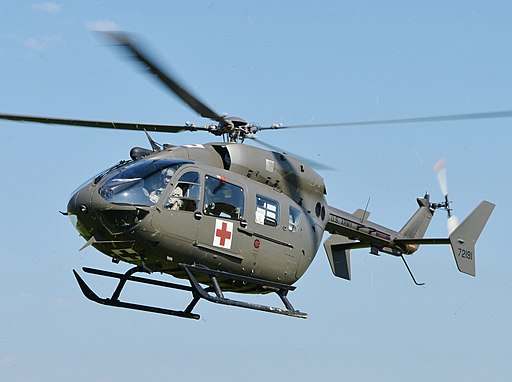
Eurocopter UH-72 Lakota
The Eurocopter UH-72 Lakota is the United States Army’s modern light utility helicopter, derived from Airbus Helicopters’ EC145 platform. Since its introduction in 2006, the Lakota has become a cornerstone for a broad spectrum of missions—ranging from pilot training to search and rescue, medical evacuation, and homeland security support. Its remarkable blend of proven European airframe design, American avionics integration, and cost-efficient sustainment has set new standards for military utility rotorcraft.
Development and Procurement
U.S. Army Light Utility Helicopter Program
In the early 2000s, the U.S. Army sought to replace aging Bell UH-1 and OH-58 fleets with a modern, off-the-shelf helicopter tailored for noncombat support roles. The Light Utility Helicopter (LUH) program emphasized rapid fielding, minimized total-ownership cost, and commonality with civilian maintenance practices.
Eurocopter–Sikorsky Partnership
Airbus Helicopters (then Eurocopter) teamed with Sikorsky to meet the LUH requirements. Sikorsky handled final assembly, avionics integration, and U.S. domestic support, while Eurocopter supplied the EC145 airframe and rotor systems. The first UH-72A rolled off the line in Columbus, Mississippi, in 2006, and full-rate production commenced in 2007.
Design and Structure
Airframe and Composite Materials
The UH-72’s fuselage employs an aluminum-alloy frame with bonded composite skins on the cabin and tailboom fairings. This hybrid structure:
- Lowers overall empty weight by roughly 10% compared to an all-metal design
- Improves corrosion resistance in coastal and maritime training environments
- Facilitates rapid component replacement through modular composite panels
Main Rotor System
- Five-blade, composite-construction main rotor with swept tips for reduced vibration and noise
- Spheriflex® hub: an elastomeric, bearing-free design that eliminates periodic lubrication and lowers maintenance
- Rotor diameter: 10.69 m (35 ft 1 in), optimized for hover efficiency and low-downwash footprint
Fenestron Tail Rotor and Landing Gear
- Eight-blade Fenestron® ducted-fan tail rotor: enhances safety on the ground, reduces foreign object ingestion, and trims external noise by ~5 dB
- Fixed skid landing gear with energy-attenuating struts for simple design, low weight, and robust operation on unprepared surfaces
Cabin and Mission Configurations
The UH-72’s cabin measures 2.2 m in length, 1.7 m in width, and 1.5 m in height—enough to accommodate:
- Up to four fully equipped troopers plus two pilots in basic utility layout
- Two litters and medical attendants in aeromedical evacuation (MEDEVAC) configuration
- Modular bench seating, cargo racks, and stretchers that swap in under 20 minutes
Technical Specifications
Dimensions and Weights
| Parameter | Metric | Imperial |
|---|---|---|
| Main Rotor Diameter | 10.69 m | 35 ft 1 in |
| Fenestron Diameter | 1.81 m | 5 ft 11 in |
| Overall Length (rotors turning) | 13.08 m | 42 ft 11 in |
| Fuselage Length | 10.33 m | 33 ft 11 in |
| Overall Height | 3.49 m | 11 ft 5 in |
| Cabin Length (floor) | 2.20 m | 7 ft 3 in |
| Cabin Width | 1.70 m | 5 ft 7 in |
| Empty Weight | ~2 203 kg | ~4 857 lb |
| Maximum Takeoff Weight (MTOW) | 3 585 kg | 7 910 lb |
Payload and Capacity
- Crew: 2 pilots
- Troop seats: up to 4 (with 1.5 m³ cargo bay behind seats)
- Useful load: ≈1 382 kg (3 050 lb)
- External cargo hook capacity: 1 360 kg (3 000 lb)
- Fuel capacity: 780 L (206 gal US)
Performance Parameters
| Parameter | Metric | Imperial |
|---|---|---|
| Maximum Cruise Speed | 246 km/h | 133 kt |
| Maximum Speed (VNE) | 259 km/h | 140 kt |
| Range (standard fuel, no reserves) | 680 km | 367 NM |
| Service Ceiling | 6 096 m | 20 000 ft |
| Hover Ceiling IGE (in ground effect) | 4 267 m | 14 000 ft |
| Hover Ceiling OGE (out of ground effect) | 2 743 m | 9 000 ft |
| Rate of Climb | 7.2 m/s | 1 420 ft/min |
| Endurance (normal reserves) | ~2.5 hours | — |
Powerplant and Performance
Engines
- Two Pratt & Whitney Canada PW206B3 turboshaft engines
- Takeoff power: 550 shp (410 kW) each
- Continuous power: 455 shp (340 kW) each
- FADEC (Full Authority Digital Engine Control) for automatic power management, engine-out alarms, and seamless transition in single-engine operations
Transmission System
- Main gearbox: single-stage, epicyclic design rated for 5 000 hr TBO
- Automatic oil lubrication and integrated health sensors monitor temperature, pressure, and vibration
- Fenestron drive shaft with torque-monitoring coupling to detect tail-rotor loads in real time
Fuel and Range
- Central tank with two removable forward auxiliary tanks
- In-flight refueling probe optional for extended endurance
- Fuel system redundancy via dual-feed lines and shut-off valves
Avionics and Flight Systems
Cockpit Layout and Displays
- Dual-screen Garmin G500H flight deck: Primary Flight Display (PFD) and Multi-Function Display (MFD) integrate engine, navigation, terrain, and traffic data
- Stand-by analog altimeter, airspeed indicator, and attitude gyro
- Night-vision-goggle (NVG) compatible lighting and controls
Flight Control and Automation
- Two-axis Automatic Flight Control System (AFCS): collective and cyclic stabilization, hover hold, and coupled instrumental approaches
- Digital Audio Management System (DAMS) for clear inter-crew communication and secure military radios
- Optional 4-axis autopilot upgrade for precision hover missions and reduced pilot workload
Communication and Navigation
- ARC-210 VHF/UHF multi-band radios with HAVE QUICK II and SINCGARS anti-jam modes
- Embedded GPS/INS with WAAS/EGNOS augmentation
- Traffic Collision Avoidance System (TCAS I) and Terrain Awareness Warning System (TAWS)
Operational Roles
Military Training and Light Utility
As the Army’s dedicated primary trainer, the UH-72’s docile handling, wide cockpit visibility, and predictable autorotation characteristics shorten pilot syllabus time. Beyond training, it performs logistics runs, VIP transport, and airborne command post duties.
Search and Rescue and Medical Evacuation
Equipped with a rescue hoist (rated 272 kg) and cargo hook, the Lakota retrieves stranded personnel. Its flat-floor cabin, rapid-install litter system, and onboard oxygen outlets enable efficient MEDEVAC support, particularly in austere training environments.
Law Enforcement and Homeland Security
The National Guard and Department of Homeland Security deploy UH-72s for border patrol, counter-drug operations, and disaster relief. High-resolution EO/IR sensor pods, loudhailers, and rescue baskets are field-installable in under 60 minutes.
Civil and Disaster Response
In hurricane relief and firefighting support, the Lakota’s low-downwash, powerful cargo hook, and quick-release tanks for water buckets offer versatile aerial firefighting and supply-drop capabilities.
Variants and Modifications
UH-72A Primary Trainer
The baseline UH-72A includes the standard utility kit and government-furnished avionics. Over 400 units have delivered to the Army and Army National Guard for Initial Entry Rotary Wing training.
EH-72A Special Mission Helicopter
Configured for intelligence, surveillance, and reconnaissance (ISR), the EH-72A adds signal-intelligence suites, tactical radios, and data-link terminals. Only a handful of these variants operate within the U.S. Customs and Border Protection fleet.
Future Upgrades
- Center console redesign for digital mission management
- 4-axis AFCS retrofit to support single-pilot IFR operations
- Engine control software enhancements to boost hot-and-high performance
Maintenance and Support
Sustainment and Logistics
Sikorsky’s Global Repair Network and U.S. Army depots provide Tier 1–4 maintenance. A dedicated Army Lakota Sustainment team tracks 40,000+ flight-hours of health-monitoring data, driving a 96% mission-capable rate.
Cost of Ownership
By leveraging civilian supply chains and shared EC145 spares, the UH-72’s direct operating cost is approximately $1 200 per flight hour—nearly 60% less than legacy utility helicopters. Scheduled inspections follow condition-based maintenance practices, reducing downtime and parts consumption.
Safety and Comfort Features
Crashworthiness and Survivability
- Energy-attenuating seats certified to 9 G
- Crash-resistant fuel cells and strategically placed sponson tanks
- Ballistically tolerant driveshaft and rotor-mast shear pins
Vibration and Noise Control
- Spheriflex rotor hub and tuned-mass dampers reduce cabin vibration by 40% over earlier Super Puma variants
- Fenestron tail rotor and composite main-rotor blades cut external noise footprint by 5 dB, enabling low-noise approaches near training areas
Conclusion
The Eurocopter UH-72 Lakota exemplifies how a commercially derived platform can meet rigorous military standards for safety, reliability, and versatility. From initial pilot training through lifesaving MEDEVAC sorties and homeland security missions, the Lakota’s technical pedigree—spanning composite airframes, FADEC-controlled engines, glass-cockpit avionics, and low-maintenance rotor systems—ensures exceptional value over its service life. As training demands and domestic mission sets evolve, the UH-72’s open-architecture design positions it for continuous upgrades, securing its role as the U.S. Army’s premier light utility helicopter well into the future.
