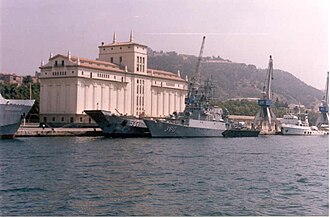
KRI Memet Sastrawiria (380) was an Indonesian Navy corvette with an unusual Cold War pedigree. Originally constructed in East Germany as Bützow (244), the ship belonged to the Parchim class, a family of compact anti-submarine warfare corvettes developed for the Volksmarine during the final decades of the Cold War. After the reunification of Germany and the disposal of much of the former East German fleet, Bützow was transferred to Indonesia and entered Indonesian service as KRI Memet Sastrawiria in June 1995. Her career under the Indonesian flag was relatively short, ending in 2008 when the ship was decommissioned and ultimately scuttled in Lampung waters.
Although KRI Memet Sastrawiria was not a large warship, she represented an interesting combination of speed, compact dimensions and specialized anti-submarine weapons. The Parchim design was created around the requirements of coastal warfare, where a relatively small combatant could operate in confined waters and respond rapidly to submarine threats. Indonesia subsequently employed these former East German corvettes in a completely different strategic environment, demonstrating how a Cold War naval design could acquire a second life thousands of kilometres from the European waters for which it had originally been conceived.
From East German Parchim to Indonesian Corvette
The Bützow years
KRI Memet Sastrawiria began her naval career as Bützow, a Parchim-class corvette constructed by Peene-Werft at Wolgast in East Germany. Her keel was associated with yard number 349, she was launched on 12 March 1980 and entered service with the East German Volksmarine on 30 December 1981 under pennant number 244. She remained in East German service until 1995, after which she was sold for service with the Indonesian Navy.
The Parchim class was developed during the late 1970s as a specialized coastal anti-submarine platform. Its official Soviet/Warsaw Pact designation was Project 1331M, and the ships were designed around the idea that a relatively inexpensive, compact corvette could provide a dedicated submarine-hunting capability in the shallow and restricted waters of northern Europe. In the original strategic environment, one of the important threats envisaged by East German planners was the West German Navy’s fleet of small coastal submarines. The design therefore placed particular emphasis on sonar, anti-submarine rocket launchers and torpedoes rather than on the long-range missile armament associated with larger surface combatants.
Sixteen Parchim-class corvettes were built for the East German Navy, while a further group was subsequently constructed for the Soviet Navy. This production history made the class one of the more distinctive naval programs associated with East German shipbuilding. The ships were small by modern frigate standards, but they carried a considerable amount of equipment relative to their displacement, giving them a clearly defined tactical purpose rather than attempting to make them general-purpose warships.
A new name in Indonesian service
The transition from Bützow to KRI Memet Sastrawiria occurred in the aftermath of the Cold War. Indonesia acquired a number of former East German Parchim-class corvettes as part of a broader effort to expand and modernize the Indonesian fleet with relatively economical second-hand vessels. Bützow was commissioned into the TNI Angkatan Laut on 2 June 1995 and received pennant number 380. Her Indonesian homeport was Surabaya, and she subsequently became part of the country’s force of compact patrol and combat vessels.
The ship’s name commemorated Captain Memet Sastrawiria, an Indonesian naval officer who died during the Battle of Aru Sea on 15 January 1962. Indonesian references identify him as an aide to Commodore Yos Sudarso aboard KRI Matjan Tutul. Naming the former East German corvette after an Indonesian naval figure connected to one of the country’s best-known post-independence maritime confrontations gave the vessel a distinctly Indonesian identity despite its foreign construction and Cold War origins.
A Compact Ship Built for Anti-Submarine Warfare
Dimensions and hull design
KRI Memet Sastrawiria measured approximately 75.2 metres in length and 9.78 metres in beam. Published specifications generally place her standard displacement at around 865 tonnes and her fully loaded displacement at approximately 935 tonnes, although Indonesian reference material also gives lower figures of about 793 tonnes standard and 854 tonnes full load. These differences illustrate an important issue when researching older warships: technical data can vary depending on whether a source describes the original configuration, a later refit, or a different method of calculating displacement.
The ship’s relatively narrow hull and modest draft were appropriate for a vessel designed to operate close to shore. Rather than sacrificing displacement to achieve the endurance and aviation facilities of a larger frigate, the Parchim design concentrated on mobility and specialized weapons. Its dimensions also made it considerably smaller than many modern surface combatants, allowing it to function effectively in coastal and confined maritime environments.
Propulsion and performance
Commonly published specifications describe the original Parchim machinery arrangement as three M-504A diesel engines producing approximately 4,750 horsepower each, for a combined output of about 14,250 horsepower. The machinery drove three fixed-pitch propellers. On this basis, the ship was capable of approximately 24.5 knots, while a frequently cited endurance figure is about 2,100 nautical miles at 14 knots. A crew of approximately 62 personnel is also commonly associated with this configuration.
There is, however, a noteworthy complication in published data concerning the propulsion systems of Indonesian Parchim-class ships. Some class-level references list different machinery for individual Indonesian vessels, including MTU diesel installations, while other sources continue to give the three-engine M-504A arrangement for KRI Memet Sastrawiria. The safest interpretation is therefore to distinguish the widely published original Parchim specification from later Indonesian modifications rather than presenting every online figure as equally certain.
Whatever the precise machinery configuration during each stage of her career, speed was an important characteristic of the design. A maximum speed in the mid-20-knot range allowed a Parchim corvette to react quickly to contacts, reposition during patrols and close the distance to a suspected submarine or surface target. For an anti-submarine vessel operating in relatively restricted waters, acceleration and maneuverability could be more valuable than the long endurance of a much larger ocean-going combatant.
Weapons and Combat Capability
The 57 mm and 30 mm guns
The primary gun armament of the Parchim design consisted of a twin 57 mm AK-725 automatic naval gun. The weapon was mounted forward and provided the ship with a substantial gun capability for a vessel of less than 1,000 tonnes. It could be employed against surface targets and, within the limitations of its era, against aerial threats.
A twin 30 mm AK-230 automatic cannon provided a second layer of rapid-fire protection. The combination of the 57 mm and 30 mm systems gave the ship a useful mixture of medium-caliber and close-range firepower. Indonesian sources also describe additional 20 mm Denel GI-2 guns in the KRI Memet Sastrawiria configuration, suggesting that the Indonesian ships should not necessarily be assumed to have retained precisely the same weapon arrangement as their East German predecessors.
RBU-6000 anti-submarine rockets
The defining weapons of KRI Memet Sastrawiria were her anti-submarine systems. Two RBU-6000 launchers were installed for engaging submerged targets. The RBU-6000 was a Soviet-designed anti-submarine rocket system capable of firing salvos of unguided rockets toward a submarine contact. Its purpose was to provide a rapid-response weapon that could be brought into action once the ship’s sonar had detected and localized an underwater target.
The original configuration also included four 400 mm torpedo tubes and two SA-N-5 short-range air-defense missile positions. Some descriptions of the Indonesian configuration omit the torpedo tubes and SA-N-5 positions while listing the additional 20 mm guns instead. This difference is another reason to treat the ship’s armament as configuration-dependent rather than assuming that every weapon listed for Bützow remained aboard KRI Memet Sastrawiria throughout her Indonesian career.
Sensors and the Anti-Submarine Mission
A ship designed for anti-submarine warfare requires sensors capable of finding targets that cannot be seen from the surface. Published Indonesian specifications associate the Parchim-class ships with the MG-322T sonar, while surface and air surveillance was supported by the MR-302 Strut Curve radar and an MR-123 Vympel/Muff Cob fire-control radar. PK-16 decoy equipment is also listed in Indonesian references.
The relationship between these systems illustrates the logic behind the entire vessel. Radar could provide awareness of surface and airborne contacts, but the core anti-submarine sequence depended on underwater detection. Once a submarine was located, the ship could maneuver into a favorable attack position and employ its RBU-6000 launchers or, where fitted and operational, torpedoes. In this sense, KRI Memet Sastrawiria was not simply a small gunship carrying a few anti-submarine weapons; the anti-submarine mission was embedded in the design of the vessel itself.
Service, Retirement and Final Fate
KRI Memet Sastrawiria had a comparatively brief Indonesian career. She was commissioned in 1995 and was retired in 2008. Sources record that the ship was ultimately scuttled in Lampung in 2008, bringing an end to a career that had begun almost three decades earlier with her launch at Peene-Werft.
Her retirement reflects the difficulties that can accompany the operation of aging Cold War-era warships. Even when the hull and basic machinery remain serviceable, older vessels can become increasingly challenging to maintain because of obsolete electronics, aging propulsion equipment, limited spare-parts availability and the changing requirements of naval warfare. By the 2000s, the technological environment surrounding a Parchim-class corvette was very different from that of the early 1980s, when the design had represented a modern specialized solution to a specific Cold War threat.
Nevertheless, KRI Memet Sastrawiria’s service remains historically significant. Her career connected three different eras: the East German naval buildup of the Cold War, the post-1990 disposal of Warsaw Pact-associated naval assets and Indonesia’s effort to expand its maritime capabilities using affordable second-hand warships. Few ships demonstrate that transition as clearly as this former Bützow.
Technical Specifications of KRI Memet Sastrawiria (380)
| Specification | KRI Memet Sastrawiria (380) |
|---|---|
| Ship type | Parchim-class / Kapitan Patimura-class corvette |
| Project designation | Project 1331M |
| Former name | Bützow (244) |
| Builder | Peene-Werft, Wolgast, East Germany |
| Yard number | 349 |
| Launched | 12 March 1980 |
| East German commissioning | 30 December 1981 |
| Indonesian commissioning | 2 June 1995 |
| Indonesian pennant | 380 |
| Homeport | Surabaya |
| Indonesian decommissioning | 2008 |
| Final fate | Scuttled in Lampung, 2008 |
| Length | 75.2 m |
| Beam | Approximately 9.78 m |
| Draft | Approximately 2.65 m |
| Standard displacement | Approximately 865 tonnes; some Indonesian sources report 793 tonnes |
| Full-load displacement | Approximately 935 tonnes; some Indonesian sources report 854 tonnes |
| Propulsion | Commonly reported as 3 × M-504A diesel engines |
| Engine power | Approximately 14,250 hp total |
| Propellers | 3 × fixed-pitch |
| Maximum speed | Approximately 24.5–24.7 knots |
| Range | Approximately 2,100 nautical miles at 14 knots |
| Crew | Approximately 62 |
| Main gun | 1 × twin 57 mm AK-725 |
| Secondary gun | 1 × twin 30 mm AK-230 |
| Additional Indonesian armament | 2 × 20 mm Denel GI-2, according to published references |
| Anti-submarine weapons | 2 × RBU-6000 launchers |
| Original torpedo armament | 4 × 400 mm torpedo tubes |
| Original air defense | 2 × SA-N-5 positions |
| Sonar | MG-322T |
| Surface-search radar | MR-302 / Strut Curve |
| Fire-control radar | MR-123 Vympel / Muff Cob |
| Countermeasures | PK-16 decoy system reported |
The figures in the table should be regarded as representative published specifications rather than an absolutely fixed snapshot of the ship at every point in her career. In particular, displacement, propulsion and weapons are reported differently by different references, with some sources describing the original East German Parchim configuration and others describing Indonesian-service modifications.
Conclusion
KRI Memet Sastrawiria (380) was a small warship with a surprisingly rich history. Born as Bützow in East Germany, she was designed at the height of the Cold War for coastal anti-submarine warfare and subsequently transferred to Indonesia after the political system that created her had disappeared. Under the Indonesian flag, she became part of a very different maritime force, operating in the vast and geographically complex waters of the Indonesian archipelago.
Her importance lies not in size or sophistication by modern standards, but in the way her career illustrates the evolution of naval technology and geopolitics. The Parchim concept concentrated speed, sensors and anti-submarine weapons into a compact platform, creating a ship optimized for a particular tactical environment. KRI Memet Sastrawiria carried that philosophy into Indonesian service for more than a decade before finally being retired and scuttled in 2008. Today, her story provides a useful window into East German shipbuilding, Cold War anti-submarine warfare and the remarkable second lives that surplus warships could receive after the end of the Cold War.
