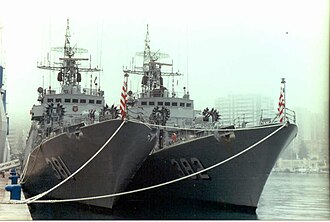
KRI Tjiptadi (381): The Indonesian Navy’s Parchim-Class Anti-Submarine Corvette
KRI Tjiptadi (381) is a fascinating example of how a Cold War naval vessel found a second life far from the waters for which it was originally designed. Operated by the Indonesian Navy (TNI Angkatan Laut), the ship belongs to the Parchim class, a family of compact corvettes developed in East Germany primarily for anti-submarine warfare in coastal and relatively shallow waters. Before becoming KRI Tjiptadi, the vessel sailed under the East German flag as Bergen with the hull number 213. She was built by Peene-Werft at Wolgast and commissioned into the East German Volksmarine in February 1985. Following the end of the Cold War and German reunification, the vessel was transferred to Indonesia and entered Indonesian service as KRI Tjiptadi in May 1996.
The ship is therefore more than simply another relatively small Indonesian warship. Her history reflects the enormous geopolitical changes that transformed European naval forces at the end of the 20th century. A vessel conceived for the Warsaw Pact’s maritime security requirements ultimately became part of the Indonesian fleet, where her compact dimensions, substantial propulsion power and anti-submarine equipment offered useful capabilities for a country with one of the world’s most complicated maritime environments. Indonesia’s geography, characterized by thousands of islands, narrow straits, busy sea lanes and extensive coastal waters, makes relatively small but capable warships particularly valuable for patrol, surveillance and maritime-security missions.
From East German Corvette to Indonesian Warship
The Bergen and the Parchim-class origins
KRI Tjiptadi began her career as Bergen (213), a Parchim-class corvette constructed at Peene-Werft in East Germany. She was commissioned on 10 February 1985 and remained associated with the East German naval system until 1996. The Parchim design was developed under the Soviet designation Project 1331M and was intended principally as a small anti-submarine warfare vessel. Its mission shaped almost every major aspect of the design: the ships were compact enough for coastal operations, fast enough to respond quickly to submarine contacts and heavily equipped for their size with anti-submarine weapons.
The Parchim class illustrates a very different approach to naval design from that of modern ocean-going frigates and destroyers. Rather than emphasizing long-range operations, large missile batteries or helicopter facilities, these corvettes concentrated considerable combat capability into a comparatively small hull. The result was a vessel of roughly 75 metres in length with a displacement below 1,000 tonnes, yet equipped with guns, anti-submarine rocket launchers and, in its original configuration, torpedo tubes and short-range air-defense weapons. That combination made the class particularly suited to operations close to shore, where a large warship could be unnecessarily expensive or cumbersome.
The Indonesian chapter
After the collapse of East Germany and the subsequent restructuring of the former East German naval fleet, a number of Parchim-class ships became available for export. Indonesia acquired a group of these vessels, giving the TNI-AL an opportunity to expand its fleet with relatively inexpensive second-hand warships. KRI Tjiptadi was commissioned into Indonesian service on 10 May 1996 and received the pennant number 381. Her new name commemorates Captain Ciptadi, an Indonesian naval officer associated with the 1962 Battle of the Aru Sea.
The transfer was significant because it gave Indonesia a class of vessels with capabilities that complemented its existing fleet. The Parchims were not designed as general-purpose ocean-going combatants in the modern sense, but their combination of speed, sensors and anti-submarine weaponry was useful for maritime patrol and security duties. Their acquisition also demonstrated how post-Cold War surplus equipment could acquire a completely different strategic purpose once transferred to another navy.
Design and Characteristics of KRI Tjiptadi
Compact dimensions with considerable power
KRI Tjiptadi is 75.2 metres long and has a beam of 9.78 metres, while the published draft is approximately 2.65 metres. Sources commonly give her standard displacement as about 865 tonnes and full-load displacement as approximately 935 tonnes, although Indonesian-language reference material gives somewhat different displacement figures. This discrepancy is worth mentioning because specifications reproduced online for older warships frequently vary according to whether they refer to original configuration, modified configuration or a particular measurement standard.
Despite her relatively modest size, the ship has a powerful propulsion arrangement. Published specifications identify three M-504A diesel engines, each rated at approximately 4,750 horsepower, giving a combined output of around 14,250 horsepower. The machinery drives three fixed-pitch propellers. This high power-to-displacement ratio is one of the defining characteristics of the Parchim design and helps explain the ship’s ability to reach approximately 24.5 knots. A range of about 2,100 nautical miles at 14 knots is also widely reported.
For a vessel of this size, such performance provides considerable tactical flexibility. A maximum speed in the mid-20-knot range allows the corvette to reposition rapidly, patrol large areas and respond to contacts without requiring the larger engines and fuel capacity associated with much bigger surface combatants. The relatively shallow draft is similarly useful in littoral environments, where access to coastal waters can be more important than the ability to remain continuously at sea for weeks at a time.
Armament and Anti-Submarine Warfare Capability
Guns and close-range defense
The original Parchim armament centered on a twin-mounted 57 mm AK-725 naval gun and a twin 30 mm AK-230 automatic cannon. These weapons provided the ship with a mixture of medium-caliber surface and anti-aircraft firepower. The 57 mm weapon was suitable for engaging surface targets and aircraft at comparatively short ranges, while the 30 mm system provided rapid-fire protection against smaller or closer threats. Sources describing Indonesian service also list two 20 mm Denel GI-2 guns, indicating that the Indonesian configuration was not necessarily identical to the original East German fit.
This distinction is important when discussing older naval vessels. A ship’s original configuration does not automatically describe the equipment it carried throughout its career. Weapons can be removed, replaced or supplemented as operational requirements, maintenance conditions and logistics change. Consequently, lists of KRI Tjiptadi’s equipment should be treated as configuration-dependent rather than as an immutable inventory.
The RBU-6000 system
The most distinctive aspect of Tjiptadi’s combat equipment is her anti-submarine armament. The ship is associated with two RBU-6000 anti-submarine rocket launchers, a Soviet-designed system intended to attack submerged targets. The RBU-6000 fires salvoes of unguided rockets and was developed to provide a rapid-response weapon against submarines detected by the ship’s sonar.
The presence of the RBU-6000 makes the ship’s original purpose especially clear. This was not simply a small gunboat with some secondary anti-submarine capability; anti-submarine warfare was central to the Parchim concept. Some published specifications also list four 400 mm torpedo tubes and, in the original configuration, short-range SA-N-5 air-defense missile positions. Other sources describing Indonesian service provide different weapon configurations. These differences underline the need to distinguish the original East German fit from later Indonesian arrangements.
Sensors and Crew
A warship’s effectiveness depends on much more than its visible weapons. Published Indonesian references associate the class with systems including the MR-302 surface-search radar, MR-123 fire-control radar and MG-322T sonar. The sonar is particularly important in understanding the ship’s intended role because detecting a submarine is the essential first step before any anti-submarine weapon can be employed. The vessel has also been associated with PK-16 decoy equipment.
The reported complement is around 62 personnel. For a 75-metre warship, this represents a relatively compact crew and reflects the specialized nature of the design. A smaller crew can reduce operating requirements, although maintaining an aging Cold War-era combatant still presents challenges in areas such as machinery maintenance, electronics support and ammunition logistics. The continued usefulness of such a ship consequently depends not only on its original design but also on the availability of maintenance, modernization and replacement parts.
KRI Tjiptadi’s Place in Indonesian Naval History
KRI Tjiptadi is representative of a broader period in Indonesian naval development when the TNI-AL incorporated a substantial number of former East German vessels. The Parchim-class ships formed part of a wider acquisition that included numerous corvettes, giving Indonesia a comparatively large group of compact combatants derived from the same basic design. Lists of Indonesian Parchim-class vessels identify Tjiptadi as pennant 381 alongside ships such as KRI Hasan Basri, KRI Imam Bonjol and others.
The class also demonstrates the long service lives that naval vessels can achieve when their basic hulls remain useful. Designed during the Cold War, the Parchims were intended for a strategic environment dominated by concerns about submarine operations in European coastal waters. In Indonesia, however, the same basic platform could be employed in a very different maritime environment. The geography changed, the strategic priorities changed and the flag changed, but the fundamental advantages of a fast, compact anti-submarine corvette remained relevant.
For enthusiasts, KRI Tjiptadi is particularly interesting because she represents the intersection of Indonesian naval history, East German shipbuilding and Cold War naval technology. Her story is not simply that of a ship being transferred from one navy to another; it is an example of how military technology can outlive the political circumstances that produced it.
Technical Specifications of KRI Tjiptadi (381)
The following table summarizes the most commonly reported specifications. Where sources disagree, the figures should be understood as approximate or configuration-dependent rather than definitive.
| Specification | KRI Tjiptadi (381) |
|---|---|
| Ship type | Parchim-class corvette |
| Original designation | Project 1331M |
| Former name | Bergen (213) |
| Builder | Peene-Werft, Wolgast, East Germany |
| Original commissioning | 10 February 1985 |
| Indonesian commissioning | 10 May 1996 |
| Indonesian pennant | 381 |
| Length | 75.2 m |
| Beam | 9.78 m |
| Draft | 2.65 m |
| Standard displacement | Approximately 865 tonnes |
| Full-load displacement | Approximately 935 tonnes |
| Main propulsion | 3 × M-504A diesel engines |
| Total power | Approximately 14,250 hp |
| Propellers | 3 × fixed-pitch propellers |
| Maximum speed | Approximately 24.5 knots |
| Range | Approximately 2,100 nautical miles at 14 knots |
| Crew | Approximately 62 |
| Main gun | 1 × twin 57 mm AK-725 |
| Secondary gun | 1 × twin 30 mm AK-230 |
| Additional guns | Sources report 20 mm Denel GI-2 weapons in Indonesian configuration |
| Anti-submarine weapons | 2 × RBU-6000 launchers |
| Original torpedo armament | 4 × 400 mm torpedo tubes |
| Original air-defense armament | 2 × SA-N-5 positions |
| Sonar | MG-322T, according to published Indonesian references |
| Radar | MR-302 and MR-123 systems reported for the class |
The specifications above draw primarily on published references describing Tjiptadi and the Parchim class. Some online sources give alternative displacement and range figures, while weapon fits may differ between the original East German configuration and subsequent Indonesian service.
Conclusion
KRI Tjiptadi (381) is a remarkable survivor of the Cold War’s naval legacy. Originally commissioned as the East German Bergen, she was built for a very specific mission: hunting submarines in coastal waters with a combination of sonar, anti-submarine rockets, torpedoes and rapid-fire guns. More than a decade later, the same hull entered Indonesian service, where it became part of a navy operating in one of the world’s most complex maritime environments.
Her compact dimensions, powerful diesel propulsion and specialized anti-submarine design make KRI Tjiptadi an excellent example of the Parchim concept. The ship was never intended to compete with large frigates or destroyers in terms of endurance, missile capacity or ocean-going capability. Instead, her strength lies in concentrating useful combat power into a relatively small platform. That philosophy explains both her original Cold War purpose and the reasons she could remain relevant after crossing from East Germany into Indonesian service.
Ultimately, the story of KRI Tjiptadi is a reminder that the history of warships is also a history of changing geopolitics. A corvette designed behind the Iron Curtain became an Indonesian naval asset after the Cold War, carrying with it a distinctive combination of East German shipbuilding, Soviet-derived weapons technology and Indonesian naval service. For anyone interested in Cold War warships, Indonesian naval history or the evolution of anti-submarine warfare, KRI Tjiptadi (381) offers an unusually interesting case study.
