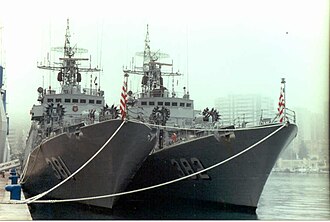
KRI Hasan Basri (382) is a fascinating example of a Cold War warship that found a second life far from the waters for which it was originally designed. Today associated with the Indonesian Navy’s Kapitan Patimura-class corvettes, the ship began her career in East Germany as Güstrow (223), one of the Parchim-class coastal anti-submarine vessels constructed by Peene-Werft at Wolgast. Launched on 31 December 1980, Güstrow was commissioned into the East German Volksmarine in the early 1980s and remained there until the end of the Cold War. Following German reunification, the vessel was eventually transferred to Indonesia and commissioned as KRI Hasan Basri on 10 May 1996, receiving pennant number 382.
The history of KRI Hasan Basri is particularly interesting because her design was built around a very specific Cold War mission: anti-submarine warfare in coastal and relatively shallow waters. The Parchim class was not conceived as a miniature destroyer or a general-purpose ocean-going frigate. Instead, the designers concentrated sonar, anti-submarine rockets, guns and powerful propulsion into a compact hull of less than 1,000 tonnes. Indonesia subsequently inherited these ships in a completely different strategic environment, where the same combination of relatively shallow draft, maneuverability and specialized weapons could be useful across the country’s enormous archipelago. KRI Hasan Basri therefore represents not only a chapter in Indonesian naval history, but also the remarkable afterlife of East German naval technology after the collapse of the Warsaw Pact.
From Güstrow to KRI Hasan Basri
Construction for the East German Navy
KRI Hasan Basri began life as Güstrow, carrying the East German pennant number 223. She was constructed at Peene-Werft in Wolgast, one of the principal shipyards responsible for building the Parchim class. Available records give her launch date as 31 December 1980, while the vessel’s commissioning date is variously recorded in references; the commonly reproduced ship history identifies 10 February 1985, although other class records give 10 November 1982. This discrepancy is worth noting when discussing the vessel’s chronology because historical databases sometimes mix commissioning information with completion or acceptance dates.
The Parchim class was developed during the late 1970s as Project 1331M for the East German Volksmarine. Its primary purpose was coastal anti-submarine warfare, particularly in the strategic environment of the Baltic Sea. In a potential NATO-Warsaw Pact confrontation, the ships were intended to search for and attack enemy submarines operating close to the East German coast. Their relatively compact size and shallow-water orientation reflected a tactical philosophy very different from that of large blue-water combatants. The ship’s most important characteristics were not enormous missile batteries or long-range endurance, but sonar, anti-submarine weapons, speed and the ability to operate effectively in restricted waters.
The resulting vessel was remarkably well armed for its size. The original configuration included a twin 57 mm AK-725 gun, a twin 30 mm AK-230 automatic cannon, two RBU-6000 anti-submarine rocket launchers, four 400 mm torpedo tubes and two SA-N-5 short-range air-defense positions. This combination allowed the corvette to conduct underwater warfare while retaining the ability to defend itself and engage surface targets. The ship’s weapon arrangement demonstrates just how strongly the Parchim design was shaped by its original anti-submarine mission.
The end of the Cold War
The collapse of East Germany transformed the future of Güstrow. Like many vessels of the former Volksmarine, she became surplus to German naval requirements after reunification. Rather than being retained as a front-line warship, she was eventually sold to Indonesia as part of a much larger transfer of former East German naval equipment. Indonesia acquired numerous Parchim-class vessels, providing the TNI Angkatan Laut with a substantial number of relatively inexpensive corvettes.
This acquisition made considerable practical sense for an archipelagic navy. Indonesia’s maritime environment consists of thousands of islands, extensive coastal areas, narrow straits and enclosed or semi-enclosed seas. A small combatant with a shallow draft and good maneuverability can be useful in circumstances where a much larger frigate may be less economical or less convenient. Although the Parchim class had been designed for Baltic operations, the fundamental characteristics of the design were not geographically exclusive.
KRI Hasan Basri entered Indonesian service on 10 May 1996 with pennant number 382 and Surabaya as her homeport. From that point forward, the vessel’s identity was no longer that of an East German coastal corvette. She became part of Indonesia’s naval force structure and acquired a name connected with Indonesian military history.
The Meaning Behind the Name Hasan Basri
Honoring an Indonesian naval figure
The ship’s name commemorates Hasan Basry, an Indonesian military figure associated with the struggle for independence and the defense of Indonesian sovereignty in South Kalimantan. The naming convention illustrates an important feature of Indonesian naval tradition: ships are frequently named after national heroes, military leaders and figures associated with important episodes in the country’s history.
The transformation from Güstrow to KRI Hasan Basri was therefore more than a simple change of identification. The ship moved from one national naval tradition into another, with an East German hull and Soviet-influenced weapons becoming part of an Indonesian institution with its own operational priorities, traditions and historical symbolism.
Her acquisition also placed her among a distinctive group of former East German vessels in Indonesian service. Other Parchim-derived ships received names such as KRI Tjiptadi, KRI Memet Sastrawiria, KRI Teuku Umar and KRI Silas Papare. Together, these ships formed a recognizable generation of Indonesian corvettes whose origins could be traced back to the Cold War shipbuilding industry of East Germany.
Hull and General Characteristics
A compact anti-submarine platform
KRI Hasan Basri measures approximately 75.2 metres in length and 9.78 metres in beam. Published specifications commonly give a standard displacement of approximately 865 tonnes and a full-load displacement of about 935 tonnes, with a draft of roughly 2.65 metres. Some Indonesian references instead report a standard displacement around 793 tonnes and a full-load figure near 854 tonnes. These variations probably reflect different measurement standards, configurations or stages in the ship’s career rather than necessarily indicating entirely different vessels.
The dimensions reveal the philosophy behind the Parchim design. At just over 75 metres long, Hasan Basri is considerably smaller than a modern frigate, yet she contains powerful propulsion machinery, multiple weapon systems, radar and sonar equipment and accommodation for a crew of roughly 60 personnel. Her compact hull also gives her an important advantage in coastal operations: she does not require the same depth of water or logistical infrastructure as a much larger combatant.
This compactness should not be confused with simplicity. The Parchim was a highly specialized warship for its time, and much of its internal space was devoted to machinery and systems necessary for anti-submarine warfare. The ship’s relatively modest displacement was therefore the result of careful prioritization rather than a lack of ambition.
Propulsion and Performance
High power in a small hull
Published general specifications describe the original Parchim propulsion system as three M-504A diesel engines, each producing approximately 4,750 horsepower. Together, they generated around 14,250 horsepower and drove three fixed-pitch propellers. Under this configuration, the ship is commonly credited with a maximum speed of approximately 24.5 knots and a range of about 2,100 nautical miles at 14 knots.
However, KRI Hasan Basri underwent a significant propulsion modernization. A technical paper from the Indonesian Naval Technology College specifically identifies KRI Hasan Basri-382 as using MTU 16 V 4000 M90 diesel engines and states that the ship underwent rejuvenation involving these engines in 2004. Another class reference lists KRI Hasan Basri among the Indonesian Parchim ships fitted with two MTU 16V 4000 M90 engines.
This distinction is important when presenting the ship’s technical specifications. The three-engine M-504A arrangement describes the original Parchim configuration commonly associated with the class, whereas the MTU installation represents a later Indonesian modernization. For that reason, a historical article should avoid presenting the original machinery as though it necessarily remained unchanged throughout the ship’s Indonesian career.
The modernization also demonstrates the practical challenges of keeping an aging Cold War warship operational. Engines, fuel systems and other machinery eventually require replacement or refurbishment, especially when original equipment becomes difficult to support. The technical study of Hasan Basri’s MTU high-pressure fuel pumps shows that machinery maintenance became an important part of sustaining the vessel’s operational life.
Armament and Combat Capability
Guns for surface and close-range defense
The principal gun of KRI Hasan Basri is the twin 57 mm AK-725, a weapon inherited from the original Parchim design. The gun provides substantial firepower for a corvette of this displacement and can be employed against surface targets and, within its limitations, aerial threats. A twin 30 mm AK-230 automatic cannon provides additional rapid-fire capability and is particularly suited to shorter-range engagements.
The Indonesian configuration added two 20 mm Denel GI-2 guns after the original SA-N-5 short-range air-defense missile positions were removed. This modification illustrates the changing priorities of the Indonesian vessels. The original Soviet air-defense system belonged to a Cold War weapons ecosystem, whereas the additional guns offered a simpler short-range defensive capability compatible with a different logistical environment.
RBU-6000 anti-submarine rockets
The two RBU-6000 anti-submarine rocket launchers are arguably the most characteristic weapons aboard Hasan Basri. The Soviet-designed system was developed to attack submerged targets using salvos of unguided rockets. It was intended to work alongside the ship’s sonar, allowing a corvette to detect an underwater contact and then engage it without necessarily relying on torpedoes.
The original Güstrow configuration also carried four 400 mm torpedo tubes. Indonesian Parchim vessels subsequently experienced changes to their torpedo arrangements because the Indonesian Navy did not maintain the same Russian torpedo logistics chain. Class references indicate that the original launchers were removed from service and that Western-style triple torpedo launchers were installed on only some vessels. Consequently, the safest description of Hasan Basri’s Indonesian configuration is to emphasize the retained RBU-6000 system while treating the original torpedo fit separately.
Sensors and the Anti-Submarine Mission
Finding submarines
The Parchim design was fundamentally an anti-submarine system rather than simply a small surface combatant carrying some underwater weapons. Its sonar was therefore central to the ship’s purpose. Published class and Indonesian references associate the ships with the MG-322T sonar, while the wider sensor suite included radar and fire-control equipment designed to support surface and aerial awareness and weapon employment.
The basic operational sequence was straightforward in concept but demanding in practice: detect a possible underwater contact, classify and track it, maneuver the ship into a favorable position and then employ an appropriate anti-submarine weapon. The RBU-6000 launchers provided the vessel with a rapid-response underwater weapon, while the original torpedoes provided another method of attack. The combination gave the Parchim a specialized capability that was unusual for such a small ship.
For Indonesia, this capability had potential relevance beyond the Cold War mission for which it was created. The country’s extensive maritime territory includes numerous passages and bodies of water where submarine detection can be strategically important. Although the technology of the 1980s was increasingly dated by the 21st century, the basic requirement to monitor underwater approaches remained relevant.
Modernization and Service in Indonesia
Extending the life of a Cold War vessel
KRI Hasan Basri’s Indonesian career illustrates the effort required to keep older naval platforms useful. The ship’s 2004 machinery rejuvenation with MTU 16V 4000 M90 engines was a major step in extending her operational life. The technical literature surrounding the ship specifically discusses the high-pressure fuel pumps of these engines, showing that the modernization introduced modern common-rail diesel technology while also creating new maintenance requirements.
Other aspects of the Indonesian Parchim program involved adapting weapons and equipment to local requirements. The removal of SA-N-5 missile positions, addition of 20 mm guns and changes to the torpedo arrangements illustrate a broader process of adapting an inherited Cold War design to a different logistical and operational environment.
The result was not a completely new ship, nor was it an untouched East German corvette. Instead, Hasan Basri became a hybrid of original design and Indonesian modernization: the basic hull, anti-submarine concept and several major weapon systems remained recognizable, while propulsion and selected armament elements were adapted over time.
Technical Specifications of KRI Hasan Basri (382)
| Specification | KRI Hasan Basri (382) |
|---|---|
| Ship type | Kapitan Patimura-class / Parchim-class corvette |
| Project designation | Project 1331M |
| Former name | Güstrow (223) |
| Builder | Peene-Werft, Wolgast, East Germany |
| Yard number | 352 |
| Launched | 31 December 1980 |
| East German service | Volksmarine |
| Indonesian commissioning | 10 May 1996 |
| Indonesian pennant | 382 |
| Homeport | Surabaya |
| Status | Reported in Indonesian Navy service |
| Length | 75.2 m |
| Beam | 9.78 m |
| Draft | Approximately 2.65 m |
| Standard displacement | Approximately 865 tonnes |
| Full-load displacement | Approximately 935 tonnes |
| Alternative published displacement | Approximately 793 tonnes standard / 854 tonnes full load |
| Original propulsion | 3 × M-504A diesel engines |
| Original total power | Approximately 14,250 hp |
| Indonesian propulsion | 2 × MTU 16V 4000 M90 reported after modernization |
| Original propellers | 3 × fixed-pitch propellers |
| Original maximum speed | Approximately 24.5 knots |
| Published range | Approximately 2,100 nautical miles at 14 knots |
| Crew | Approximately 62 |
| Main gun | 1 × twin 57 mm AK-725 |
| Secondary gun | 1 × twin 30 mm AK-230 |
| Additional Indonesian guns | 2 × 20 mm Denel GI-2 |
| Anti-submarine weapons | 2 × RBU-6000 launchers |
| Original torpedo armament | 4 × 400 mm torpedo tubes |
| Original air defense | 2 × SA-N-5 positions |
| Primary original role | Coastal anti-submarine warfare |
The figures in this table should be read as historical specifications rather than a single immutable snapshot. In particular, the original M-504A propulsion system differs from the MTU machinery documented for Hasan Basri after her Indonesian modernization, while published displacement figures also vary between references.
Conclusion
KRI Hasan Basri (382) is an excellent example of how naval technology can survive the political circumstances that originally produced it. Built in East Germany as Güstrow, she was conceived for a highly specific Cold War mission: detecting and attacking submarines in coastal waters. Her compact hull, powerful machinery, sonar and RBU-6000 anti-submarine rockets were all components of that specialized concept. When the Cold War ended, however, the ship’s story did not end with the disappearance of East Germany. Instead, she became part of Indonesia’s naval modernization effort and entered service under a new name in 1996.
Her Indonesian career also demonstrates the importance of modernization in extending the useful life of older warships. The replacement of her original propulsion machinery with MTU 16V 4000 M90 engines, documented in Indonesian naval technical research, illustrates the practical work required to keep a Cold War-era corvette operational decades after its construction. Changes to the weapons fit similarly reflected the needs of a different navy operating within a different logistical and strategic environment.
Ultimately, KRI Hasan Basri is more than a small Indonesian corvette. She is a surviving link between East German shipbuilding, Soviet-influenced naval technology, the end of the Cold War and Indonesia’s long-running effort to maintain a capable maritime force across an enormous archipelago. Her story demonstrates that the value of a warship is not determined solely by its age or original purpose. With modernization and adaptation, a vessel designed for the Baltic Sea could find a remarkably long second chapter thousands of kilometres away in Southeast Asia.
