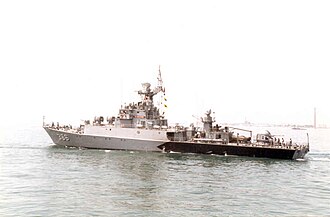
KRI Silas Papare (386) is one of the Indonesian Navy’s distinctive Kapitan Patimura-class corvettes, a group of warships whose origins lie in the Cold War naval industry of East Germany. Before becoming an Indonesian vessel, the ship was known as Gadebusch (211) and served with the East German Volksmarine. Built by Peene-Werft at Wolgast, Gadebusch was laid down in 1981, launched in 1982 and commissioned in August 1984. After German reunification, the vessel briefly became part of the unified German Navy under the hull number P 6167 before being laid up and subsequently transferred to Indonesia. She was commissioned as KRI Silas Papare on 27 October 1996 and assigned pennant number 386.
The ship belongs to the Parchim class, also known as Project 1331M, a design created primarily for coastal anti-submarine warfare. The Parchims were not intended to compete with large frigates or destroyers in open-ocean operations. Instead, they concentrated considerable firepower and underwater-warfare capability into a relatively compact hull. That made them well suited to coastal waters and narrow maritime environments, and it also helped explain why Indonesia saw value in acquiring the former East German vessels after the end of the Cold War. KRI Silas Papare therefore represents an unusual meeting of two very different naval histories: an East German Cold War design and an Indonesian Navy operating across the enormous and geographically complicated waters of the Indonesian archipelago.
From Gadebusch to KRI Silas Papare
Construction for the East German Navy
KRI Silas Papare began life as Gadebusch, one of the later Parchim-class corvettes constructed for the East German Volksmarine. The ship was laid down at Peene-Werft in Wolgast on 17 August 1981 and launched the following year. She was commissioned on 31 August 1984 with the East German hull number 211. Her construction formed part of a program that ultimately produced 16 Parchim-class vessels for East Germany, with the ships intended to provide a relatively inexpensive platform dedicated to submarine hunting in coastal waters.
The strategic reasoning behind the design was closely connected with the Cold War naval balance in northern Europe. The Parchims were developed to conduct anti-submarine operations in relatively shallow and restricted waters, where their compact size and specialized sensors could be advantageous. Their original mission included countering small submarines such as the West German Navy’s Type 206 boats. Instead of being built around long-range missiles or aviation facilities, the ships emphasized sonar, anti-submarine rockets and torpedoes, supported by guns and short-range air-defense weapons.
This specialized design also explains the relatively unusual appearance of a Parchim-class ship. At approximately 75 metres long and under 1,000 tonnes in displacement, KRI Silas Papare is much smaller than a modern frigate, yet her original armament included a twin 57 mm gun, a twin 30 mm automatic cannon, anti-submarine rocket launchers, torpedo tubes and short-range air-defense missiles. The result was a compact combatant whose individual systems were selected to support a particular tactical mission rather than to provide every capability expected from a modern multi-role warship.
A short German Navy interlude
The collapse of East Germany brought an abrupt end to the original political purpose of Gadebusch. She was decommissioned from the Volksmarine on 2 October 1990, immediately before German reunification, and was subsequently integrated into the unified German Navy on 3 October. During this short period she received the hull number P 6167. Her service with the unified German fleet did not last long, however, and she was laid up in 1991 before eventually being sold to Indonesia.
Indonesia’s acquisition of the former East German Parchims was part of a much larger post-Cold War transfer of naval equipment. Sixteen former East German Parchim-class vessels were purchased for the Indonesian Navy as part of a package that also included other naval vessels. The Parchims underwent refurbishment before entering Indonesian service, allowing Indonesia to acquire a substantial number of relatively capable corvettes at a fraction of the cost of building an equivalent fleet of new ships.
The Indonesian Career of Silas Papare
A new identity
The former Gadebusch was renamed KRI Silas Papare and commissioned into the Indonesian Navy on 27 October 1996. She received pennant number 386 and was associated with Surabaya as her homeport. The name honors Silas Papare, a prominent figure from the history of Indonesia’s struggle over the status of western New Guinea. Giving the ship an Indonesian historical name transformed what had originally been a Cold War East German corvette into a vessel carrying a distinctly national identity within the TNI Angkatan Laut.
Her acquisition also made practical sense in geographical terms. Indonesia is an archipelagic state with thousands of islands, extensive territorial waters and numerous strategic straits. A relatively small corvette capable of operating at high speed and carrying anti-submarine weapons could be useful for patrol, maritime security and combat operations in coastal and archipelagic environments. Although the Parchim concept had been created for European waters, its fundamental characteristics—compact size, maneuverability, sonar and specialized anti-submarine armament—were not tied exclusively to the European theater.
Hull, Dimensions and Performance
A compact and fast warship
KRI Silas Papare has a reported length of 75.2 metres and a beam of approximately 9.78 metres. Published specifications generally place the class at around 865 tonnes standard displacement and approximately 935 tonnes fully loaded, although other references give slightly different figures. A separate naval reference lists a full-load displacement of approximately 908 tonnes, illustrating the variation that can occur among published specifications for older warships.
The ship’s proportions reflect the priorities of the Parchim design. Her relatively narrow beam and modest draft allowed her to operate in coastal waters while retaining the hull volume necessary for machinery, weapons, sensors and crew facilities. The design did not attempt to maximize endurance or aviation capability; instead, space was allocated to systems supporting the anti-submarine mission and to propulsion powerful enough to give the ship a useful tactical speed.
Propulsion and speed
Published information concerning KRI Silas Papare’s machinery is inconsistent, and this is an important point when compiling technical information about the ship. One detailed listing identifies three M-504A diesel engines producing a combined 14,250 horsepower and driving three fixed-pitch propellers, with a maximum speed of approximately 24.5 knots.
However, class-level references identify KRI Silas Papare among Indonesian Parchim vessels fitted with two MTU 16V 4000 M90 diesel engines, rated at approximately 7,300 horsepower in total. Other Indonesian Parchims received different engine arrangements, and the class was significantly refurbished after transfer to Indonesia.
The discrepancy should therefore be treated as a configuration issue rather than simply choosing one number without qualification. The original Parchim propulsion arrangement is commonly described using the three-engine M-504A configuration, while Indonesian-service references indicate that some vessels, including Silas Papare, underwent machinery changes. For historical writing, it is more accurate to acknowledge both sets of information than to imply that every published specification describes the ship at exactly the same point in her career.
Armament and Combat Systems
The main guns
The original Parchim armament centered on a twin 57 mm AK-725 naval gun. Positioned forward, this weapon gave the relatively small corvette a significant surface-gunnery capability. A twin 30 mm AK-230 automatic cannon provided a second layer of rapid-fire weaponry and could be employed against smaller surface targets and short-range aerial threats. These guns reflected the defensive and coastal-combat environment for which the Parchims were designed.
The Indonesian configuration altered some elements of this original arrangement. Published information identifies KRI Silas Papare with the twin 57 mm weapon and twin 30 mm gun, while other class references report that the 30 mm AK-230 on Silas Papare was eventually replaced by a Chinese Type 730 close-in weapon system. This illustrates the gradual evolution of Indonesian Parchim vessels as their operators sought to adapt aging Cold War ships to changing operational requirements.
Anti-submarine weapons
Anti-submarine warfare remained the most distinctive feature of the Parchim concept. KRI Silas Papare retained two RBU-6000 anti-submarine rocket launchers, a Soviet-designed system capable of firing salvos of rockets at submerged targets. The launchers were intended to work with the ship’s sonar, allowing the corvette to attack submarines detected beneath the surface without relying exclusively on torpedoes.
The original Gadebusch configuration also included four 400 mm torpedo tubes and two SA-N-5 short-range air-defense missile positions. Indonesian modifications altered this arrangement, with published sources reporting the removal of the SA-N-5 systems and their replacement by 20 mm guns on some ships. Other class-level references also note that some Indonesian Parchims received Western-style triple torpedo launchers, although the available sources do not establish that such a system formed part of Silas Papare’s standard configuration.
Sensors and the Anti-Submarine Mission
The weapons of a Parchim-class corvette make sense only when considered alongside its sensors. Published specifications associate KRI Silas Papare with the MR-302 Strut Curve surface and air-search radar, an MR-123 Vympel fire-control radar and an MG-322T hull-mounted sonar. Some detailed references additionally identify navigation radar and electronic countermeasure equipment, including chaff launchers and radar-warning systems.
The sonar was particularly important because anti-submarine warfare begins with detection rather than attack. A submarine cannot normally be engaged effectively until its position has been established with sufficient confidence. The Parchim’s sonar and anti-submarine rocket systems were therefore part of an integrated tactical concept: search for underwater contacts, classify and track them, maneuver into an advantageous position and then employ the appropriate weapon. This approach was highly relevant to the restricted-water environment in which the class was originally expected to operate.
The ship’s reported complement of around 60–62 personnel was also modest compared with larger surface combatants. Such a crew size reflects the compact nature of the platform, although the operation of a complex warship inevitably requires personnel for engineering, weapons, sensors, navigation, communications and general shipboard duties.
Modernization and Long-Term Relevance
One of the most interesting aspects of KRI Silas Papare is the way her career demonstrates the adaptability of older naval platforms. The Indonesian Navy did not simply take the former East German ships and operate them unchanged. The Parchims underwent significant rehabilitation, including machinery and habitability improvements, while their weapons and electronic systems were modified according to Indonesian requirements. Class-level references note a major refit program that included air-conditioning and engine replacements.
This process was important because the strategic environment of the Indonesian Navy was fundamentally different from the one for which the Parchims had been designed. The original vessels had been built around a narrowly defined Cold War anti-submarine mission. Indonesian operators, by contrast, needed ships capable of supporting broader maritime-security requirements across a huge archipelago. Modernization could not transform a small 1980s corvette into a modern frigate, but it could extend the usefulness of the existing hulls by improving reliability and adapting selected weapons and equipment.
KRI Silas Papare is therefore best understood not simply as an old East German warship but as an Indonesian-adapted naval platform. Her history demonstrates how military vessels can remain useful long after the strategic assumptions behind their original designs have disappeared.
Technical Specifications of KRI Silas Papare (386)
| Specification | KRI Silas Papare (386) |
|---|---|
| Ship type | Kapitan Patimura-class / Parchim-class corvette |
| Project designation | Project 1331M |
| Former name | Gadebusch (211) |
| Builder | Peene-Werft, Wolgast, East Germany |
| Laid down | 17 August 1981 |
| Launched | 1982 |
| East German commissioning | 31 August 1984 |
| Unified German Navy hull number | P 6167 |
| Indonesian commissioning | 27 October 1996 |
| Indonesian pennant | 386 |
| Homeport | Surabaya |
| Length | 75.2 m |
| Beam | 9.78 m |
| Draft | 2.65 m |
| Standard displacement | Approximately 865 tonnes |
| Full-load displacement | Approximately 935 tonnes; other references report about 908 tonnes |
| Original propulsion | 3 × M-504A diesel engines |
| Original total power | Approximately 14,250 hp |
| Indonesian-service propulsion | Sources identify 2 × MTU 16V 4000 M90 on Silas Papare |
| Propellers | 3 fixed-pitch propellers in the commonly cited original configuration |
| Maximum speed | Approximately 24–24.5 knots |
| Range | Approximately 2,100 nautical miles at 14 knots in commonly cited specifications |
| Crew | Approximately 60–62 |
| Main gun | 1 × twin 57 mm AK-725 |
| Original secondary gun | 1 × twin 30 mm AK-230 |
| Later close-in defense | Type 730 CIWS reported for Silas Papare in class references |
| Anti-submarine weapons | 2 × RBU-6000 launchers |
| Original torpedo armament | 4 × 400 mm torpedo tubes |
| Original air defense | 2 × SA-N-5 positions |
| Indonesian additional armament | 20 mm guns reported in modified configurations |
| Surface-search radar | MR-302 Strut Curve |
| Fire-control radar | MR-123 Vympel / Muff Cob |
| Sonar | MG-322T |
| Countermeasures | Chaff and radar-warning systems reported |
The technical figures should be treated as historical and configuration-dependent. In particular, published sources disagree over the propulsion installed on Silas Papare, while weapon fits changed during Indonesian service. The three-engine M-504A specification is widely reproduced for the individual ship, whereas class-level records identify Silas Papare among vessels receiving MTU machinery.
Conclusion
KRI Silas Papare (386) is a particularly interesting example of how a Cold War warship can acquire an entirely new identity and purpose. Launched in East Germany as Gadebusch, she was designed around the specialized requirements of coastal anti-submarine warfare and spent the final years of the Cold War in the Volksmarine. Following reunification, she briefly entered the unified German Navy before being laid up and eventually transferred to Indonesia, where she was rebuilt and commissioned as KRI Silas Papare in 1996.
Her compact dimensions, high speed and anti-submarine equipment reveal the philosophy behind the Parchim class. These were never intended to be miniature destroyers. Their strength came from concentrating a carefully selected collection of sensors, guns and underwater weapons into a small platform capable of operating close to shore. In Indonesian service, that basic concept was adapted to a radically different maritime environment through refurbishment, machinery changes and alterations to the weapon fit.
The history of KRI Silas Papare also demonstrates why older warships can remain historically important even after their original technology has become dated. Her career links East German shipbuilding, Soviet-influenced naval engineering, German reunification and Indonesia’s post-Cold War naval modernization. As one of the Parchim-class vessels that made the journey from the Baltic region to Southeast Asia, KRI Silas Papare stands as a tangible example of how the end of the Cold War reshaped naval fleets far beyond Europe. Her story is ultimately not only about one corvette, but about the extraordinary afterlife of military technology when ships, nations and strategic priorities all change.
