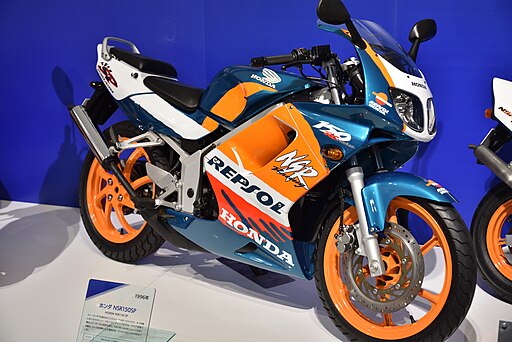
Honda NSR150
The Honda NSR150 remains an icon among lightweight sportbikes, celebrated for its potent two-stroke powerplant, razor-sharp handling, and razor-edged styling. Born as a 147 cc race‐replica inspired by Honda’s Grand Prix machines, the NSR150 found global fame in Southeast Asia and Latin America. In this article, we’ll unpack every technical parameter that defines the NSR150—its engine, transmission, chassis, brakes, dimensions, and maintenance needs—so you can grasp why this compact sportbike still enthralls riders decades after its debut.
History and Evolution
Origins and Concept
Honda launched the NSR150 in the early 1990s to bring two-stroke Grand Prix technology into a street-legal package. While most manufacturers had moved on to four-strokes, Honda leveraged its 125 cc GP heritage to create a high-revving, reed-valve two-stroke with a race-inspired chassis and slim bodywork. The goal was a nimble, lightweight machine that delivered explosive acceleration and razor-sharp agility.
Regional Variants and Updates
– Asia (NSR150SP): Featured upside-down forks, an aluminum swingarm, and digital instrument cluster. – Latin America (NSR150R): Often kick-start only, with simplified electronics and standard telescopic forks. – Special Editions: Limited-run color schemes, “Boss Edition” decals, and minor engine port revisions.
Though basic styling and mechanicals remained constant, regional spec sheets varied in suspension, ignition mapping, and fairing graphics.
Engine and Performance
Two-Stroke Reed-Valve Powerplant
At the heart of the NSR150 lies a liquid-cooled, 147 cc two-stroke single with a 56 × 50.6 mm bore and stroke. Key features include:
- Reed-valve induction: Enhances low-end response and midrange power.
- Nikasil-coated cylinder: Reduces wear and friction for sustained performance.
- Dual exhaust ports: Tuned expansion chamber delivers a broad torque band.
- CDI ignition: Digital timing ensures crisp throttle response up to the 11 000 rpm redline.
Power and Torque Figures
| Specification | Value |
|---|---|
| Peak Power | 29 PS (21.4 kW) @ 10 500 rpm |
| Peak Torque | 24 Nm @ 9 000 rpm |
| Redline | 11 500 rpm |
| Power-to-Weight Ratio | ~0.21 PS/kg (dry weight) |
With nearly 30 PS in a machine weighing just 138 kg dry, the NSR150 delivers explosive acceleration—0–60 km/h in under 3 seconds—and a top speed pushing 140 km/h.
Power Delivery and Character
The NSR150’s two-stroke power curve is famously peaky: a tractable pull through the lower revs gives way to a ferocious powerband surge between 7 000 and 11 000 rpm. Riders learn to keep the tachometer dancing near redline for best performance, making the NSR150 an engaging, high-revving thrill ride.
Transmission and Final Drive
Six-Speed Gearbox
- Gear Ratios: Close-ratio first through fourth for strong acceleration; longer fifth and sixth for highway cruising.
- Positive-feel shifting: Short throw shifter and crisp engagement lend confidence in tight traffic or on the track.
- Clutch: Wet multi-plate, offering predictable leverage and reliable engagement even under hard pull.
Chain Final Drive
A standard 520-series O-ring chain transmits power to the 17-tooth front and 39-tooth rear sprockets. Simple to adjust and replace, the chain final drive ensures efficient power transfer and relatively low maintenance costs.
Chassis and Suspension
Frame Geometry
- Frame Type: Twin-spar aluminum in SP models; steel cradle in base variants.
- Wheelbase: 1 300 mm
- Rake / Trail: 25° / 95 mm
The twin-spar frame SP edition delivers exceptional torsional rigidity, translating throttle inputs directly into corner-entry precision.
Front Suspension
- NSR150SP: 35 mm inverted telescopic forks, 110 mm travel
- Standard: 33 mm conventional telescopic forks, 110 mm travel
Upgraded SP forks reduce unsprung weight and improve damping at high speeds, giving a planted feel under hard braking.
Rear Suspension
- Type: Pro-link monoshock, piggyback reservoir
- Travel: 108 mm
- Adjustment: 7-step preload
The Pro-link linkage ensures a progressive spring rate—comfortable over small bumps, yet resistant to bottoming on big compressions.
Brakes, Wheels, and Tires
Braking System
- Front: 296 mm hydraulic disc, dual-piston caliper
- Rear: 220 mm disc, single-piston caliper
High-mount front disc and powerful caliper deliver strong initial bite, while the rear disc maintains stability under lock-up resistance.
Wheels and Tires
- Wheels: 17″ ten-spoke aluminum alloys
- Front Tire: 110/70-17
- Rear Tire: 130/70-17
The combination provides nimble turn-in and confident mid-corner grip. Wider rear rubber in SP models further enhances traction under acceleration.
Dimensions, Weight, and Capacities
| Parameter | NSR150 Base | NSR150SP |
|---|---|---|
| Overall Length | 1 930 mm | 1 930 mm |
| Overall Width | 660 mm | 660 mm |
| Overall Height | 1 095 mm | 1 095 mm |
| Seat Height | 765 mm | 780 mm |
| Wheelbase | 1 300 mm | 1 300 mm |
| Ground Clearance | 165 mm | 165 mm |
| Dry Weight | 135 kg | 138 kg |
| Fuel Tank Capacity | 13 L | 13 L |
| Oil Capacity (2T) | 1.1 L | 1.1 L |
Compact dimensions and a low center of gravity aid in rapid direction changes and tight U-turns.
Electronics and Instrumentation
Digital-Analog Dash
– Tachometer: Large analog dial for easy rev monitoring – Digital LCD: Speedometer, dual trip meters, fuel gauge, clock – Warning Lights: Oil pressure, CDI fault, turn signals
Clear readouts keep critical data in the rider’s eye path—vital when chasing the powerband.
Ignition and Safety
– CDI Ignition: Advanced spark-curves minimize detonation and maximize top-end performance. – Self-starter: Electric start with optional kickstart backup in some regions.
The CDI unit’s programmable maps allow minor tuning via aftermarket modules.
Riding Characteristics and Ergonomics
Rider Triangle
The NSR150 offers a semi-sporty posture: low clip-on style handlebars with moderate reach, a narrow tank for knee grip, and rear-set footpegs that encourage a forward-leaning stance without sacrificing all-day comfort.
Handling Traits
– Agility: Feather-light steering makes flicking between corners effortless. – Stability: Well-balanced frame and suspension resist headshake at triple-digit speeds. – Feedback: Crisp front end delivers confidence-inspiring communication of road surface changes.
Maintenance and Tuning Potential
Routine Service
- Two-Stroke Oil Mix: 1 : 50 premix ratio (2T oil to gasoline)
- Spark Plug: Change every 5 000 km
- Reed Valve Inspection: Every 10 000 km for petal wear or cracking
- Exhaust Decarbonizing: Annually or after 8 000 km to clear port blockages
- Valve Clearance (if OEM rotary valve): Adjust per manual specs
Consistent maintenance keeps the NSR150’s two-stroke heart in peak condition and ensures longevity.
Performance Upgrades
– Expansion Chamber: High-performance aftermarket pipe unlocks broader powerband. – Big Carburetor: 28–30 mm shim-type carb for improved throttle response. – Reed Valve Tuning: Carbon-fiber petals for sharper midrange punch. – Ignition Module: Programmable CDI for custom timing curves.
With the right bolt-on mods, output can climb past 35 PS, further enhancing the NSR150’s track capabilities.
Conclusion
The Honda NSR150 lives on as a testament to two-stroke performance packaged in a lightweight, race-bred chassis. Its fiery engine, precise handling, and sleek GP-inspired styling continue to captivate riders who crave a pure, high-revving experience. By exploring every technical parameter—from the reed-valve two-stroke engine and six-speed gearbox to the Pro-link suspension and potent braking system—we see why the NSR150 remains a cult favorite and an enduring legend in the world of 150 cc sportbikes.
