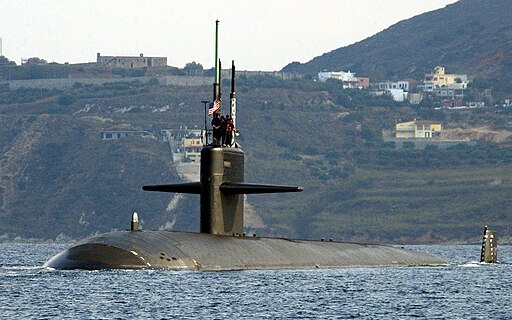
USS Newport News (SSN-750): Silent Hunter of the Deep
USS Newport News (SSN-750) prowls the oceans as a member of the Los Angeles-class attack submarines, blending stealth, endurance and firepower. Commissioned in December 1989, she exemplifies Cold War engineering that has since evolved with incremental modernizations. This article breaks down her technical specifications, design philosophy and operational capabilities.
Design and Construction
Hull Form and Structural Features
Newport News carries the teardrop hull shape refined in U.S. attack submarines since the 1960s. Her single-piece pressure hull is fabricated from HY-80 high-yield steel, welded into a continuous inner shell. Outside this lies anechoic tiles that dampen sound reflections and reduce detectability by active sonar. The sail (conning tower fairwater) is swept back and slimmed to minimize hydrodynamic drag, while retractable masts and antennas stow flush behind retractable fairings.
Modular Build and Shipyard History
Built at Newport News Shipbuilding, her construction leveraged modular sections—each outfitted with piping, cable trays and machinery skid-mounted for rapid alignment. Sections were joined in a giant drydock pit complex, then rolled over for final assembly. This block-technique cut build time by roughly 20 percent compared to earlier submarines.
Dimensions and Displacement
- Overall length: 362 feet (110 meters)
- Beam (hull maximum): 33 feet (10 meters)
- Draft (keel to sail top): 31 feet (9.5 meters)
- Surface displacement: approx. 6,900 long tons
- Submerged displacement: approx. 7,300 long tons
Her compact profile suits deep-water maneuvering, while an overall beam ratio of roughly 11 percent keeps flow separation low at flank speeds.
Propulsion and Performance
Nuclear Reactor Plant
At her core sits a single S6G pressurized water reactor driving two steam turbines. The reactor’s heat exchangers generate high-pressure steam that spins a reduction gearbox connected to the main shaft. This single-shaft arrangement delivers power to a skew-back propeller blade assembly designed to reduce cavitation and acoustic signature.
Speed, Range and Endurance
- Maximum submerged speed: 30+ knots
- Cruising speed (silent): 5 knots for covert patrols
- Range: effectively unlimited while nuclear fuel remains; constrained by food and supplies (90 days standard patrol)
- Test depth: greater than 650 feet
Her reactor refueling interval spans nearly 20 years, allowing operations across multiple deployments without core change-out.
Armament
Torpedo and Missile Systems
Two Mk 67 torpedo rooms house a total of four 21-inch torpedo tubes. Newport News typically embarks up to 26 weapons in the forward torpedo magazine, mixing:
- Mk 48 heavyweight torpedoes for anti-submarine and anti-surface warfare
- UGM-109 Tomahawk land-attack cruise missiles launched via torpedo tubes
- UGM-84 Harpoon anti-ship missiles when embarked for surface strike
Magazine handling systems feature automated hoists that move weapons from storage racks to tube entrances in under three minutes.
Countermeasures and Decoys
Her countermeasure suite includes:
- APR-39(V)2 radar warning receivers for marine and airborne radar detection
- TB‐16 towed decoys capable of seduction and confusion against incoming torpedoes
- AN/SLQ-25C Nixie acoustic decoy system deploying towed noisemakers
These systems deploy automatically when torpedo alarms activate, creating layered protection.
Sensors and Electronics
Sonar and Acoustic Processing
The bow houses the BQQ-10 active/passive spherical sonar array, offering long-range detection of submarines and surface vessels. Flank arrays mounted along the hull’s lower sides extend passive coverage. A high-frequency BQS-15 intercept array sits in the sail for mine and obstacle avoidance during shallow transits.
Combat Control and Navigation
Combat decisions run through the AN/BYG-1 Fire Control System, which fuses sonar tracks, optronics data and periscope imagery. Multifunction screens allow rapid reprogramming of fire-control solutions. Navigation rests on a ring-laser inertial navigation system, augmented by GPS when at periscope depth. A digital bathymetric database aids under-ice or littoral waypointing.
Crew Accommodations and Habitability
Crew Composition and Living Spaces
USS Newport News operates with approximately 14 officers and 115 enlisted sailors. Staterooms for officers are two-berth cabins while enlisted bunks are stacked six-high in modular berthing compartments. Hot-racking (three sailors per station) optimizes space on extended patrols.
Life-Support and Amenities
- Air purification and CO₂ scrubbing ensure fresh-air circulation
- Water-maker distills over 10,000 gallons/day from seawater
- Galley serves three hot meals daily, augmented by freeze-dried ration stores for emergencies
- Exercise equipment and touch-screen entertainment terminals help combat confinement fatigue
Fault-tolerant environmental controls keep temperature and humidity within narrow comfort bands despite reactor and machinery heat loads.
Operational Capabilities
Anti-Submarine and Anti-Surface Warfare
Silent running at low speeds and anechoic coating make her hard to detect. When conditions favor, she can sprint at flank speed to intercept targets. Torpedo salvo tactics allow multiple engagement profiles—closing range for Mk 48 or launching standoff Tomahawks against coastal targets.
Intelligence, Surveillance and Reconnaissance
Digital communications mast suites support high-bandwidth bursts to satellites once at periscope depth. Her photonics mast offers low-light and infrared imaging to collect imagery for intelligence exploitation without requiring analog periscope exposure.
Special Operations Support
A rear lock-in/lock-out chamber allows deployment of up to a dozen special-forces divers in equipment-laden wetsuits. Lock-out operations can occur while the submarine remains submerged at shallow depths, minimizing surface exposure.
Service History and Upgrades
Commissioning and Early Patrols
Commissioned in Hampton Roads in 1989, Newport News conducted initial patrols under Atlantic Fleet command. She swiftly integrated into carrier-strike and hunter-killer groups before the Cold War’s end.
Mid-Life Modernizations
During a 2002 overhaul, she received:
- AN/BQQ-5C sonar upgrades with improved signal processing
- Digital fiber-optic databus installation for faster sensor to weapon handoff
- Habitability enhancements including new galley equipment and stateroom refurbishments
Subsequent dry-docks added communications uplinks to emerging satellite constellations and improved hull-mounted sonar projector arrays.
Recent Deployments
In the past decade, Newport News has supported Arctic exercises beneath polar ice, tracked foreign submarines in the Atlantic and launched Tomahawks into expeditionary operations. Regular North Atlantic Treaty Organization exercises have validated her interoperability with allied anti-submarine task groups.
Future Outlook and Legacy
As the Virginia-class boats enter service, Los Angeles-class submarines like Newport News will gradually shift to secondary roles—training, test platforms and intelligence collection. Yet every patrol she sails underscores three decades of stealth technology maturing at sea. Her hull remains a silent sentinel, reminding the world that beneath the waves, power moves unseen.
Whether charting under ice shelves or lurking off distant coasts, USS Newport News harnesses nuclear propulsion, cutting-edge acoustics and hardened fire-control systems to maintain undersea dominance. Her story is one of continuous evolution, ensuring she remains an essential asset until her final patrol.
