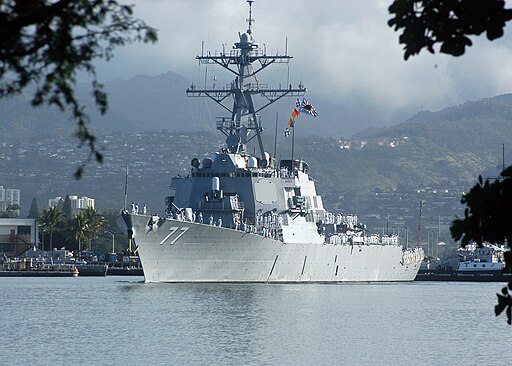
USS O’Kane (DDG-77)
USS O’Kane (DDG-77) is the twenty-seventh Arleigh Burke–class guided-missile destroyer in the United States Navy. Commissioned in October 1999, she bears the name of Medal of Honor recipient Rear Admiral Richard H. O’Kane. Designed for multi-mission operations, O’Kane combines air defense, surface warfare, undersea warfare and strike capabilities in a single hull.
Design and Construction
Namesake and Keel Laying
The destroyer honors Richard H. O’Kane, whose daring submarine patrols in World War II earned him the nation’s highest valor award. Bath Iron Works in Maine began fabrication of O’Kane on 8 May 1997. Her hull arrived afloat and was christened on 28 March 1998 by Mrs. Leslie Allen Berry, granddaughter of the namesake. Final fitting out preceded commissioning at Pearl Harbor on 23 October 1999.
Hull Architecture
O’Kane’s steel hull and superstructure follow the proven Arleigh Burke profile, optimized for stealth through inclined surfaces and radar-absorbent coatings. The beam-to-length ratio yields both stability and maneuverability, while a bulbous bow and fine transom improve fuel efficiency and reduce cavitation noise.
General Characteristics
| Attribute | Specification |
|---|---|
| Displacement (full load) | 8 637 long tons (8 776 t) |
| Length | 505 ft (154 m) |
| Beam | 59 ft (18 m) |
| Draft | 31 ft (9.4 m) |
| Propulsion | 4 × GE LM2500-30 gas turbines (100 000 shp) on 2 shafts |
| Speed | In excess of 30 knots |
| Range | 4 400 nmi at 20 knots |
| Complement | 33 officers, 38 chief petty officers, 210 enlisted |
| Homeport | Naval Base San Diego, California |
Propulsion and Performance
Power Plant
Four General Electric LM2500-30 gas turbines drive two shafts via reduction gears. Total installed power reaches approximately 100 000 shaft horsepower. This arrangement supports rapid acceleration, high sustained speed and redundancy in case of machinery casualty.
Speed, Range and Endurance
The destroyer cruises efficiently at 20 knots for over 4 400 nautical miles and can sprint above 30 knots when required. Gas-turbine fuel consumption and onboard stores support extended multi-theater deployments without frequent replenishment.
Combat Systems and Armament
Aegis Combat System
At the heart of O’Kane’s defenses lies the Aegis battle management system. AN/SPY-1D phased-array radars provide continuous 360° air and missile surveillance. The Aegis core computer suite automatically tracks hundreds of targets and assigns weapons for optimal engagement.
Vertical Launch System
Two Mark 41 vertical launching system modules (29 cells forward, 61 cells aft) accommodate a flexible missile loadout:
- Standard SM-2/SM-6 for air defense
- Tomahawk cruise missiles for land attack
- RUM-139 VL-ASROC for anti-submarine warfare
- Evolved Sea Sparrow Missile (ESSM)
Guns, CIWS and Close-In Defense
A 5-inch/54 caliber Mk 45 gun fires high-explosive and guided projectiles for surface and naval gunfire support. Two Mk 15 Phalanx CIWS mountings and two Mk 38 25 mm gun systems defend against close-in threats. Four .50 caliber machine guns augment soft-target suppression.
Sensors and Electronic Warfare
Radar and Sonar Suites
Surface search and navigation employ secondary radars such as AN/SPS-73. Undersea detection uses an onboard hull-mounted sonar complemented by towed array sonar to prosecute submarines beyond the ship’s beam.
Countermeasures
Electronic warfare suite AN/SLQ-32 detects and jams hostile radars. Torpedo decoys Nixie and Mk 36 Mod 12 launchers deploy acoustic countermeasures. A Mk 53 Nulka rocket-propelled decoy further lures anti-ship missiles away from the hull.
Crew and Habitability
Accommodations
O’Kane’s crew lives in modular berthing compartments, each with personal storage and task lighting. Mess decks, a ship’s office, wardroom and fitness area support morale on long patrols.
Training and Automation
Integrated console-based trainers in combat and damage-control centers allow watch teams to rehearse standardized scenarios. Automated machinery-control and monitoring systems reduce manual watch requirements and enhance fault diagnosis.
Operational History
Early Deployments
After shakedown trials, O’Kane joined Carrier Strike Group 3 for Western Pacific deployments. She provided air-defense escort and maritime interception operations during the early 2000s, flying the Navy E Ribbon and earning a Navy Unit Commendation.
Ballistic Missile Defense Role
In 2011, O’Kane became one of the first destroyers to achieve Aegis BMD certification. She successfully engaged a simulated ballistic missile with an SM-3 interceptor, expanding her mission set into strategic homeland defense.
Modernization and Upgrades
The destroyer’s open-architecture combat system allows periodic insertion of hardware and software enhancements. Upgrades include improved computer processors, new radar firmware for enhanced look-down capability and expanded missile compatibility for emerging threats.
Conclusion
USS O’Kane (DDG-77) blends proven hull form, potent sensors and a comprehensive weapons suite to deliver persistent presence across the undersea, surface and air domains. Continuous modernization ensures she remains a versatile combatant, ready to execute world-wide strikes, defend allied forces and deter aggression into the decades ahead.
_as_she_leaves_Pearl_Harbor,_Hawaii,_for_a_scheduled_deployment.jpg)