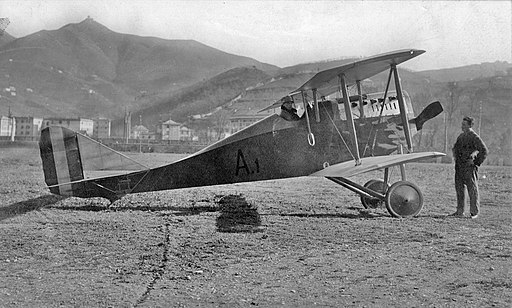
Ansaldo A.1 Balilla
The Ansaldo A.1 Balilla was Italy’s first domestically designed and produced single-seat fighter to enter operational service during World War I. Introduced in mid-1918, it combined robust construction with respectable performance for its time. Though it arrived late in the conflict, the Balilla laid the groundwork for Italy’s interwar aviation industry and influenced several postwar export designs.
Development and Design
Concept and Prototypes
Following the success of licensed French fighters, the Italian government sought an indigenous design to reduce reliance on foreign types. Ansaldo’s engineering team began work in early 1917, targeting a clean aerodynamic layout and easy manufacturing. The first prototype flew in March 1918, demonstrating promising speed and maneuverability but requiring refinement to its wing and cooling systems.
Airframe and Materials
Ansaldo employed a mixed-construction approach:
- Fuselage frame built from welded steel tubes
- Plywood formers and stringers covered with doped fabric
- Detachable aluminum cowling panels around the engine for maintenance
This combination delivered a lightweight yet stiff structure that withstood combat stresses.
Wings
The Balilla featured a single-bay biplane wing arrangement with moderate stagger and slight sweep:
- Upper and lower wings each supported by N-type interplane struts
- Main spars crafted from spruce, plywood ribs for contour
- Ailerons fitted only on the upper wing to simplify control linkages
Wings were fabric-covered and treated with a special dope to enhance moisture resistance.
Powerplant
Power came from a water-cooled Fiat A.12bis inline-six engine, rated at 300 horsepower for takeoff:
- Radiator mounted ahead of the upper wing’s leading edge
- Twin Lamblin “lobster-pot” external oil coolers under the fuselage
- Four-blade fixed-pitch wooden propeller
Engine installation aimed for minimal drag and straightforward maintenance in frontline conditions.
Performance and Handling
Speed and Rate of Climb
Flight trials in May 1918 yielded the following key performance figures:
- Maximum speed: 230 kilometers per hour at sea level
- Initial climb: 5,000 meters in 18 minutes
These numbers placed the Balilla on par with contemporary Allied designs.
Ceiling and Range
High-altitude capability and operational range were equally important:
- Service ceiling: 7,200 meters
- Range: 500 kilometers on internal fuel
Pilots valued the Balilla’s steady high-altitude handling, which aided observation and interception roles.
Armament
Fixed Guns
The Balilla carried two synchronized Vickers machine guns mounted on the upper fuselage:
- Caliber: 7.7 mm
- Ammunition load: 500 rounds per gun
- Synchronization gear driven off the engine camshaft
Gun placement offered a clear field of fire with minimal barrel interference.
Additional Equipment
Provision existed for light bomb racks under the lower wings:
- Single 25 kg bomb per rack as optional equipment
- Quick-release mechanisms for dive-bombing missions
These stores enhanced the Balilla’s versatility in ground-attack sorties.
Cockpit and Avionics
Pilot ergonomics and situational awareness were focal points of the design:
- Open cockpit with wraparound windscreen for forward visibility
- Simple instrument panel featuring altimeter, airspeed indicator, tachometer, oil-pressure gauge, and fuel gauge
- Dual control stick and rudder bar adjustable to pilot stature
A basic drift sight was available for aerial photography and reconnaissance tasks.
Production and Variants
Prototype A.1
The initial A.1 prototype series, designated A.1 Tipo 1, underwent minor tweaks to wing incidence and tailplane balance. Three pre-production airframes served in advanced training units for pilot evaluation.
Export Versions and Modifications
Postwar interest spawned export models with modified engines:
- A.1bis: Fitted with a 350 hp Isotta-Fraschini V.6 engine for enhanced climb rate
- A.1ter: Reduced wingspan and lighter controls for airshow aerobatics
Small batches shipped to Argentina and Brazil featured local instrumentation and metric engines.
Operational History
Italian Service
The Balilla’s squadron deployment began in July 1918 with 91a and 92a Squadriglie:
- Conducted patrols over the Piave front during the Vittorio Veneto offensive
- Engaged Austro-Hungarian fighters and performed limited ground strafing
Despite its late entry, pilots praised its sturdiness and responsive controls in dogfights.
Postwar Use
Following the Armistice, surplus Balillas served in liaison, training, and air-mail roles:
- Italian civil aero clubs adopted them for advanced flight instruction
- A handful pressed into service with the newly formed Italian Air Force until 1922
Exported examples continued flying in South America through the mid-1920s.
Legacy and Influence
Although production totaled fewer than 200 airframes, the Ansaldo A.1 Balilla established key benchmarks for Italian fighter design:
- Metal-tube fuselage construction became standard in subsequent Ansaldo types
- Lessons in engine installation and cooling informed the acclaimed Ansaldo SVA series
Its appearance at postwar airshows also helped market Italian aviation technology abroad.
Technical Specifications
| Parameter | Specification |
|---|---|
| Crew | 1 |
| Length | 7.20 meters |
| Wingspan | 9.00 meters |
| Height | 2.85 meters |
| Wing area | 26.5 square meters |
| Empty weight | 800 kilograms |
| Gross weight | 1,150 kilograms |
| Powerplant | 1 × Fiat A.12bis V-12 engine, 300 hp |
| Maximum speed | 230 km/h at sea level |
| Range | 500 km |
| Service ceiling | 7,200 m |
| Rate of climb | 5.2 m/s |
| Armament (fixed) | 2 × 7.7 mm Vickers machine guns |
| Optional ordnance | 2 × 25 kg light bombs |
The Ansaldo A.1 Balilla remains a landmark in Italian military aviation, bridging early war designs with the more advanced fighters of the 1920s and beyond.
.jpg)