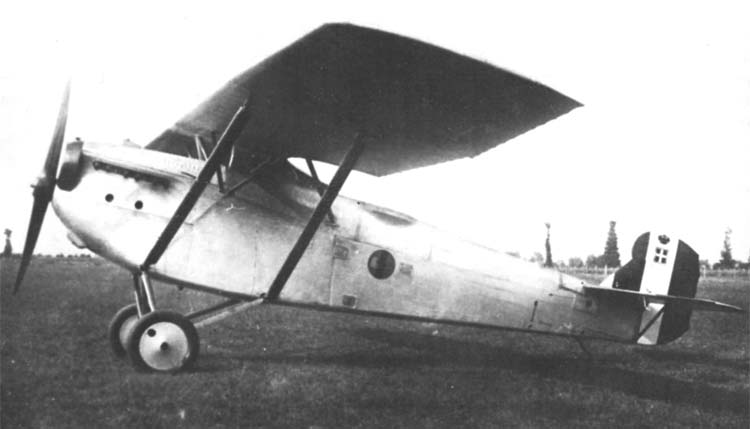
Ansaldo A.120
The Ansaldo A.120 was a two-seat reconnaissance biplane developed by the Italian firm Ansaldo in the mid-1920s. Conceived to replace aging World War I machines, it married traditional mixed‐construction methods with incremental aerodynamic refinements. Although only a handful of prototypes were completed, the A.120 served as a testbed for advanced inline engines and influenced several subsequent Ansaldo designs.
Development and Design
Concept and Requirements
In 1924, the Italian Air Ministry issued a requirement for a modern reconnaissance aircraft capable of long-range photography and artillery spotting. Ansaldo’s design team responded with the A.120, emphasizing structural simplicity, maintainability, and ease of operation from improvised front-line fields. The goal was a rugged platform that could also accommodate emerging radio‐telephony equipment.
Airframe Structure
The A.120 utilized mixed construction typical of its era:
- Fuselage: welded steel tube framework with formers and longerons
- Wing panels: spruce box spars, plywood ribs, fabric covering
- Empennage: wood-framed stabilizers with balanced control surfaces
Quick-release fittings allowed removal of upper wing center-sections for transport and maintenance.
Powerplant Installation
Early prototypes flew with the 450 hp Fiat A.22 water-cooled inline engine:
- Lamblin cylindrical radiators mounted beneath the lower wing
- Aluminum cowling panels arranged for straightforward engine access
- Two-bladed wooden propeller optimized for climb performance
Subsequent trials evaluated a 500 hp Lorraine-Dietrich 12E V12, improving high-altitude speed.
Cockpit and Crew Stations
The A.120 featured tandem, open cockpits separated by a streamlined fuel tank fairing:
- Forward cockpit for pilot with slip-in instrument panel and dual controls
- Observer’s cockpit aft with swing-mount Scarff ring for a Lewis gun
- Provisions for an aerial camera in the observer’s floor pan
Both cockpits had removable glare shields and cutouts for downward visibility.
Flight Characteristics
Performance Profile
Flight tests conducted in late 1925 yielded the following baseline figures:
- Maximum speed: 210 km/h at sea level
- Service ceiling: 6,200 m
- Range: 650 km on a full fuel load
Climb to 4,000 m required approximately 15 minutes, competitive with contemporary reconnaissance types.
Handling and Stability
Pilots praised the A.120’s docile stall behavior and predictable control harmony:
- Mild wing drop at stall onset, easily corrected by rudder
- Positive longitudinal stability during photographic runs
- Responsive ailerons and balanced rudder for tight turning in evasive maneuvers
Cross‐country cruises at half power remained steady in mild turbulence.
Operational Evaluation
Prototype Trials
Three A.120 prototypes entered evaluation with 48a Squadriglia in 1926:
- Assessment of camera installation, radio reliability, and crew ergonomics
- Live-fire gunnery trials against towed targets over Sardinia
- Engine swap demonstrations to compare Fiat and Lorraine-Dietrich installations
All three airframes returned to Ansaldo for incremental modifications.
Service Feedback
While praised for ruggedness and load-carrying capacity, the A.120 drew criticism for:
- Relatively high fuel consumption at cruise settings
- Limited forward gun arc due to cockpit placement
- Non-retractable landing gear restricting top-end speed
These factors ultimately led the Regia Aeronautica to prioritize faster, all-metal designs.
Variants
A.120 (Prototype)
- Three airframes built between 1925 and 1926
- Fitted with Fiat A.22 engine and Lamblin radiators
- Testing focused on basic reconnaissance and photography roles
A.120bis
- Single prototype re-engined with a 500 hp Lorraine-Dietrich 12E
- Modified upper wing center-section to improve pilot visibility
- Achieved a 10 km/h speed increase at altitude
Technical Specifications
| Parameter | A.120 (Fiat A.22) |
|---|---|
| Crew | 2 (pilot and observer) |
| Length | 8.50 m |
| Wingspan | 12.80 m |
| Height | 3.30 m |
| Wing area | 42.0 m² |
| Empty weight | 1,650 kg |
| Gross weight | 2,450 kg |
| Powerplant | 1 × Fiat A.22 V12, 450 hp |
| Maximum speed | 210 km/h at sea level |
| Cruise speed | 170 km/h |
| Range | 650 km |
| Service ceiling | 6,200 m |
| Rate of climb | 4.5 m/s |
| Armament (fixed) | None |
| Armament (defensive) | 1 × Lewis machine gun on Scarff ring |
| Cameras | 1 × downward-facing 35 cm focal length |
Legacy and Impact
Although the Ansaldo A.120 never entered mass production, it proved a valuable stepping stone in Italian military aviation. Its engine trials refined liquid‐cooled installations, and its mixed‐material structure guided Ansaldo toward the metal frameworks of the late 1920s. Insights gained on crew ergonomics and reconnaissance equipment placement directly influenced the subsequent Ansaldo A.300 series, cementing the A.120’s role as a formative prototype rather than a frontline workhorse.
