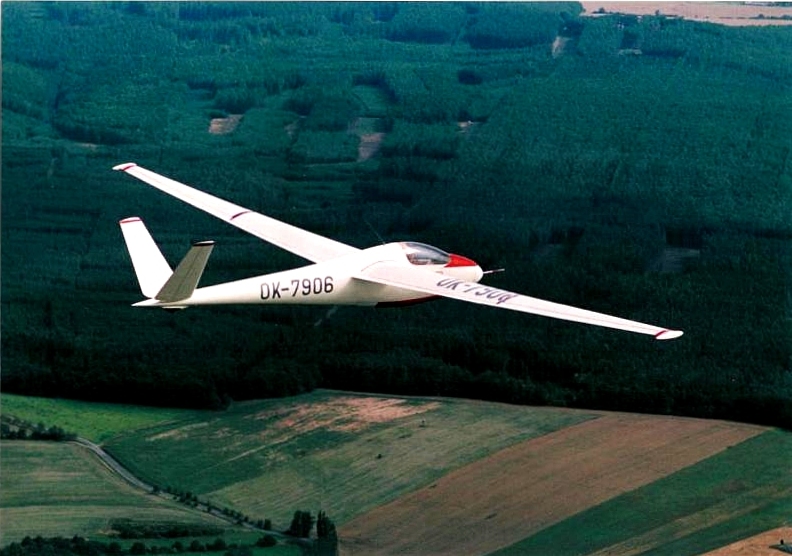
Antonov A-15
The Antonov A-15 was a high-performance, single-seat sailplane developed by the Antonov Design Bureau in the early 1960s. Conceived as a competition glider, it married advanced laminar-flow airfoils with a lightweight yet robust structure. Its combination of exceptional glide ratio and handling qualities made it a benchmark for Soviet soaring efforts and a testbed for aerodynamic innovations.
Development and Design
Origin and Concept
In 1959, Oleg Antonov’s team initiated the A-15 project to close the performance gap between Soviet gliders and Western counterparts. Emphasis fell on sustaining high speeds in weak thermals and achieving a low minimum sink rate. Wind-tunnel testing refined the laminar-flow wing sections, while flight models validated boundary-layer control on the wing’s upper surface.
Airframe Structure and Materials
The A-15 employed a hybrid construction that balanced weight and stiffness:
- Wing spars and ribs crafted from high-strength spruce and steel alloy
- Fuselage shell of riveted aluminum alloy panels over a steel-tube framework
- Empennage with wooden frames and Dacron fabric covering
Surface finish used polyester resin paint to maintain a smooth profile and protect against moisture.
Wing Geometry and Control Surfaces
With an 18 meter wingspan and an aspect ratio of 21:1, the A-15 featured a straight taper planform:
- Elliptical root fairings to minimize induced drag
- Full-span Schempp-Hirth airbrakes for steep descent control
- Frise-type ailerons on the outer panels for crisp roll response
An adjustable pneumatic ballast system allowed pilots to optimize wing loading for varying thermal conditions.
Cockpit and Instrumentation
Pilot comfort and situational awareness were central to the cockpit layout:
- Semi-reclined seat with five-point harness
- One-piece, forward-hinged canopy for unobstructed visibility
- Electric variometer, altimeter, airspeed indicator, compass, and slip-skid indicator
Optional fittings included a small photographic camera mount and data-logging recorder.
Flight Characteristics
Performance Metrics
Extensive flight trials in 1962 produced the following performance benchmarks:
- Maximum glide ratio: 38:1 at 95 km/h
- Minimum sink rate: 0.56 m/s at 65 km/h
- Maximum permissible speed: 250 km/h
These figures placed the A-15 among the world’s leading sailplanes, especially impressive given its predominantly metal structure.
Handling and Response
Pilots praised the A-15 for its balanced controls and benign stall behavior:
- Progressive wing drop at stall, easily arrested with rudder
- Harmonized elevator and rudder allowing tight, coordinated turns
- Effective airbrakes that maintained controllability even when fully extended
The sailplane remained steady in chop and executed precise high-speed glides between thermals.
Ballast and Polar Characteristics
An onboard ballast system held up to 100 liters of water:
- Enabled wing loading adjustments from 19 kg/m² (empty) to 26 kg/m² (full)
- Improved cruising L/D in strong thermal conditions
- Quick-drain valves allowed jettisoning ballast before landing
The polar curve showed a broad performance band, making the A-15 versatile in both weak and strong soaring days.
Operational Use
Soviet Aero Clubs and Competitions
Following certification in 1963, production units were distributed to DOSAAF clubs and national teams:
- Leningrad and Kiev gliding centers adopted the A-15 for record attempts
- Soviet pilots set multiple national straight-distance and triangle records
- Winch launch and aerotow operations were equally reliable on improvised fields
Export and Legacy Flights
Limited exports reached Bulgaria and Hungary, where local pilots also reported strong performance in regional contests. A handful of A-15s continued flying in vintage gliding gatherings well into the 21st century, celebrated for their timeless aerodynamic efficiency.
Variants
A-15B
A reinforced version featuring uprated control linkages and beefed-up wing roots to permit basic aerobatics without structural penalties.
A-15M
Equipped with a refined ballast installation and cockpit ventilation improvements, enhancing cross-country comfort in hot climates.
Impact and Legacy
The A-15 established design principles that influenced later Antonov sailplanes, notably the A-18 series. Its successful application of laminar-flow wings in a domestic design bolstered confidence in Soviet aerodynamic research. Restoration projects today preserve several airframes, showcasing the A-15’s enduring blend of performance and structural ingenuity.
Technical Specifications
| Parameter | Specification |
|---|---|
| Crew | 1 |
| Length | 7.20 meters |
| Wingspan | 18.00 meters |
| Height | 1.10 meters |
| Wing area | 15.4 square meters |
| Aspect ratio | 21:1 |
| Empty weight | 280 kilograms |
| Maximum takeoff weight | 385 kilograms |
| Wing loading (empty/full) | 19 kg/m² / 26 kg/m² |
| Maximum glide ratio | 38:1 at 95 km/h |
| Minimum sink rate | 0.56 m/s at 65 km/h |
| Maximum permissible speed | 250 km/h |
| Stall speed | 60 km/h |
| Airbrakes | Schempp-Hirth type |
The Antonov A-15 remains a milestone in sailplane design, proving that meticulous aerodynamic refinement and smart structural choices can yield world-class performance.
