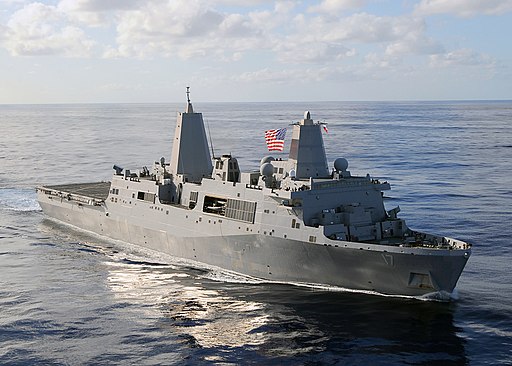
USS San Antonio (LPD-17)
The USS San Antonio (LPD-17) is the lead ship of the San Antonio class, representing the U.S. Navy’s latest generation of amphibious transport docks. Commissioned in January 2006, she serves as a flexible platform designed to embark, transport, and land elements of a Marine Expeditionary Unit (MEU) by air, surface, and subsurface assets. Her advanced hull form, signature-reduction features, and integrated combat systems make her a versatile asset for expeditionary warfare, humanitarian assistance, and disaster relief operations.
Design and Development
Mission Profile
- Transport up to 800 Marines and their equipment.
- Embark and operate landing craft air cushion (LCAC), conventional landing craft, and amphibious assault vehicles.
- Embark, launch, recover, and maintain helicopters, MV-22 Osprey tiltrotors, and unmanned aerial vehicles (UAVs).
- Provide command, control, communications, computers, intelligence, surveillance, and reconnaissance (C4ISR) facilities.
Signature Reduction
- Enclosed bow blowers, angled superstructure panels, and infrared-suppressive exhaust stacks.
- Shallow hull topography minimizes radar cross section.
- Acoustic dampening measures reduce hull noise for submarine-detection avoidance.
Hull and Dimensions
Hull Form
- Steel monohull with bulbous bow for improved seakeeping and fuel efficiency.
- Flared hull sides to deflect spray and improve stability.
Key Dimensions
- Length overall: 684 feet (208.5 m)
- Beam: 105 feet (32 m)
- Draft: 23 feet (7 m)
- Displacement (full load): approximately 25,000 long tons
Propulsion and Performance
Machinery Plant
- Combined diesel and gas (CODAG) configuration:
- Two Rolls-Royce MT30 gas turbines (each 36 MW)
- Two Colt-Pielstick diesel engines (each 8,200 hp)
- Two shafts with controllable-pitch propellers
Performance
- Maximum speed: 22+ knots
- Range: 7,000 nautical miles at 15 knots
- Endurance: 90 days sustained operations without replenishment
Armament and Defense Systems
Gun Systems
- One Mk 45 Mod 2 5-inch/62-caliber naval gun
- Two 30 mm Mk 46 remote-weapon stations
Close-In and Missile Defense
- Rolling Airframe Missile (RAM) launcher, 21 cells
- Two Phalanx Block 1B Close-In Weapon Systems (CIWS)
- Decoy launchers: SRBOC chaff and AN/SLQ-32(V) electronic warfare suite
Aviation Facilities
Flight Deck
- Full-width flight deck capable of simultaneous operations of two CH-53E helicopters or MV-22B Ospreys.
- Touch-and-go spots for UAV operations.
Hangar and Support
- Enclosed hangar with maintenance shops, aviation fuel storage (JP-5), and helicopter traversing system.
- Supports up to four medium helicopters or two tiltrotors plus unmanned assets.
Sensors and Electronic Systems
Radar and Sonar
- SPS-48E 3D air search radar
- SPS-73 surface search/navigation radar
- SQQ-89A(V)15 anti-submarine warfare combat system
Combat Management
- Aegis-derived command and control consoles
- Integrated Bridge System with voyage management, track-while-scan, and automatic identification system (AIS)
Crew and Accommodations
Ship’s Company
- Officers: 28
- Enlisted personnel: 340
Embarked Forces
- Marine complement: up to 800 (including air-crew)
- Vehicle stowage: 500 square meters of mission bay
- Cargo handling: two 60-ton electro-hydraulic cranes
Habitability
- Modular berthing with adjustable bunks
- Fitness room, medical/dental clinic, galleys, and chapel
Survivability and Damage Control
Structural Protection
- Double-bulkhead compartmentalization
- Torpedo and mine impact mitigation features
Damage Control Systems
- Digital centralized control for firemain, dewatering, and ventilation
- Automated firefighting foam monitors in machinery spaces
- Multiple damage-control lockers and EEBD (emergency escape breathing devices)
Operational Capabilities
Amphibious Assault
- LCAC well deck: two hovercraft or one conventional landing craft per side-by-side operation
- Stern gate and side port ramp for rapid deployment of amphibious vehicles
Humanitarian Assistance
- Large vehicle and cargo stowage areas configurable for relief supplies
- Extensive fresh water production: 90,000 gallons per day
- Medical facilities: operating room, ICU, and triage spaces
Modernization and Upgrades
Combat Systems
- Ongoing integration of Cooperative Engagement Capability (CEC) for networked air defense
- Upgraded AN/SLQ-32(V)6 with advanced electronic attack modes
Propulsion and Auxiliary
- Energy-saving devices (e.g., preswell–hull appendages)
- Improved CORROSION-resistant coatings to reduce maintenance
Technical Specifications Summary
| Attribute | Specification |
|---|---|
| Length | 684 ft (208.5 m) |
| Beam | 105 ft (32 m) |
| Draft | 23 ft (7 m) |
| Displacement (full load) | ~25,000 long tons |
| Propulsion | CODAG: 2× MT30 (36 MW), 2× diesels |
| Speed | 22+ knots |
| Range | 7,000 nmi at 15 knots |
| Crew | 28 officers, 340 enlisted |
| Embarked Troops | Up to 800 Marines |
| Flight Deck | 2× CH-53E/MV-22B simultaneous ops |
| Well Deck | 2× LCAC or 1× LCU |
| Gun Armament | 1× 5″/62 Mk 45, 2× 30 mm |
| Missile Defense | 21-cell RAM, 2× Phalanx CIWS |
| Decoys/EW | SRBOC, AN/SLQ-32(V) |
Conclusion
The USS San Antonio (LPD-17) redefines modern amphibious warfare by blending robust command facilities, advanced signature management, and flexible mission configurations. Her balanced combination of transportation capacity, defensive systems, and automation makes her a cornerstone of expeditionary strike group operations for decades to come.
_deploy.jpg)