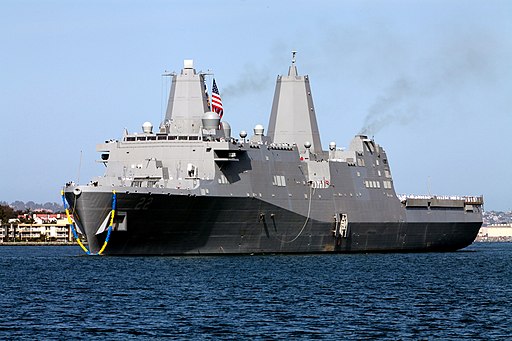
USS San Diego (LPD-22)
The USS San Diego (LPD-22) is the sixth amphibious transport dock in the San Antonio class, commissioned on September 8, 2012. Built by Huntington Ingalls Industries in Pascagoula, Mississippi, she embodies the U.S. Navy’s vision for next-generation expeditionary warfare vessels. Designed to transport and land Marines, their equipment, and supporting aircraft, San Diego serves as a core asset for expeditionary strike groups and humanitarian assistance missions around the globe.
Design and Development
Mission Profile
- Deploy and sustain a Marine Expeditionary Unit (MEU) via sea and air
- Conduct amphibious assaults using landing craft air cushion (LCAC) and amphibious vehicles
- Provide aviation support for helicopters, MV-22B Ospreys, and unmanned aerial systems
- Host command, control, communications, computers, intelligence, surveillance, and reconnaissance (C4ISR) nodes
Signature Reduction
- Angled superstructure panels and enclosed mast to minimize radar cross section
- Infrared-suppression exhaust stacks and below-deck blowers for heat signature management
- Acoustic isolation materials in machinery spaces to reduce underwater radiated noise
Hull and Dimensions
Hull Form
The USS San Diego features a steel monohull with a bulbous bow that enhances fuel efficiency and seakeeping. Flared hull sides deflect spray and improve deck operations in rough seas, while the tumblehome superstructure contributes to radar evasion.
Key Dimensions
- Length overall: 684 feet (208.5 meters)
- Beam: 105 feet (32 meters)
- Draft: 23 feet (7 meters)
- Displacement (full load): Approximately 25,170 long tons
Propulsion and Performance
Machinery Plant
- Combined diesel and gas (CODAG) arrangement
- Two Rolls-Royce MT30 gas turbines (each rated at 36 MW)
- Two Colt-Pielstick diesel engines (each rated at 8,200 hp)
- Twin shafts with controllable-pitch propellers for precise maneuvering
Performance
- Maximum speed: 22+ knots
- Cruising range: 7,000 nautical miles at 15 knots
- Endurance: 90 days of sustained operations without external replenishment
Armament and Defense Systems
Gun Systems
- One Mk 45 Mod 2 5-inch/62-caliber naval gun forward
- Two 30 mm Mk 46 remote-controlled weapon stations
Missile Defense
- 21-cell Rolling Airframe Missile (RAM) launcher
- Two Phalanx Block 1B Close-In Weapon Systems (CIWS)
- SRBOC chaff and AN/SLQ-32(V)6 electronic warfare suite for decoy and jamming
Aviation Facilities
Flight Deck
A full-width flight deck supports simultaneous operations of two CH-53E helicopters, two MV-22B tiltrotors, or a mix of manned and unmanned aerial vehicles. Seven tie-down spots accommodate diverse air assets during surge operations.
Hangar and Support
- Enclosed hangar with integrated maintenance workshops
- JP-5 aviation fuel storage and pump systems
- Helicopter traversing system capable of moving aircraft between hangar and deck
Sensors and Electronic Systems
Radar and Sonar
- SPS-48E 3D air search radar for long-range aerial detection
- SPS-73 surface search and navigation radar
- SQQ-89A(V)15 anti-submarine warfare suite integrating hull-mounted and towed array sonars
Combat Management
- AN/UYQ-XX open-architecture mission computers
- Cooperative Engagement Capability (CEC) for networked air defense
- Integrated Bridge System featuring track-while-scan and automatic identification
Crew and Accommodations
Ship’s Company
- 28 commissioned officers
- 340 enlisted sailors
Embarked Forces
- Up to 800 Marines, including air and ground detachments
- Vehicle stowage: 500 square meters of mission bay space
- Two 60-ton electro-hydraulic cranes for cargo handling
Habitability
- Modular berthing with adjustable rack-beds
- Fitness center, medical and dental facilities, multipurpose spaces, and a chaplain’s ministry area
Survivability and Damage Control
Structural Protection
- Double-bulkhead subdivision throughout vital compartments
- Enhanced hull framing to mitigate damage from torpedoes and mines
Damage Control Systems
- Digital centralized control for firefighting, dewatering, and ventilation
- Automated aqueous film-forming foam (AFFF) monitors in machinery and aviation fuel spaces
- Rapid-response damage control stations with emergency breathing apparatus
Operational Capabilities
Amphibious Assault
- Well deck configurable for two LCACs side by side or one landing craft utility (LCU) and an amphibious assault vehicle
- Stern gate and side port ramps enable rapid debarkation of personnel and vehicles
Humanitarian Assistance
- Reconfigurable cargo decks for relief stores, vehicles, and temporary shelters
- Desalinization plant producing 90,000 gallons of fresh water per day
- Comprehensive medical complex with operating rooms and ICU capacity
Modernization and Upgrades
- Incremental integration of advanced electronic warfare modes in the AN/SLQ-32(V)6 suite
- Upgraded bridge displays and navigation software with cybersecurity enhancements
- Application of corrosion-resistant coatings and propeller boss cap fins for fuel efficiency
Technical Specifications Summary
| Attribute | Specification |
|---|---|
| Length | 684 ft (208.5 m) |
| Beam | 105 ft (32 m) |
| Draft | 23 ft (7 m) |
| Displacement (full load) | ~25,170 long tons |
| Propulsion | CODAG: 2× MT30 gas turbines, 2× diesels |
| Speed | 22+ knots |
| Range | 7,000 nmi at 15 knots |
| Ship’s Company | 28 officers, 340 enlisted |
| Embarked Troops | Up to 800 Marines |
| Flight Deck Capacity | 2× CH-53E/MV-22B simultaneous ops |
| Well Deck Configuration | 2× LCAC side by side or 1× LCU + AAV |
| Main Gun | 1× 5″/62 Mk 45 |
| Close-In Defense | 2× 30 mm RWS, 21-cell RAM, 2× Phalanx CIWS |
| Electronic Warfare | SRBOC, AN/SLQ-32(V)6 |
Conclusion
The USS San Diego (LPD-22) stands at the forefront of modern amphibious warfare, blending advanced stealth, robust defensive systems, and versatile mission spaces. From amphibious assaults to disaster relief, her design ensures mission success across the spectrum of naval operations, making her an indispensable component of America’s expeditionary forces.
