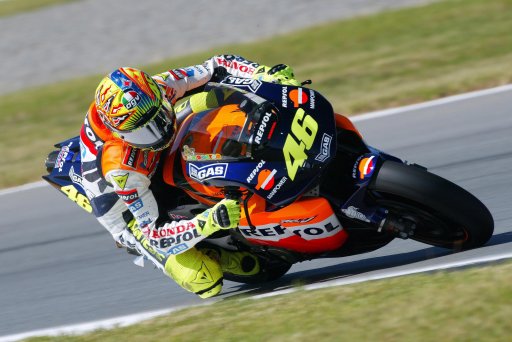
The Honda RC211V is a groundbreaking MotoGP racing motorcycle developed by Honda Racing Corporation (HRC) for the 990 cc era of Grand Prix motorcycle racing. Introduced in 2002 to replace the RC45, the RC211V was Honda’s response to new regulations that increased engine displacement from 500 cc to 990 cc while maintaining four-stroke technology. Designed for maximum performance, agility, and reliability, it quickly became a dominant force on the grid and is widely regarded as one of Honda’s most technically advanced racing machines.
Engine Architecture and Performance
The RC211V is powered by a 990 cc V5 engine, a unique configuration designed to combine the compactness of a V4 with the high-revving characteristics of a V5 layout. The engine is liquid-cooled, four-stroke, and features a DOHC setup with 20 valves.
Key engine specifications include:
-
Displacement: 990 cc
-
Configuration: 75.5-degree V5, liquid-cooled
-
Bore x Stroke: 86 mm x 43.5 mm
-
Compression Ratio: Approximately 13:1
-
Valve Train: Dual overhead camshaft, 4 valves per cylinder (except the fifth cylinder)
-
Power Output: 220–240 horsepower at 16,500–17,500 rpm
-
Torque: Approximately 110 Nm at 14,000 rpm
-
Fuel System: Electronic fuel injection with individual throttle bodies
-
Ignition: Advanced digital engine control
The V5 engine delivers a unique combination of strong midrange torque and high-end power, providing superior acceleration out of corners and stability at high speeds. Titanium connecting rods and lightweight pistons reduce reciprocating mass, enabling extremely rapid throttle response.
Transmission and Drivetrain
The RC211V is equipped with a six-speed seamless-shift gearbox, designed for minimal interruption of power delivery during upshifts and downshifts. The gearbox is coupled with a multi-plate wet clutch optimized for racing applications.
-
Gearbox: 6-speed seamless shift
-
Clutch: Multi-plate wet clutch with adjustable actuation
-
Final Drive: Chain with quick-change sprockets for circuit-specific gearing
The seamless-shift technology ensures smooth power transfer while minimizing rear-wheel disturbance, a critical advantage in MotoGP competition.
Electronic Systems and Management
Advanced electronics play a crucial role in the RC211V’s performance, with Honda employing state-of-the-art engine management and rider-assist systems.
-
Traction Control: Multiple levels for varying track conditions
-
Engine Braking Control: Adjustable to suit rider preference and cornering
-
Launch Control: Optimizes race starts for maximum acceleration
-
Data Acquisition: Sensors monitoring throttle position, suspension, wheel speeds, and engine parameters
-
ECU: Highly programmable, capable of real-time tuning
These electronics allowed riders to exploit the engine’s potential safely while maintaining stability under extreme conditions.
Chassis and Frame
The RC211V features an aluminum twin-spar frame designed to provide rigidity while allowing controlled flex for traction optimization. The frame layout contributes to precise handling and agility through high-speed corners.
Chassis specifications:
-
Frame Type: Aluminum twin-spar
-
Wheelbase: Approximately 1,400 mm
-
Rake/Trail: 24.5 degrees / 99 mm
-
Dry Weight: Approximately 148–150 kg (minimum weight regulations)
-
Seat Height: 830 mm
The lightweight frame, combined with compact packaging of the V5 engine, enables rapid direction changes and consistent handling at high speeds.
Suspension System
Honda collaborated with Öhlins to provide advanced suspension systems capable of fine adjustments for competitive racing.
Front Suspension:
-
Type: Inverted telescopic fork
-
Diameter: 43–50 mm depending on season
-
Adjustability: Compression, rebound, and preload
Rear Suspension:
-
Type: Öhlins Pro-Link monoshock with aluminum swingarm
-
Adjustability: Preload, compression, and rebound damping
This suspension setup allows precise tuning to accommodate tire characteristics, rider style, and circuit conditions.
Braking Components
The RC211V employs top-of-the-line braking components designed to withstand extreme racing conditions.
Front Brakes:
-
Dual carbon fiber discs
-
Diameter: Approximately 320 mm
-
Calipers: Brembo 4 or 6-piston radial mount
Rear Brake:
-
Single carbon disc
-
Diameter: 220 mm
Braking systems are fully adjustable, enabling riders to tailor braking response for maximum control during aggressive deceleration.
Wheels and Tires
The RC211V uses magnesium alloy wheels and racing-specific tires to reduce unsprung weight and improve grip.
-
Front Wheel: 16.5-inch magnesium alloy (later 17-inch as regulations evolved)
-
Rear Wheel: 16.5-inch magnesium alloy (later 17-inch)
-
Tires: Michelin or Bridgestone racing slicks depending on season
-
Tire Dimensions: Front 120/60-16.5, Rear 200/65-16.5 (varies by development year)
These lightweight wheels allow rapid directional changes and enhance cornering stability.
Fuel and Exhaust System
The RC211V’s fuel system is optimized for maximum power and efficiency.
-
Fuel Capacity: 23 liters (regulated for MotoGP)
-
Fuel Delivery: Individual throttle bodies per cylinder with electronic injection
-
Exhaust: Titanium system with under-seat routing
-
Features: Tuned for maximum mid-range torque and reduced weight
The exhaust layout contributes to weight distribution and aerodynamic packaging while maximizing engine output.
Aerodynamics and Bodywork
The RC211V’s fairing is designed to minimize drag and stabilize airflow at high speeds.
-
Bodywork: Lightweight carbon fiber and composite panels
-
Features: Integrated air channels to optimize engine cooling and reduce lift
-
Rider Ergonomics: Narrow profile to allow weight shifting and reduce frontal area
The aerodynamic design helps maintain stability at speeds exceeding 330 km/h while keeping the center of gravity low.
Development and Evolution
The RC211V underwent continuous development throughout its competitive years (2002–2006). Updates included revisions to engine mapping, crankshaft layouts, chassis stiffness, swingarm design, and electronics. These changes were aimed at improving traction, cornering speed, and overall lap times. Notable riders such as Valentino Rossi and Nicky Hayden achieved world championships aboard the RC211V, cementing its legacy in MotoGP history.
Legacy and Influence
The RC211V is remembered as one of Honda’s most innovative and successful MotoGP machines. Its V5 engine, advanced electronics, and lightweight frame influenced future generations of Honda superbikes, including the RC212V and RC213V. Its combination of power, agility, and reliability set a benchmark for engineering excellence in motorcycle racing.
Conclusion
The Honda RC211V is a pinnacle of MotoGP engineering, combining a unique V5 engine, advanced electronics, precise suspension, and aerodynamic bodywork into a lightweight, high-performance racing machine. Its dominance on the track and continuous development showcase Honda’s commitment to innovation and performance, making it one of the most iconic motorcycles in modern racing history.
