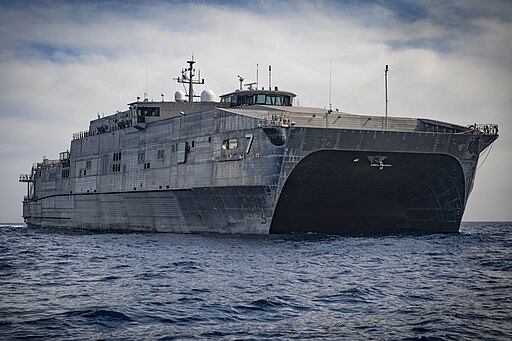
USNS Carson City (JHSV-7/T-EPF-7) is a high-speed expeditionary fast transport vessel operated by the United States Navy’s Military Sealift Command (MSC). The vessel is part of the Spearhead-class and is designed to provide rapid intra-theater transport of troops, military vehicles, and equipment. With its shallow draft and high-speed catamaran hull, Carson City can access austere ports and coastal regions that are inaccessible to larger, deeper-draft vessels. This capability enables rapid deployment and sustainment of forces in a wide range of operational environments, including humanitarian assistance, disaster relief, and military logistics missions.
The ship is named after Carson City, Nevada, reflecting the Navy’s tradition of honoring U.S. cities and communities.
Construction and Background
USNS Carson City was constructed by Austal USA in Mobile, Alabama, as the seventh vessel of the Spearhead-class. This class is based on a commercial high-speed ferry design adapted for military operations, with modifications for heavy vehicle transport, roll-on/roll-off capability, and modular mission support.
-
Keel laid: 2014
-
Launched: 2015
-
Delivered to MSC: 2015
-
Homeport: Norfolk, Virginia
The design emphasizes versatility, with large cargo spaces, flight deck capability for helicopter operations, and the ability to operate in shallow-water ports and harbors.
General Characteristics
-
Class and Type: Spearhead-class Expeditionary Fast Transport (EPF / JHSV)
-
Hull Number: JHSV-7 / T-EPF-7
-
Builder: Austal USA, Mobile, Alabama
-
Operator: Military Sealift Command
-
Primary Mission: Rapid intra-theater transport of troops, vehicles, and cargo
-
Crew: Approximately 26 civilian mariners with capacity for 312 embarked personnel
Physical Specifications
-
Displacement: Approximately 2,400 tons at full load
-
Length overall: 338 feet (103 meters)
-
Beam: 93.5 feet (28.5 meters)
-
Draft: 12.5 feet (3.8 meters)
-
Hull Type: Aluminum catamaran for stability and high-speed operations
-
Vehicle Deck Area: Over 20,000 square feet (1,860 square meters)
-
Flight Deck: Capable of operating helicopters such as MH-60 Seahawk or CH-53E Super Stallion
-
Ramp System: Roll-on/roll-off capability for tactical and logistical vehicles
The catamaran hull reduces hydrodynamic resistance, enabling high-speed transit and access to ports with shallow water depths.
Propulsion and Performance
USNS Carson City is designed for speed and maneuverability in coastal and open-water operations:
-
Propulsion Type: Four waterjet-propelled diesel engines
-
Engines: Four MTU 20V 8000 M71L diesel engines
-
Total Power Output: Approximately 36,400 kW (12,200 hp per engine)
-
Maximum Speed: Over 40 knots (74 km/h)
-
Cruising Speed: 35 knots under operational load
-
Range: 1,200 nautical miles at 35 knots; over 5,500 nautical miles at reduced economic speeds
-
Fuel Capacity: Approximately 135,000 gallons (510,000 liters)
-
Endurance: 5 to 10 days without resupply, depending on load and mission profile
Waterjet propulsion allows high-speed operation in shallow water, improved maneuverability, and reduced draft sensitivity.
Navigation and Control Systems
-
Integrated Bridge System (IBS) with multi-function displays
-
Electronic Chart Display and Information System (ECDIS)
-
GPS and inertial navigation systems
-
Dynamic Positioning (DP) for station-keeping during cargo operations
-
Automated ship control and monitoring systems for propulsion, steering, and power
These systems allow single-operator control in many situations while providing redundancy and safety during complex maneuvers or port operations.
Crew and Accommodations
-
Civilian Crew: 26 MSC mariners
-
Embarked Personnel Capacity: Up to 312 troops or mission-specific staff
-
Additional Space: Accommodates up to 100 additional personnel depending on mission
-
Amenities: Air-conditioned staterooms, galley, medical facilities, recreation areas, and fitness facilities
Habitability is designed for extended deployments, providing comfort and efficiency for both the crew and embarked forces.
Cargo and Mission Capabilities
Carson City’s design prioritizes rapid loading and unloading of vehicles and cargo:
-
Cargo Deck: Over 20,000 square feet of configurable space
-
Vehicle Ramp: Stern ramp enabling roll-on/roll-off operations directly to piers, causeways, or shallow beaches
-
Cargo Capacity: Up to 600 short tons of vehicles, containers, and equipment
-
Container Tie-Downs: Compatible with ISO containers and modular cargo configurations
-
Deck Height: 16 feet clear height for accommodating large tactical vehicles
The vessel can operate independently or alongside amphibious task forces, supporting rapid distribution of personnel and material.
Aviation Facilities
-
Flight Deck: Supports operation of medium to heavy helicopters
-
Aircraft Capability: MH-60 Seahawk, CH-53E Super Stallion
-
Refueling Systems: Flight deck fuel and support for helicopter operations
-
No Hangar: Aircraft operations are limited to takeoff, landing, and vertical replenishment
The flight deck enables rapid personnel movement, medical evacuation, and logistical resupply operations.
Communications and Electronics
-
Satellite communications (SATCOM) for secure and non-secure voice and data
-
HF, VHF, and UHF radio systems for short and long-range communications
-
Shipboard LAN and data systems for operational coordination
-
Capability to integrate with Link-16 networks for task force interoperability
These systems allow seamless integration with naval operations, joint commands, and allied forces.
Operational Roles
USNS Carson City serves a variety of military and humanitarian missions:
-
Rapid intra-theater transport of troops, vehicles, and cargo
-
Humanitarian assistance and disaster relief operations
-
Medical evacuation and mobile medical support
-
Support for special operations and joint force insertion
-
Joint Logistics Over-the-Shore (JLOTS) operations
-
Coalition training and interoperability missions
Its flexibility enables rapid adaptation to changing mission requirements and operational theaters.
Operational History
Since its delivery in 2015, USNS Carson City has participated in multiple operational deployments:
-
Pacific Partnership humanitarian missions
-
Exercises with allied naval forces in the Indo-Pacific region
-
Disaster relief operations in areas affected by typhoons or other natural disasters
-
Training missions supporting fleet readiness and joint force integration
The vessel has proven capable of high-speed transport and operations in austere ports worldwide.
Maintenance and Modernization
Routine maintenance and upgrades ensure operational readiness:
-
Updated navigation and communication systems
-
Improved fuel efficiency and automation
-
Deck and cargo handling enhancements
-
Habitability upgrades for crew and embarked personnel
These measures extend the vessel’s service life and ensure continued mission effectiveness.
Role Within the Spearhead-Class Fleet
USNS Carson City is the seventh vessel in the Spearhead-class, joining sister ships such as USNS Spearhead (T-EPF-1), USNS Fall River (T-EPF-4), and USNS Brunswick (T-EPF-6). Together, these ships provide rapid transport capability, complementing traditional sealift and amphibious operations by enabling flexible, high-speed deployment of forces and material.
Strategic Importance
Carson City enhances the U.S. Navy’s operational agility, providing rapid transport, logistical flexibility, and shallow-water access. The vessel enables forward-deployed forces to sustain operations without reliance on large ports, providing a strategic advantage for both military and humanitarian missions. Its speed, capacity, and modular configuration make it a critical component of modern expeditionary maritime operations.
Summary
USNS Carson City (JHSV-7/T-EPF-7) is a high-speed, shallow-draft expeditionary transport capable of carrying troops, vehicles, and cargo rapidly across theaters of operation. Built by Austal USA and operated by the Military Sealift Command, the vessel combines an aluminum catamaran hull, waterjet propulsion, and flexible cargo systems to support a wide range of missions. From humanitarian assistance to military logistics, Carson City exemplifies modern naval expeditionary capabilities, ensuring rapid response, operational flexibility, and global reach for the United States Navy.
.jpg)